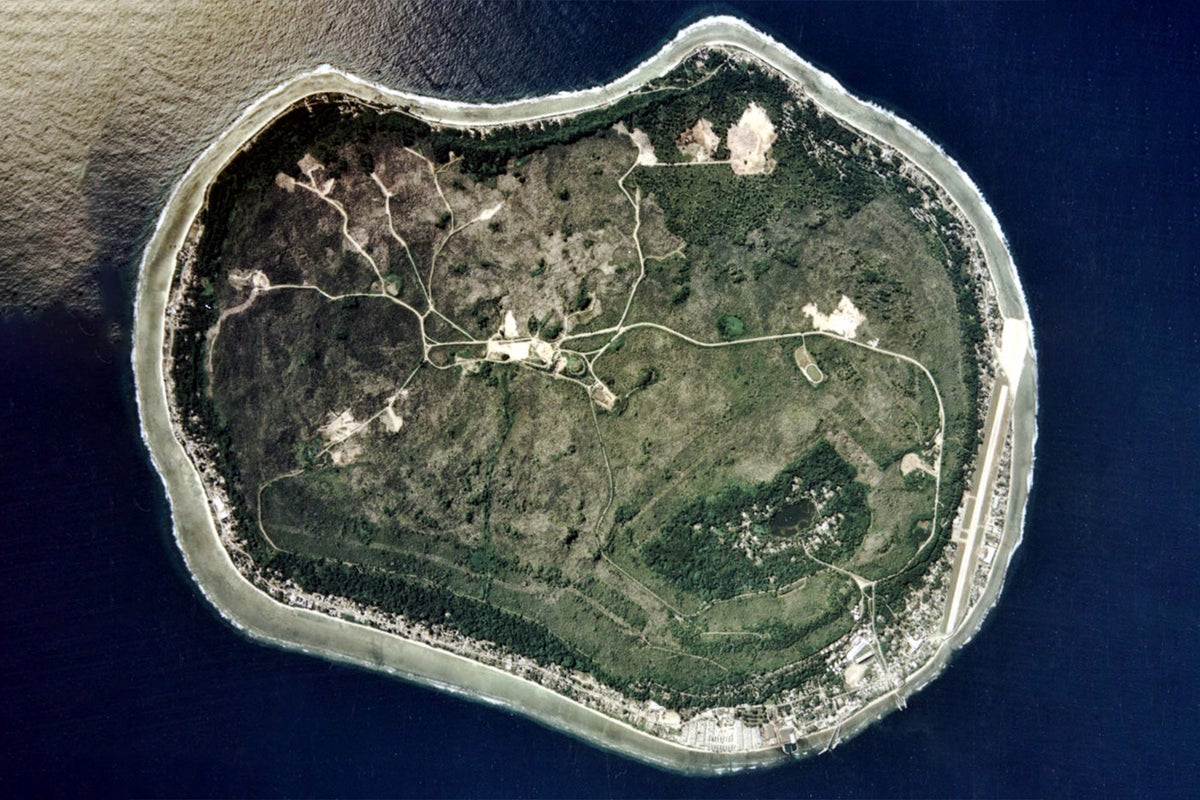
The world's third-smallest independent state is executing a desperate geopolitical maneuver as rising sea levels threaten to erase its landmass entirely. Tuvalu, a tiny Polynesian island nation spread across a scattering of low-lying atolls in the Pacific Ocean, is officially rewriting its national identity to survive. This constitutional overhaul is not merely a symbolic branding exercise. It is a calculated legal and existential insurance policy designed to preserve statehood, maritime borders, and international recognition when the physical soil beneath its citizens' feet vanishes completely into the ocean.
Most mainstream reporting frames this national renaming effort as a tragic, poetic farewell. That framing misses the actual mechanics of modern international law. Tuvalu is weaponizing its own constitution to outmaneuver a global legal vacuum. Under traditional international frameworks, a country requires a defined territory and a permanent population to legally exist. When the former disappears under the waves, the nation state effectively evaporates. By rewriting their foundational laws to anchor sovereignty in digital space and ancestral heritage rather than physical geography, Tuvalu's leaders are attempting a legal pivot that has no historical precedent.
The Geography of the Crisis
To understand why a country feels compelled to alter its constitutional identity, look at the physical reality of the archipelago. Tuvalu sits roughly halfway between Hawaii and Australia. It comprises nine coral atolls and reef islands. The total land area measures a meager twenty-six square kilometers.
None of these islands rise higher than four point six meters above sea level. Most points sit significantly lower. High tides regularly swamp inland areas, turning drinking water wells brackish with saltwater intrusion and killing the taro crops that local families have cultivated for generations.
The arithmetic of climate change leaves little room for optimism. Intergovernmental panels on climate change project that sea levels will continue to rise aggressively through the twenty-first century. Storm surges, intensified by warming ocean temperatures, batter the coasts with increasing frequency. Coastal erosion eats away at the beaches meters by meters.
For decades, external observers watched these islands with a sense of distant pity. They viewed Tuvalu as a tragic casualty of industrial emissions generated thousands of miles away in wealthier nations. But pity does not stop seawater from flooding school yards. The leadership in Funafuti, the capital, realized long ago that waiting for global carbon reduction targets to materialize was a fool's errand. They had to construct a defense strategy using the only tools left in their arsenal: international law and digital sovereignty.
Rewriting the Rules of Statehood
The core of Tuvalu's new strategy rests on constitutional amendments designed to redefine what constitutes the nation. The updated constitution explicitly states that the state of Tuvalu, as a sovereign entity and member of the international community, shall remain in perpetuity regardless of the physical impacts of climate change or sea-level rise.
This is where the maneuver becomes fascinating from an international relations perspective. International law, specifically the Montevideo Convention of nineteen thirty-three, outlines the traditional criteria for statehood:
- A permanent population
- A defined territory
- Government
- The capacity to enter into relations with other states
When a nation's territory is entirely submerged, the second criterion collapses under the weight of physical reality. Without a defined territory, what happens to a country's exclusive economic zone? Tuvalu claims an enormous maritime space spanning hundreds of thousands of square kilometers of the Pacific Ocean. This ocean territory contains lucrative tuna fisheries and potential seabed minerals.
If Tuvalu legally ceases to exist as a state, those maritime boundaries dissolve. Neighboring powers or international shipping conglomerates could theoretically claim those waters as international commons. By cementing statehood as a permanent legal concept untethered from physical land, Tuvalu aims to lock in its maritime rights permanently. The fish in the water and the minerals on the seabed become the economic lifeblood that funds the diaspora, even if the islands themselves become uninhabitable shoals.
The Digital Twin Solution
Alongside the legal rewrite, the government launched the Future Now Project. This ambitious initiative seeks to build a digital replica of the entire nation.
Engineers and archivists are scanning islands, coral reefs, cultural artifacts, and historical records. The goal is to create a fully immersive, operational virtual version of Tuvalu. Citizens scattered across foreign lands due to climate migration will be able to interact with their homeland through virtual reality. Government services, cultural traditions, and legal identity will be hosted on cloud servers located in safer jurisdictions.
Critics dismiss this as a hollow sci-fi gimmick. They ask how a virtual island can feed a displaced family or replace the sensory experience of living on ancestral soil. Those critics misunderstand the primary function of the project. It is not designed to replace physical reality. It is designed to maintain legal continuity and cultural cohesion.
When a community is forced to scatter across Fiji, New Zealand, and Australia, cultural erosion happens within a single generation. Language fades, oral histories are forgotten, and national identity dissolves into the broader immigrant melting pot. A digital homeland provides a centralized anchor point for a diaspora that would otherwise be entirely untethered.
The Human Cost of Relocation
Legal frameworks and digital twins mean very little to an elderly fisherman watching his family cemetery wash away into the surf. The human element of this crisis remains intensely painful.
Migration agreements, such as the Falepili Union signed with Australia, offer a pathway for a specific number of Tuvaluans to relocate annually. This agreement provides permanent residency and access to education and healthcare in a country with secure land.
Yet, moving away carries a heavy psychological price. Tuvaluans possess a profound spiritual connection to their land. The soil holds the remains of their ancestors. Leaving the islands means abandoning a subsistence lifestyle based on fishing and small-scale agriculture for a precarious existence in urban centers where the cost of living is punishingly high.
Generational divides complicate the situation further. Younger citizens often favor rapid relocation, recognizing that the long-term outlook on the atolls is bleak. They want job training, English fluency, and integration into larger economies. Elders, conversely, display fierce resistance to leaving. They prefer to stay behind and ride out the changes, viewing evacuation as an admission of defeat.
This tension creates deep societal friction within a population of just over eleven thousand people. When your entire universe fits on a tiny coral ring, every disagreement feels magnified. The national name change and constitutional shifts force every citizen to confront a grim question: at what point does staying on your homeland cross the line from resilience into self-endangerment?
The Precedent for the Rest of the World
Tuvalu is the canary in the coal mine for low-lying island nations across the globe. Kiribati, the Marshall Islands, and the Maldives face identical existential threats from rising oceans. They are watching Tuvalu's constitutional gamble very closely.
If Tuvalu successfully maintains its international recognition, its voting rights at the United Nations, and its maritime economic zones after its physical landmass disappears, it will establish a groundbreaking legal precedent. It will force international law to evolve beyond nineteenth-century definitions of geography and sovereignty.
If the strategy fails, however, these populations risk becoming stateless refugees overnight. The international community has no established legal category for citizens of a country that drowned. Traditional refugee law requires fleeing persecution or violence; it does not account for a homeland that simply dissolved due to thermal expansion and melting ice sheets.
The name change and the legal maneuvering represent a defiant refusal to vanish quietly. Tuvalu is using every diplomatic, legal, and technological lever available to ensure that even if the waves claim the coral, the nation refuses to sink into historical oblivion.