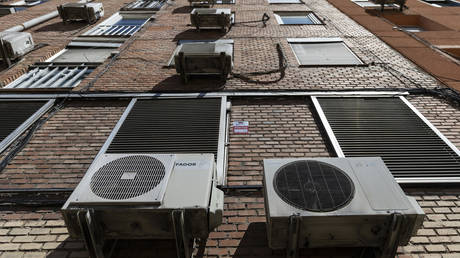
The metal railing of a balcony in Seville does not just get hot in July. It transforms. By mid-afternoon, it becomes a searing hazard capable of blistering human skin.
For generations, the ritual of the European summer was defined by a collective retreat. Shutters were slammed shut against the midday glare. Thick stone walls, built centuries ago, held the cool ghost of the previous night. People drank espresso over ice, took long breaks, and waited for the sun to sink. It was a cultural pride, this refusal to mechanicalize the air. To the average European, the noisy, dripping metal boxes hanging from American windows were a sign of weakness, an inability to live in harmony with the seasons.
That pride is dead. It melted away during the record-breaking heatwaves of the last few seasons, replaced by a desperate, quiet panic.
Consider Mateo. He is a retired schoolteacher living in a third-floor apartment in Madrid. His building was constructed in the 1960s, a concrete box that absorbs heat like a brick oven. For years, Mateo relied on a single plastic desk fan that merely shifted the stifling air around his living room. But three summers ago, the thermometer hit 44°C (111°F) and stayed there for a week. The nights offered no relief; the brickwork radiated heat until dawn. His chest grew heavy. His pulse raced.
Mateo’s doctor gave him a blunt choice: install air conditioning or risk a fatal heat stroke.
He bought a unit. Most of his neighbors did too. Today, walking down his street feels like walking past a roaring engine room. Hundreds of external compressors hum in unison, dripping condensation onto the sizzling pavement below. Mateo is cool inside, but his electricity bill has doubled, and he feels a strange, gnawing guilt. He knows that the hot air his machine pumps out of his bedroom is making the street outside even hotter for those who cannot afford the luxury.
This is the great, unspoken paradox fracturing the European continent. Air conditioning is no longer a luxury item or a symbol of American excess. It has become a basic tool for human survival. Yet, this collective rush for survival is pushing Europe into a dangerous trap, exposing the fragile state of its energy grid and testing the very definition of continental freedom.
The Cost of the Cool Breeze
For decades, the European Union built its identity on environmental leadership. It set aggressive targets to slash carbon emissions, championing wind turbines, solar arrays, and the preservation of old-world architectural charm. But climate reality moving faster than policy.
The numbers are stark. Across the continent, heat-related mortality has surged by nearly 30% over the past decade. In vulnerable regions, the summer months are now viewed with the same dread once reserved for the bitterest winters.
When millions of citizens like Mateo plug in their new cooling units simultaneously, the strain on the electrical infrastructure is immediate and severe. Consider what happens to an electric grid designed for a temperate climate when every apartment block in Rome, Paris, and Athens suddenly demands maximum power at 3:00 PM.
The wires buzz. Substation transformers overheat.
To prevent catastrophic blackouts, grid operators are forced to make uncomfortable choices. When renewable energy from solar and wind cannot keep pace with the frantic spike in demand, utilities must fire up old, fossil-fuel-burning peaker plants. The irony is total, vicious, and cyclical. To survive the immediate consequences of global warming, Europeans are burning the very fuels that accelerate it.
This is not just an environmental crisis. It is a geopolitical vulnerability.
True freedom, as the EU has learned through bitter experience, requires energy independence. When a society relies on external actors to keep its lights on and its factories running, its political sovereignty is compromised. For years, Europe relied heavily on imported natural gas to heat its homes in the winter. Tremendous effort and political capital were spent breaking that specific dependence.
Now, a new vulnerability is rising from the south. The threat is no longer a winter freeze, but a summer bake. If the continent’s ability to function through July and August depends on a massive, uninterrupted influx of energy to power hundreds of millions of air conditioners, the definition of security changes entirely.
The Myth of the Green Transition
Step inside the sterile, fluorescent-lit offices of an energy consultancy in Brussels. Analysts look at charts that resemble jagged mountain ranges.
The traditional view held that solar power would perfectly match the cooling demand. After all, the sun shines brightest when the weather is hottest. It sounds like a beautifully balanced equation.
But the real problem lies elsewhere. The peak demand for cooling does not happen at noon when the sun is highest. It happens between 5:00 PM and 9:00 PM. This is the exact window when workers return home, turn their AC units to the lowest setting, cook dinner, and wash their clothes. Meanwhile, the sun is setting, and solar generation drops to near zero.
To bridge this gap, Europe needs an astronomical amount of energy storage. Batteries. Huge, expensive installations that do not yet exist at the required scale.
Without them, the reliance on gas-fired generation remains locked in place. It is an uncomfortable truth that many political leaders prefer to gloss over. They speak of a seamless transition to a green future, but the immediate human need for cooling is outstripping the slow pace of infrastructure upgrades.
There is also a profound structural challenge built into Europe’s beloved historic cities.
An American suburb is designed for mechanical climate control. Central air ducts are woven through the drywall of spacious homes. In contrast, a typical apartment building in Vienna or Florence features thick, load-bearing masonry, narrow stairwells, and strict historical preservation laws. You cannot easily drill through a 300-year-old facade to install coolant lines without a mountain of bureaucratic permits.
Even if you get the permit, the cost is prohibitive for the working class.
This creates a sharp, dangerous social divide. The wealthy can afford premium, efficient heat pumps that cool their homes quietly and cleanly. The working class is left to buy cheap, inefficient portable units that vent through cracked windows, wasting half the electricity they consume. Or worse, they go without, suffering in silence behind closed blinds.
The Invisible Stakes
We tend to view climate change as a series of grand, distant events. Melting ice sheets. Flooded coastal metropolises. Wildfires consuming pristine forests.
But the transformation of Europe shows that the crisis is also intimate, quiet, and domestic. It is measured in the steady, relentless hum of a compressor outside a bedroom window. It is felt in the anxiety of an elderly person checking their smart meter to see if they can afford another hour of relief.
This is the ultimate freedom test for the continent. Can Europe protect its citizens from an increasingly hostile climate without sacrificing its climate goals or its geopolitical autonomy?
There are no easy answers. Some architects advocate for a return to passive cooling. They want to paint roofs white, plant massive urban forests to combat the heat-island effect, and revive ancient building techniques that encourage natural ventilation. These are noble, necessary long-term endeavors.
But they do nothing for Mateo tonight.
Tonight, the air in Madrid is thick, heavy, and smelling of hot asphalt. Mateo sits in his armchair, watching the news. A small green light glows on his wall unit, and a gentle stream of 22°C air washes over him. He knows he is safe, for now. But outside his window, the collective hum of a city trying to cool itself down echoes into the dark, a frantic chorus of survival that carries a heavy, unknown price for tomorrow.