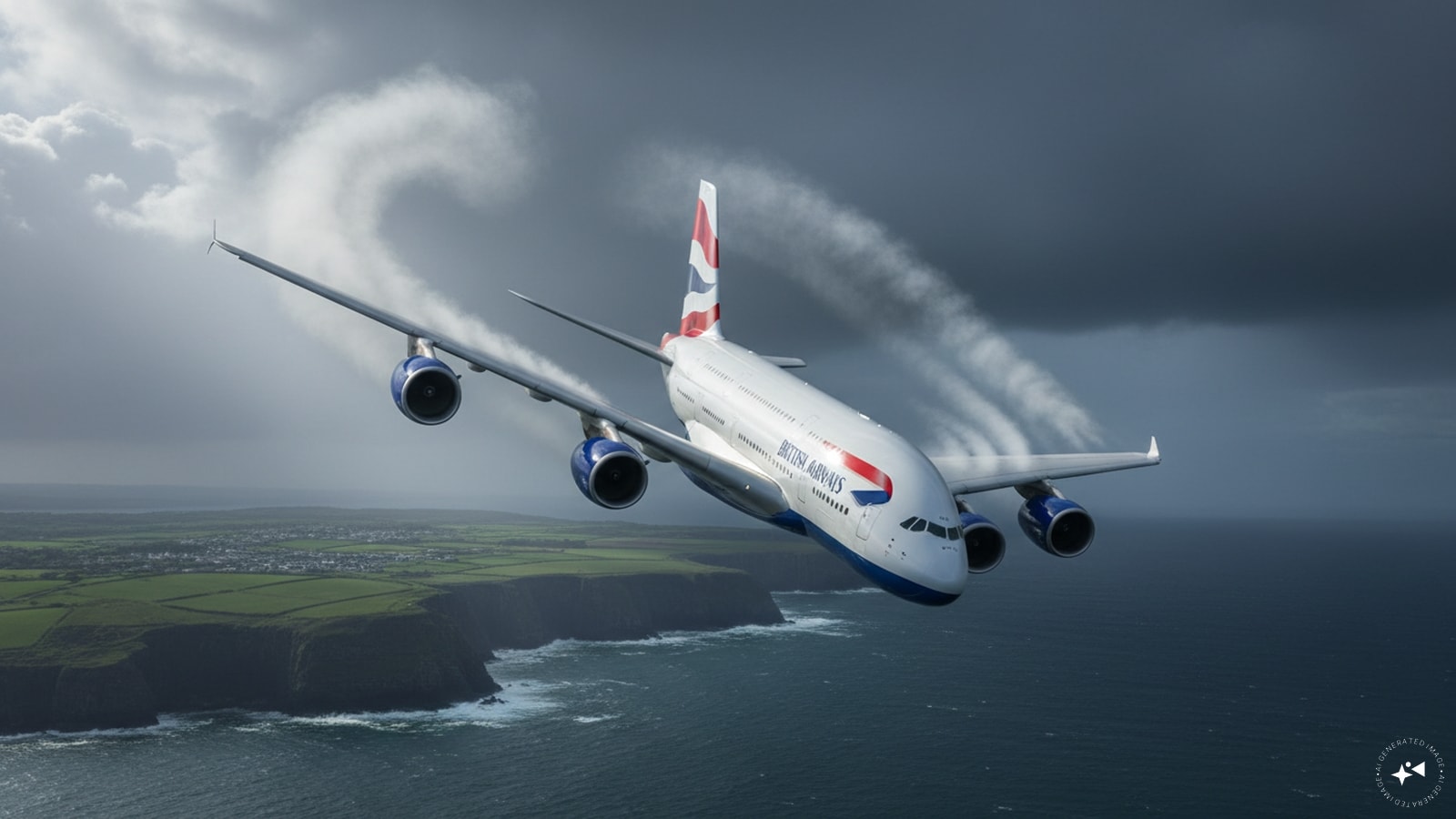
A commercial airliner cruising at thirty-eight thousand feet is a pressurized metal tube hurtling through a near-vacuum where the ambient air can neither sustain human life nor support combustion. When that pressure capsule breaches or the outflow valves misbehave, the margin for human error narrows to seconds. A British Airways flight operating over the North Atlantic recently declared an emergency and executed a rapid descent toward Irish airspace after encountering a sudden cabin altitude anomaly. Passengers experienced the sudden drop of oxygen masks, the violent shudder of spoilers deploying, and the abrupt pitch-down maneuver that every pilot trains for in a flight simulator but hopes never to fly in the real world.
To understand what happened during that high-altitude emergency, we have to look past the sensationalized social media videos filmed by anxious passengers and examine the cold mechanics of aviation safety systems. Modern widebody and narrowbody aircraft rely on complex bleed-air systems that bleed compressed air from the engine compressor stages, cool it, and pump it into the cabin through outflow valves that continuously regulate internal pressure. When cabin altitude—which measures the air density inside the cabin in equivalent feet above sea level—begins to spike past ten thousand feet, automated warnings trigger. If the cabin altitude climbs past fourteen thousand feet, chemical oxygen generators drop masks from the overhead panels, buying passengers roughly fifteen minutes of breathable air while the flight deck crew initiates an emergency descent. Discover more on a related topic: this related article.
The primary objective during a rapid decompression or severe pressurization failure is simple: get the aircraft down to a breathable altitude as fast as humanly and structurally possible. That altitude is typically ten thousand feet, where supplemental oxygen is no longer required for survival. Executing this maneuver requires a synchronized choreography between the captain and the first officer. The autopilot is disengaged, the throttles are hauled back to idle, speedbrakes or spoilers are extended to increase aerodynamic drag without overspeeding the airframe, and the nose is pitched down into a controlled dive.
Witnesses on the ground or passengers in the cabin often describe these maneuvers as terrifying plunges, but from an engineering standpoint, they are highly calculated. Aircraft are structurally tested to withstand immense aerodynamic loads, yet descending from the flight levels down to ten thousand feet while managing terrain clearance, air traffic control separation, and potential structural integrity issues demands absolute discipline. The crew must balance the need for speed against the structural limits of the airframe, ensuring that the dynamic pressure doesn't exceed design parameters while thousands of pounds of thrust are absent. Further journalism by Travel + Leisure highlights related perspectives on the subject.
Beyond the immediate cockpit actions, incidents like this cast a harsh spotlight on the aging infrastructure of global commercial fleets and the ongoing pressures faced by maintenance teams. While commercial aviation remains statistically the safest mode of transportation ever devised, the mechanical components responsible for pressurization—outflow valves, pressure controllers, static ports, and cabin sealing gaskets—undergo thousands of pressure cycles over their operational lifespans. Fatigue is an invisible adversary. A microscopic crack in a fuselage skin patch, a failing pneumatic valve seal, or a glitch in the digital cabin pressure controller can turn a routine transatlantic crossing into a high-stakes scramble for airspace over the Irish Sea.
When air traffic control in Shannon or Dublin receives an emergency squawk and a rapid descent clearance request, the operational tempo shifts instantly. Controllers must carve out a descending column of airspace, clearing other traffic out of the way while the stricken aircraft plummets through the flight levels. The coordination required in oceanic airspace, where radar coverage can be sparse and procedural separation is often standard, adds another layer of complexity. Pilots rely on pre-established contingencies, turning ninety degrees off the track to clear the airway before descending safely into lower altitudes where air density permits normal respiration.
Passengers rarely comprehend the physics of what is happening when the oxygen masks drop. The sudden deployment of yellow rubber cups is accompanied by a rush of cold air and the deafening roar of wind rushing over the fuselage skin if a structural breach occurred. The physiological effects are immediate. Hypoxia can set in rapidly if supplemental oxygen isn't secured, impairing cognitive function before the individual even realizes they are in danger. This is why flight crews drill endlessly on rapid descent profiles. Muscle memory takes over when the blood oxygen saturation begins to drop.
The British Airways incident over Ireland serves as a stark reminder that the modern sky is not a docile highway. It is a hostile environment held at bay entirely by engineering redundancy and human vigilance. Every bolt, every seal, and every redundant computer system exists because someone, decades ago, learned a hard lesson at thirty-eight thousand feet. When the cabin altitude warning klaxon sounds, the passengers see chaos, but the flight deck sees a checklist.
As the aviation industry continues to push for greater efficiencies, lighter composite materials, and extended twin-engine operations over remote oceanic expanses, the reliance on automated environmental control systems will only increase. Yet, no software patch or composite fuselage can entirely eliminate the baseline risk of mechanical wear and tear. The safe resolution of this particular emergency is a testament to the rigorous training regimens mandated by international civil aviation authorities, proving that when the pressure fails, the people at the controls do not