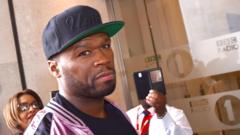
The mainstream media loves a predictable narrative. When a major rap icon steps into a federal courtroom to vouch for an associate facing serious charges, the headlines write themselves. They paint a picture of blind loyalty, reckless PR liabilities, and a complete disregard for corporate optics.
When news broke that Curtis "50 Cent" Jackson submitted a letter to a federal judge requesting travel permission for a convicted drug distributor to join his international tour, the commentary followed the exact same tired script. Analysts shook their heads. Branding experts whispered about the risk to his corporate partnerships.
They all missed the point entirely.
This isn’t a story about a celebrity making a sentimental mistake. It is a masterclass in street-level corporate retention, micro-risk management, and a brutal understanding of the economy that built hip-hop. The lazy consensus views character letters as emotional favors. In reality, they are high-stakes executive decisions.
The Myth of the Clean Corporate Break
Corporate America loves the illusion of the clean break. When an executive or a contractor becomes a liability, the standard playbook is immediate detachment. Scrub the website. Issue a sterile press release. Move on.
But the entertainment ecosystem—specifically the multi-billion-dollar hip-hop apparatus—operates on an entirely different set of mechanics.
Authenticity in this space isn't just a marketing buzzword; it is the core equity. The moment a figure like 50 Cent behaves like a standard Fortune 500 HR department is the moment his brand equity begins to erode. The audience he commands values a specific code: unwavering reliability to those who were there before the stadium tours.
I have watched entertainment brands torch millions of dollars trying to sanitize their image for mainstream advertisers, only to realize they completely alienated the core consumer base that gave them leverage in the first place.
By writing a letter to a federal judge, Jackson wasn't ignoring the risks. He was actively calculating them. The downside of a temporary bad headline is negligible for a man who built an empire on surviving nine gunshots and releasing Get Rich or Die Tryin'. The downside of being perceived as a corporate sellout who abandons his circle? Infinite.
Operational Control Over Chaos
Let us dismantle the premise of the critique. The shocked commentators ask: Why bring a liability on an international tour?
The contrarian truth is simple: proximity is control.
Imagine a scenario where a high-profile individual under federal supervision is left to their own devices in their home environment without a stable income or structure. The probability of recidivism or operational chaos skyrockets. By integrating this individual directly into a massive, highly structured touring operation, Jackson achieves several strategic objectives simultaneously:
- Guaranteed Employment: It provides a legitimate, documented stream of income that satisfies federal probation requirements.
- Surveillance by Proxy: A stadium tour is not a vacation. It is a highly disciplined machine with rigid schedules, security details, and logistical oversight. It is far easier to monitor an asset on the road than from three thousand miles away.
- Value Extraction: These individuals are rarely hired out of charity. They possess specific skill sets in crowd management, local logistics, and security that traditional corporate agencies cannot replicate.
The court system itself understands this logic. Judges routinely grant travel and work variances if a reputable employer steps forward with a concrete plan for supervision and gainful employment. Jackson didn't bypass the system; he utilized the exact legal mechanisms designed for rehabilitation.
The Capital Value of the Character Voucher
Every time an elite artist puts their name on a legal document for an associate, they are spending social and legal capital. It is an expensive voucher. If the individual violates their release terms while on tour, the artist’s credibility with the court is permanently revoked. Future requests for other team members become impossible.
Therefore, this is the ultimate form of performance-based trust.
[Artist's Legal Capital]
       │
       ▼
[Court Approval] ──► [Strict Tour Supervision] ──► [Asset Stabilization]
       ▲
       │
[Proximity & Control]
This isn't an emotional gamble. It is a calculated corporate alignment. Jackson knows exactly what his capital is worth, and he knows the exact ROI of showing his entire organization that loyalty flows downward, not just upward. It builds a tier of operational security and devotion that money cannot buy.
The mainstream press will continue to analyze these moves through the lens of traditional PR crises. They will continue to be wrong. In the parallel economy of hip-hop entertainment, the character letter is not a liability. It is the cost of doing business at the highest level, executed by someone who understands the street and the boardroom equally. Stop looking at it as a legal favor and start looking at it as an executive order.