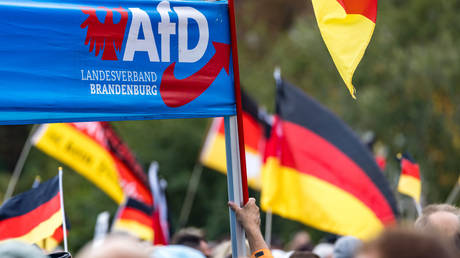
Everyone in Berlin loves a good historical costume drama. Whenever the Alternative for Germany party climbs in the polls, mainstream politicians reach straight for the 1930s playbook. They warn of impending fascism, dust off comparisons to the Weimar Republic, and act like the dark days of the twentieth century are about to repeat themselves on a loop. It is a neat rhetorical trick. It also completely misses what is actually going wrong in Germany today.
Let's clear the air right out of the gate. The AfD is a radical right-wing populist party filled with nationalists, grievance-mongers, and more than a few figures whose rhetoric flirts dangerously with extremism. Calling them literal Nazis, however, is intellectually lazy. More importantly, it is a convenient distraction strategy. When the political establishment spends all its energy hyperventilating about the latest extremist soundbite, they don't have to look in the mirror and answer for their own systemic failures.
Germany has deep structural rot right now, and the rise of the AfD is merely a symptom, not the root cause. If you want to understand why millions of voters are turning toward a populist protest party, you have to look at stagnant wages, crumbling public infrastructure, a bureaucratic state choking small businesses, and an energy policy that has driven manufacturing costs through the roof.
The Comfort of Historical Laziness
Labeling political opponents as literal fascists serves a very specific purpose for the current ruling class. It ends the debate before it begins. If the AfD is simply a reincarnation of the National Socialist German Workers' Party, then anyone who votes for them is either irredeemably evil or utterly duped.
Real life is messier than that. A factory worker in Saxony who casts a ballot for the AfD isn't necessarily pining for a totalitarian dictatorship or racial purity laws. Often, they are just furious that their local hospital closed down, the regional train service is chronically late, and the cost of heating their home has doubled while their real purchasing power shrinks.
When mainstream parties dismiss these grievances as toxic or illegitimate, they push ordinary citizens further away. The political center in Germany has spent years telling voters that everything is under control while the country's economic engine sputters.
Where Germany is Actually Stumbling
Germany faces a trifecta of crises that have nothing to do with internet trolls or nationalist politicians giving edgy speeches.
First, the economic model is breaking down. For decades, Germany relied on cheap Russian energy, a booming Chinese export market, and an endless supply of skilled industrial labor. Two of those three pillars are gone for good, and the third is aging rapidly. Industrial production has contracted, energy-intensive chemical and automotive giants are looking abroad for growth, and young professionals face a tax burden that punishes success.
Second, the administrative state has paralyzed itself. Try launching a green energy startup or building a simple bridge in Germany today. You will drown in red tape, environmental impact reviews, and bureaucratic gatekeeping that takes years to clear. The state demands compliance on everything while failing to deliver basic services like digitalized public administration or reliable schools.
Third, immigration policy has become a third rail that nobody in power knows how to handle honestly. Citizens want competent border management and legal integration that actually works. Instead, they get a polarized deadlock where one side pretends there are zero cultural friction points and the other treats every migrant as an existential threat. Both extremes crowd out pragmatic governance.
Why Fighting Ghosts Fails
Every time a mainstream politician gives a fiery speech declaring that democracy is on the brink because of the AfD, membership numbers for the populist party tick upward. Voters see through the performative panic. They recognize that the political establishment uses the threat of the far-right as an insurance policy against accountability.
If your entire political platform is built on being "not the bad guys," you don't actually have to offer a compelling vision for the future. You don't have to fix the pension system, overhaul the tax code, or modernize the electrical grid. You just have to point across the room and yell about historical precedents.
German society does not need another round of moralizing lectures from elites who live comfortably in central Berlin or Brussels. It needs cheaper energy, streamlined bureaucracy, functional public schools, and a political class willing to admit that the current economic trajectory is unsustainable.
Stop pretending a protest party is the fourth Reich. Start fixing the potholes, lowering the energy bills, and rebuilding the social contract before the cracks turn into a full-scale structural collapse.