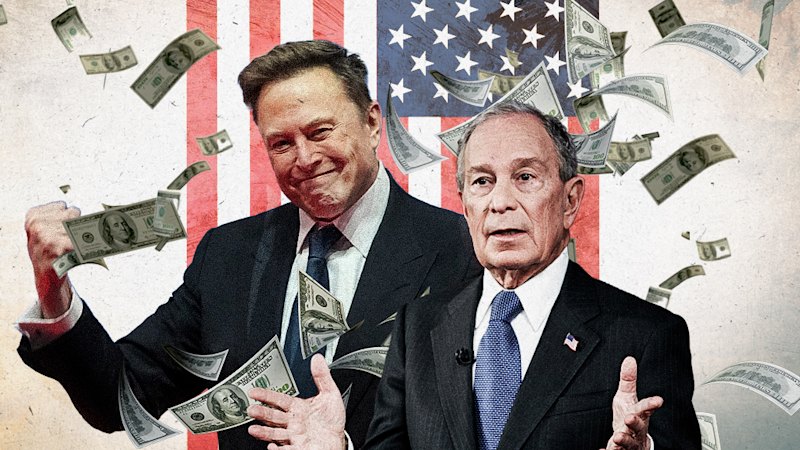
Modern federal elections no longer operate as retail persuasion contests funded by broad coalitions of small donors. They function as capital-intensive infrastructure deployments where a microscopic tier of ultra-high-net-worth individuals underwrites parallel campaign operations. When a single financier like Elon Musk deploys hundreds of millions of dollars through specialized political action committees, the underlying mechanics of electoral competition shift from mass-market fundraising to concentrated venture-style capital allocation. Understanding this shift requires dissecting the regulatory architecture that enables unlimited spending, the operational substitution of party infrastructure by outside groups, and the diminishing marginal returns of late-stage political capital.
The Structural Shift from Retail to Institutional Capital
Historically, federal campaign finance relied on a distributed model. Candidates raised funds directly from individuals subject to strict statutory contribution limits. This forced campaigns to build broad donor networks, aligning fundraising capacity with baseline popular support. The regulatory dismantling of expenditure limits for independent groups—anchored by the Citizens United v. FEC and SpeechNow.org v. FEC rulings—severed the link between a candidate’s popular fundraising base and their total operational budget.
In the resulting capital market, political spending bifurcates into two distinct asset classes: hard money and soft money.
- Hard Money (Direct Candidate Contributions): Strictly capped per election cycle, transparent, and subject to lowest-unit-rate broadcast advertising protections. Hard money funds core campaign staff, candidate travel, and primary media buys.
- Soft Money (Independent Expenditures): Uncapped contributions routed through Super PACs (Independent Expenditure-Only Committees) and 501(c)(4) social welfare organizations. These entities cannot legally coordinate strategy directly with candidates, yet they absorb the highest-cost operational burdens of modern campaigning.
The economic consequence is a massive asymmetry in fundraising efficiency. A traditional campaign must spend between 15 and 35 cents to raise every dollar through direct mail, digital acquisition, and fundraising events. A mega-donor writing an eight-figure check to a Super PAC operates at near-zero customer acquisition cost. One transaction replaces the fundraising output of hundreds of thousands of small-dollar contributors, fundamentally altering how campaign strategists allocate time and resources.
The Three Pillars of Mega-Donor Operations
When mega-donors enter an election cycle at scale, they do not merely buy television commercials. Legacy media markets saturate quickly; once a swing-state voter sees an advertisement twenty times, the marginal persuasive value of the twenty-first impression drops toward zero. To extract actual return on investment, sophisticated political financiers deploy capital across three operational pillars that traditionally belonged to national party committees.
1. Outsourced Ground Game and Field Infrastructure
Historically, voter registration, door-to-door canvassing, and get-out-the-vote (GOTV) operations were managed by state and national party apparatuses funded by hard money. Recent regulatory interpretations by the Federal Election Commission permit campaigns to coordinate canvassing scripts and voter targeting data with outside Super PACs.
This change allows a mega-donor to underwrite a campaign's entire physical field operation. By funding external field organizations—such as America PAC in the 2024 cycle—billionaire backers assume the fixed overhead of payroll, field offices, and canvassing logistics. This frees the candidate's hard-money accounts to focus exclusively on discounted television and radio airtime. However, outsourcing field operations introduces principal-agent problems. Third-party contractors paid per door knocked face perverse incentives to falsify data or target low-propensity voters simply to hit volume metrics, requiring rigorous, real-time GPS auditing and data verification that external groups often fail to execute cleanly.
2. High-Frequency Digital Micro-Targeting and Platform Control
Capital concentration enables the acquisition and deployment of proprietary data models and high-volume digital distribution. Unlike broadcast television, digital channels allow campaigns to run thousands of multivariate creative tests simultaneously, isolating specific demographic cohorts in decisive counties.
Beyond ad buying, platform ownership or algorithmic alignment alters the information environment at a structural level. When a mega-donor controls a major social distribution network, the distinction between paid media and earned media blurs. Algorithmic amplification of specific political narratives functions as an unquantified in-kind subsidy, bypassing traditional campaign finance disclosure frameworks entirely because organic platform moderation and amplification decisions are protected under the First Amendment.
3. Dark Money Laundering and Liability Shielding
Mega-donors rarely wish to attach their personal or corporate brands to the sharpest edges of negative campaigning. To solve this reputational risk, capital flows through a layered corporate structure:
- The 501(c)(4) Originator: A donor transfers funds to a tax-exempt social welfare organization. Under current Internal Revenue Service rules, 501(c)(4) entities do not disclose their donors publicly, provided politics is not their "primary" activity (routinely interpreted as spending less than 50 percent of total outlays on explicit electoral advocacy).
- The Super PAC Pass-Through: The 501(c)(4) transfers funds to a registered Super PAC. The Super PAC files public disclosures with the FEC, listing the 501(c)(4) as the source of funds rather than the underlying individual.
- The LLC Vendor Layer: The Super PAC pays a newly formed Limited Liability Company for media production or consulting. The LLC subcontracts the actual ad buys, obscuring the granular financial trail from competitors and journalists until months after ballots are cast.
This architecture allows mega-donors to fund aggressive attack ads or ballot-access litigation while maintaining plausible deniability in their primary commercial enterprises.
The Cost Function of Electoral Saturation
Why do elections routinely shatter spending records without producing proportional shifts in vote share? The answer lies in the economics of duopolistic competition and the inelasticity of swing-state media inventory.
In a standard commercial market, increased capital investment expands production capacity or lowers consumer prices. In a federal election, the supply of persuasive attention is fixed. In a presidential cycle, the outcome hinges on roughly six to eight battleground states, representing less than 20 percent of the national electorate. Within those states, the subset of genuinely undecided or persuadable voters often shrinks to less than 5 percent of the local population.
When billions of dollars chase a shrinking pool of persuadable voters, the market experiences hyper-inflation. Local television stations in cities like Philadelphia, Detroit, and Phoenix operate under statutory "lowest unit charge" windows for candidates, but Super PACs pay commercial market rates. As mega-donors dump tens of millions of dollars into these specific designated market areas (DMAs) during the final sixty days, stations raise rates exponentially.
The result is a classic prisoner's dilemma. Neither side can unilaterally disarm without ceding share-of-voice to the opposition, yet the collective escalation forces both coalitions to pay vastly higher prices for the exact same eyeballs. Total expenditure skyrockets, enriching media conglomerates and political consulting firms—who typically charge a percentage commission on gross media buys—while producing negligible net movement in polling averages.
Principal-Agent Friction in Outside Spending
A common analytical error is equating total dollar volume with operational effectiveness. In practice, mega-donor capital suffers from severe structural inefficiencies compared to direct campaign spending.
First, media rate penalties degrade purchasing power. Because federal law mandates that broadcast stations offer candidates their lowest commercial rate during the 45 days before a primary and 60 days before a general election, a dollar spent by a candidate's campaign often buys twice as much airtime as a dollar spent by a mega-donor's Super PAC. Consequently, a $100 million Super PAC injection may only yield $50 million in equivalent media weight.
Second, strategic fragmentation undermines message discipline. When multiple billionaires fund separate Super PACs to support the same candidate, those entities cannot legally coordinate with the campaign or, frequently, with one another. One group may run ads emphasizing economic inflation while another floods the same market with cultural wedge issues, diluting the central narrative and confusing low-information voters.
Third, consultant capture drains capital before it reaches voters. The political consulting ecosystem extracts substantial friction costs through layered retainers, creative production fees, and media placement commissions. Without the strict internal financial controls of a centralized campaign headquarters, mega-donor vehicles are easily exploited by vendors optimizing for gross billings rather than vote yield.
Evaluating the Return on Political Capital
If mega-donor spending faces steep media rate penalties, saturation effects, and operational friction, why do rational economic actors continue to write nine-figure checks? The answer requires looking beyond immediate vote-share ROI to long-term regulatory and access optionality.
For an ultra-high-net-worth individual whose corporate empire depends on federal defense contracts, regulatory approvals, tax policy, or antitrust enforcement, a $100 million political expenditure is not a charitable donation; it is an asymmetric hedge. If the favored administration takes office and alters a single regulatory framework, awards a major federal procurement contract, or preserves favorable capital gains treatment, the financial return to the donor's core businesses can exceed the political outlay by orders of magnitude.
Furthermore, political capital buys agenda-setting power. By underwriting the primary infrastructure of a campaign, a mega-donor transitions from a passive supporter to an indispensable stakeholder. This proximity guarantees direct channels of communication with executive branch decision-makers, allowing the financier to influence personnel appointments and policy priorities long after the election concludes.
Strategic Framework for Capital Allocation
For strategists managing high-net-worth political capital—or analysts evaluating the real-world impact of mega-donor deployments—raw fundraising totals are a vanity metric. True electoral impact depends on capital efficiency and timing.
- Front-Load Infrastructure Over Late-Stage Media: Capital deployed twelve to eighteen months before an election buys voter registration, data architecture, and permanent field staff at standard market rates. Capital deployed in October buys hyper-inflated broadcast inventory with near-zero marginal persuasion value.
- Audit Field Operations Through Independent Telemetry: Never rely on self-reported canvassing metrics from third-party vendors. Require real-time photographic verification, GPS breadcrumb tracking, and independent phone-bank validation of knocked doors to eliminate vendor fraud.
- Concentrate Capital in Low-Cost Asymmetric Channels: Bypass saturated broadcast television in favor of direct-to-voter relational organizing tools, targeted ballot-chasing operations in mail-in voting jurisdictions, and localized digital networks where cost-per-impression remains decoupled from broadcast auction spikes.
- Enforce Flat Fee Structures: Eliminate percentage-of-spend commissions for media buyers and consultants. Compensate vendors via fixed retainers tied to verified voter contact milestones and net registration gains to align agency incentives with electoral outcomes.