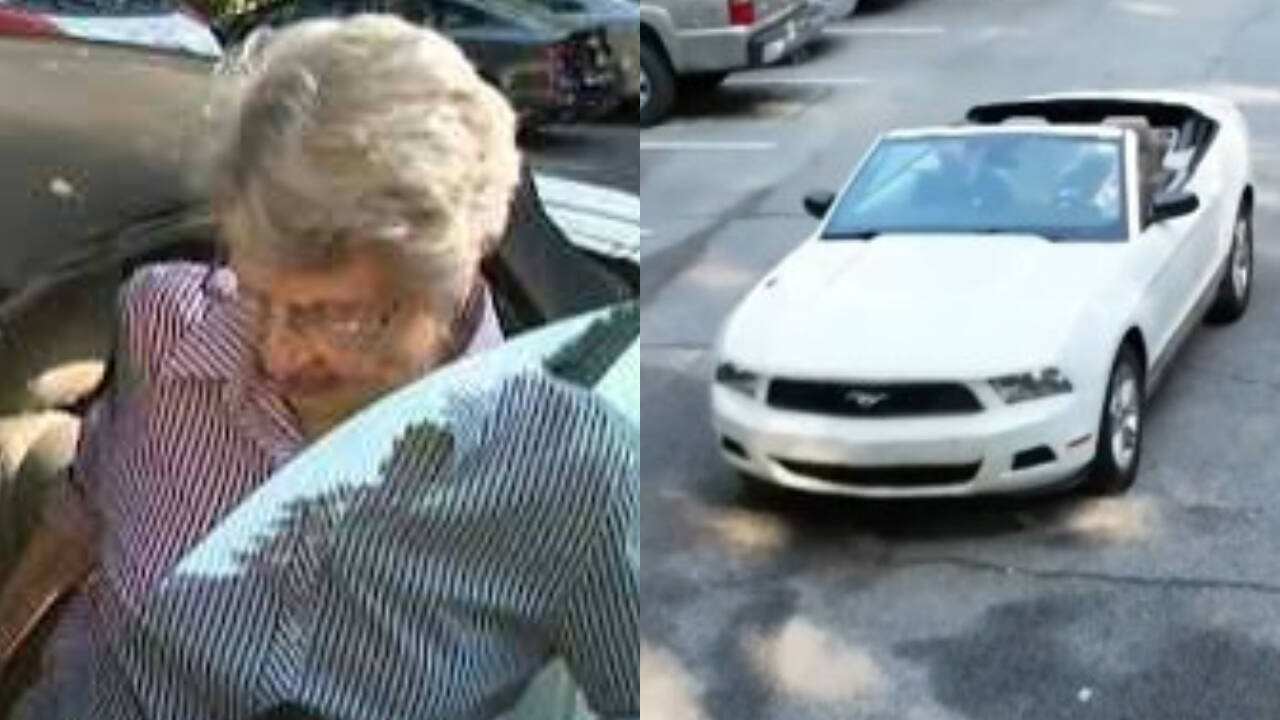
Every few months, the media rolls out the same tired feel-good trope. A centenarian climbs behind the wheel of a vintage muscle car, smiling for local cameras, proving that age is just a number. The headline praises their grit. The narrative pushes a lazy consensus: put caution before age, stay active, defy the calendar.
It makes for sweet morning television. It is also an absolute disaster of public safety reasoning.
Let us dismantle the romanticism. Celebrating a hundred-year-old motorist because they managed to steer a Ford Mustang down a suburban side street without a collision is not a testament to human potential. It is an indictment of our failure to separate sentimentality from hard actuarial reality.
I have spent years analyzing transit safety data, behavioral patterns in aging populations, and the brutal physics of kinetic energy management on modern asphalt. The comfortable myth that individual willpower and a positive attitude can override biological decay has a body count. And it is time to stop pretending otherwise.
The Cognitive Fallacy of Self-Rated Competence
The core premise of the centenarian driver narrative rests on self-reported capability. Barbara Haig says she is careful. Her family says she is sharp. The local DMV clerk watches her pass a basic visual acuity test and stamps the license renewal.
Here is what the data actually says about cognitive self-assessment in advanced age: humans are uniquely terrible at recognizing our own neurological decline.
As the frontal cortex and parietal lobes experience age-related atrophy, the brain's metacognitive monitoring systems—the internal dashboard that tells us how well we are performing a task—deteriorate right alongside our reaction times. A driver at ninety-five or one hundred experiences delayed processing speeds, diminished peripheral awareness, and reduced executive function. Yet, their subjective feeling of competence remains completely intact. They feel fine. They have always driven. Therefore, they assume they are safe.
Traffic safety research from the Insurance Institute for Highway Safety and academic transit departments paints a grimly consistent picture. While teenagers crash due to reckless overestimation of skill combined with high velocity, drivers past a certain biological threshold pose a different kind of risk. They are over-represented in fatal intersection collisions where complex visual scanning, rapid calculation of oncoming velocity, and split-second braking decisions are mandatory.
When a centenarian creeps through a blinking yellow arrow or misjudges the speed of an oncoming semi-truck on a rural highway, caution is a nice sentiment, but physics does not care about your positive attitude.
The Sentimentality Trap
Why do we indulge this? Because confronting the reality of aging means confronting our own mortality and the painful loss of autonomy. Taking away car keys feels like executing a civil death sentence. It strips an elder of their independence, reducing them to a passenger in their own life story.
So society engages in collective bargain. We elevate the statistical outliers—the rare centenarians whose genetics and environmental luck kept their faculties sharper than average—and turn them into poster children for aging gracefully. We treat them as proof that the system works, ignoring the hundreds of thousands of families quietly dealing with minor fender-benders, near-misses, and terrifying midnight calls from emergency rooms because Grandpa refused to admit his night vision vanished three years ago.
This is where the contrarian truth cuts deepest: protecting dignity by enabling potential vehicular homicide is not compassion. It is cowardice disguised as respect.
True respect means establishing hard, objective thresholds for driving privileges that apply to everyone equally, regardless of how charming their local news feature is. It means separating the emotional grief of losing a license from the mathematical reality of piloting a two-ton weapon of mass transit down a crowded corridor.
Dismantling the People Also Ask Illusion
Let us address the common queries populating search engines regarding elderly motorists, and let us tear down the flawed premises underpinning them.
Are older drivers really more dangerous than teenagers?
The lazy consensus loves to point out that teenagers have higher per-mile crash rates, using this as a shield to deflect scrutiny from older demographics. But look closer at the denominator. Teenagers crash because of impulsivity, intoxication, and deliberate risk-taking. Older drivers crash because of functional impairment—failing to yield right-of-way, confusing the gas and brake pedals, or missing a stop sign entirely. When older drivers do crash, their fragility index means the collision is exponentially more likely to be fatal for them and for innocent bystanders. Comparing a reckless eighteen-year-old to a cognitively compromised ninety-year-old is comparing apples to an unexploded ordnance.
How often should elderly drivers be retested?
The standard answer from safety advocates is a polite biennial vision check. That is laughably inadequate. A sixty-second eye chart test does not measure working memory, processing speed, visuospatial attention, or executive flexibility. If we are serious about safety, mandatory behind-the-wheel retesting should begin at age seventy-five, recurring every two years, incorporating cognitive stress tests designed to simulate emergency braking and sudden hazard avoidance. If you cannot pass a computerized reaction simulation, your keys belong in a drawer.
What are the alternatives to taking away keys?
People ask this as if loss of driving equals permanent house arrest. The failure here lies in our disastrous suburban infrastructure, which prioritizes cars over human existence. Instead of bending over backwards to keep centenarians behind the wheel, municipalities should be dumping resources into micro-transit, subsidized rideshare programs for seniors, and walkable community design. Keeping unsafe drivers on the road is a lazy substitute for building cities where people do not need a steel cage just to buy groceries.
The Downside of My Approach
Let us be completely transparent about the cost of this hardline stance. Implementing rigorous, non-negotiable functional testing for aging drivers will cause immediate social friction. It will isolate rural seniors who lack alternative transit. It will spark fierce political backlash from lobbying groups who weaponize sentimentality. It will force difficult, heartbreaking conversations around dining room tables across the country.
It will feel cruel.
But public safety cannot be run on warm fuzzies and feel-good human-interest stories about centenarians defying the clock in a Mustang. Every time we applaud an eighty-five or one-year-old for driving against the odds, we normalize a gamble with other people's lives.
Barbara Haig can enjoy her car in her driveway. But the highway belongs to everyone else. Stop romanticizing the danger.