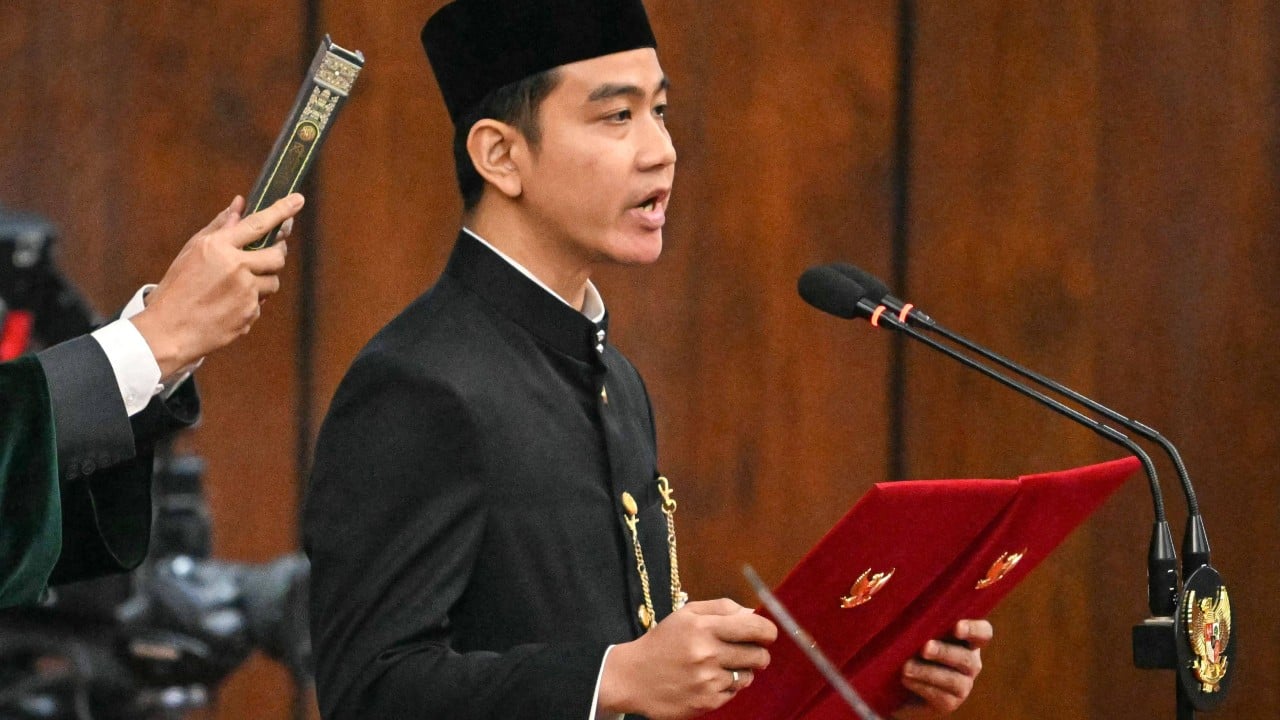
Political instability at the executive level in Southeast Asia’s largest economy rarely stems from isolated personality clashes. When rumors, procedural friction, or actual resignation threats emerge around the Indonesian Vice Presidency under President Prabowo Subianto, the underlying mechanism is an acute failure in coalition transaction-cost management. Governing a sprawling archipelago through a supermajority coalition requires continuous distribution of patronage, cabinet seats, and regulatory authority. Any public fracture between the presidency and vice presidency signals that the cost of keeping divergent political factions aligned has exceeded the executive branch’s capacity to pay.
To evaluate the operational impact on Prabowo’s administration, analysts must separate surface-level political theater from the structural constraints of Indonesia’s presidential system. Under the 1945 Constitution (and its post-1998 amendments), the President and Vice President are elected on a single ticket, yet they possess entirely asymmetric constitutional powers and distinct political bases. When friction escalates into resignation drama, it exposes three systemic vulnerabilities: the erosion of legislative discipline in the House of Representatives (DPR), the paralysis of fiscal execution across ministries, and the repricing of sovereign risk by domestic and foreign capital. Don't miss our recent article on this related article.
The Asymmetry of the Indonesian Executive Ticket
In standard corporate governance, a chief operating officer serves at the pleasure of the chief executive. In Indonesian politics, the Vice President functions as an equity partner representing a distinct bloc of political capital, electoral legitimacy, or dynastic continuity. When the ticket comprises Prabowo—a leader anchored by his Gerindra party machinery and a nationalist-populist mandate—and a Vice President whose value proposition rests on external alliances, generational appeal, or institutional continuity from the preceding administration, the partnership operates as a joint venture rather than a hierarchy.
This joint-venture model introduces severe principal-agent problems. The President holds absolute constitutional authority over the cabinet and the military, while the Vice President possesses zero independent executive authority unless explicitly delegated by presidential decree. The Vice President’s real power is entirely informal: the ability to withhold legitimacy, signal dissent to allied party chairs, or trigger a constitutional crisis through resignation. If you want more about the history of this, USA Today provides an informative summary.
The Mechanics of Coalition Defection
In multi-party presidential systems—a configuration political scientists classify as "coalitional presidentialism"—the executive cannot govern without assembling a legislative cartel. Prabowo’s governing coalition (the Koalisi Indonesia Maju, or KIM, alongside post-election additions) is an ideological umbrella spanning nationalist, Islamist, and technocratic factions. These parties do not share a unified policy platform; they are bound by access to state resources and state-owned enterprises (SOEs).
When executive friction becomes public, it alters the strategic calculus of every party leader within the coalition through a predictable chain reaction:
- Signaling Vulnerability: Rumors or threats of a Vice Presidential resignation broadcast to coalition partners that the center of power is contested. Party elites interpret this not as a personal dispute, but as an opportunity to renegotiate their share of cabinet portfolios and budgetary allocations.
- Legislative Hold-Up: Committee chairs in the DPR slow-walk key administration bills, including tax reforms, energy subsidy adjustments, and infrastructure appropriations. By withholding legislative quorum or delaying committee approvals, coalition partners extract concessions from the presidential palace.
- Bureaucratic Hedging: Senior civil servants (Echelon I and II officials) across ministries freeze major procurement and licensing decisions. In Jakarta’s administrative culture, executing a controversial directive during an executive power struggle carries high career risk if the opposing faction consolidates control.
The Cost Function of Coalition Maintenance
Maintaining a supermajority in Jakarta obeys the law of diminishing marginal returns. Adding more parties to a governing bloc reduces the threat of formal parliamentary opposition, yet it exponentially increases internal friction. Every additional party requires ministerial appointments, deputy ministerial slots, and board seats on lucrative SOEs such as Pertamina, PLN, and state-owned banks.
When the Vice Presidency becomes a focal point of crisis, the administration faces an acute resource-allocation dilemma. Let $C$ represent the total political capital and state patronage available to the President. To keep $N$ coalition parties loyal, the President must distribute payouts $P_i$ such that each party’s utility exceeds its outside option of defecting to the opposition ($O_i$).
$$\sum_{i=1}^{N} P_i \le C$$
A Vice Presidential crisis artificially inflates $O_i$ for every coalition partner. Factions aligned with the Vice President demand higher payouts to remain loyal to the ticket, while rival factions within the coalition demand compensation for the instability caused by the Vice President’s bloc. Because the total pool of state budgets, regulatory exemptions, and cabinet seats ($C$) is fixed in the short term by statutory deficit caps (specifically Indonesia’s strict 3% GDP fiscal deficit ceiling), the administration cannot easily print more political currency.
The Fiscal Execution Bottleneck
This political gridlock collides directly with Prabowo’s ambitious macroeconomic agenda. Flagship initiatives—such as nationwide nutritional programs, food and energy self-sufficiency drives, and ongoing capital city relocation commitments—require aggressive fiscal reallocation and rapid ministerial coordination.
If executive friction forces the President to spend political capital defending his flank, three operational bottlenecks immediately materialize:
- Delayed Budget Disbursements: The Ministry of Finance relies on clean political directives to shift spending from unproductive energy subsidies toward targeted capital expenditure. Coalition infighting stalls the parliamentary Budget Committee (Banggar), pushing disbursements into the third and fourth quarters and depressing annual GDP growth.
- Regulatory Contradictions: Rival ministries controlled by competing coalition factions issue conflicting decrees. A trade ministry aligned with one faction may loosen import quotas to appease domestic distributors, directly undermining an agriculture ministry aligned with another faction pursuing protectionist self-sufficiency targets.
- SOE Governance Paralysis: State-owned enterprises serve as the primary off-balance-sheet vehicles for Indonesian infrastructure and industrial policy. Executive instability triggers turnover—or prolonged vacancies—on SOE boards of commissioners, halting capital expenditure on downstream mineral processing and grid modernization.
Constitutional Realities vs. Political Theater
To assess whether a Vice Presidential resignation drama represents a genuine regime crisis or a calculated pressure tactic, analysts must examine the rigid mechanics of the 1945 Constitution. Unlike parliamentary systems where a deputy prime minister’s exit can trigger a vote of no confidence and snap elections, the Indonesian presidency is insulated by fixed five-year terms.
What Actually Happens if an Indonesian Vice President Resigns
Under Article 8 of the Indonesian Constitution, if the Vice President resigns, dies, or is permanently incapacitated, the presidency does not fall. Instead, a specific sequence is triggered:
- Presidential Continuity: The President retains full executive authority without interruption.
- The 60-Day Replacement Window: Within 60 days of the vacancy, the People’s Consultative Assembly (MPR)—comprising both the DPR and the regional representative council (DPD)—must convene a special session to elect a new Vice President.
- Restricted Nomination: The sitting President submits two candidates to the MPR. The MPR does not have the constitutional right to nominate its own candidates from the floor; it can only choose between the two names provided by the President.
This constitutional design creates a stark asymmetry of risk. If a Vice President actually resigns, they surrender their institutional platform entirely, while the President gains the unilateral power to nominate two loyalists to the MPR, effectively purifying the executive branch.
Consequently, a credible threat of resignation is far more potent than the act itself. Public drama, leaked grievances, and strategic absences from state functions function as a "brinkmanship asset." By threatening to walk away, the Vice President inflicts maximum reputational damage on the President—projecting chaos to voters and investors—without triggering the constitutional mechanism that would allow the President to replace them with a loyalist.
Institutional Friction Points Driving the Crisis
Understanding the persistence of executive tension in Jakarta requires looking beyond individual ambitions to three structural friction points embedded in the administration’s architecture.
1. The Dual-Mandate Problem in Cabinet Management
Prabowo’s governing style favors centralized, top-down command structures modeled on military hierarchy, paired with a massive, inclusive cabinet designed to accommodate all coalition stakeholders. When a Vice President attempts to carve out an operational portfolio—whether overseeing bureaucratic reform, regional development in eastern Indonesia, or specific economic task forces—jurisdictional overlap becomes inevitable. Coordinating ministers (Menko) report directly to the President, leaving the Vice President’s staff competing for bureaucratic bandwidth. Without clear statutory boundaries, parallel reporting lines emerge, forcing ministry directors-general to choose which executive office’s directives take precedence.
2. Generational and Dynastic Divergence
When an executive ticket is forged to bridge distinct political eras or voter demographics, their long-term incentives diverge from day one. A President focused on consolidating a legacy within a five-year window prioritizes immediate, high-visibility deliverables and tight control over state apparatus. A younger Vice President, or one representing a distinct political dynasty, operates on a ten-to-fifteen-year horizon. Actions that maximize the Vice President’s future presidential viability—such as building independent patronage networks within regional governments or distancing themselves from unpopular fiscal austerity measures—directly undermine the sitting President’s demand for unified discipline.
3. The Media and Information Ecosystem
Jakarta’s political ecosystem operates through coded signaling. Elite political actors rarely state their demands openly; instead, party spokespersons, allied think tanks, and anonymous palace sources float trial balloons in national media. When resignation narratives gain traction, it indicates that private back-channel negotiations between the palace and key coalition brokers have broken down. The public airing of friction is a forcing mechanism designed to compel the President to intervene personally and reset the terms of the alliance.
Capital Market Pricing and Sovereign Risk
Financial markets do not wait for constitutional crises to materialize before repricing assets; they react to the erosion of policy predictability. For institutional investors holding Indonesian sovereign debt (IndoGBs), equities on the Indonesia Stock Exchange (IDX), or direct foreign investment commitments in the nickel and manufacturing sectors, executive friction translates directly into a higher risk premium.
- Currency Pressure: The Bank of Indonesia (BI) must expend foreign exchange reserves to defend the Rupiah whenever domestic political noise triggers capital outflows. Prolonged uncertainty forces BI to keep benchmark interest rates elevated, raising borrowing costs for domestic corporations and slowing credit growth.
- Fiscal Credibility: Global rating agencies (Moody’s, S&P, Fitch) anchor Indonesia’s investment-grade sovereign rating on institutional stability and adherence to fiscal discipline. If coalition infighting forces the President to buy political peace through off-budget populist spending or relaxed deficit rules, sovereign bond yields widen immediately.
- FDI Hesitation: Multinational corporations evaluating supply-chain diversification into Southeast Asia compare Indonesia directly against Vietnam, Malaysia, and India. While Indonesia offers unmatched commodity scale and domestic market size, investors penalize regulatory unpredictability. Visible cracks at the top of the executive branch pause greenfield investment decisions until clear lines of authority are re-established.
Limitations of Executive Crisis Management
Any strategy Prabowo deploys to neutralize Vice Presidential friction carries severe structural trade-offs. There is no zero-cost resolution available to the palace:
- Co-optation via Patronage: Granting the Vice President’s faction greater control over lucrative ministries or SOEs restores short-term surface harmony, yet it fragments executive command and reduces the patronage available to keep core Gerindra loyalists and other major coalition parties satisfied.
- Marginalization and Containment: Stripping the Vice President of formal task forces and isolating their staff preserves policy coherence at the center, yet it incentivizes the Vice President’s political network to act as an internal opposition, leaking damaging information and sabotaging legislative execution from within.
- Coalition Realignment: Attempting to replace rebellious coalition partners with former opposition parties alters the legislative math, yet integrating new parties mid-term requires a disruptive cabinet reshuffle that paralyzes ministry operations for three to six months.
Strategic Execution for the Presidency
To prevent executive friction from calcifying into systemic legislative and bureaucratic paralysis, the presidential office must shift from reactive political firefighting to strict institutional containment.
First, the administration must codify operational boundaries through a formal Presidential Regulation (Perpres) that delineates exact, non-overlapping portfolios for the Vice President, restricting their mandate to specific, measurable advisory and regional oversight functions while keeping core fiscal, defense, and state-enterprise levers exclusively under the President and Coordinating Ministers.
Second, Prabowo must bypass fragmented party intermediaries by centralizing legislative whip operations directly under the Presidential Chief of Staff (KSP) and the State Secretariat (Setneg), tying ministerial budget releases directly to parliamentary voting discipline on core macroeconomic bills.
Third, to insulate capital markets and sovereign ratings from palace intrigue, the administration must empower an independent, technocratic economic core at the Ministry of Finance and Bank Indonesia with explicit public backing, signaling to global capital that fiscal guardrails remain non-negotiable regardless of coalition turbulence. If the presidency fails to enforce these structural boundaries within the current legislative cycle, coalition partners will continuously weaponize the threat of executive defection, turning a manageable alliance dispute into a permanent tax on Indonesia’s economic growth.


