The sun beating down on the National Mall does not care about political ideology. It treats every monument, every tourist, and every body of water with the same harsh, unblinking glare. On a humid summer afternoon, the air thick enough to swallow, a family from Ohio stops just outside the perimeter of a highly publicized piece of real estate. They expected a mirror of the sky. They expected a pristine stretch of water that reflected a grand vision of American renewal.
Instead, they found a swamp.
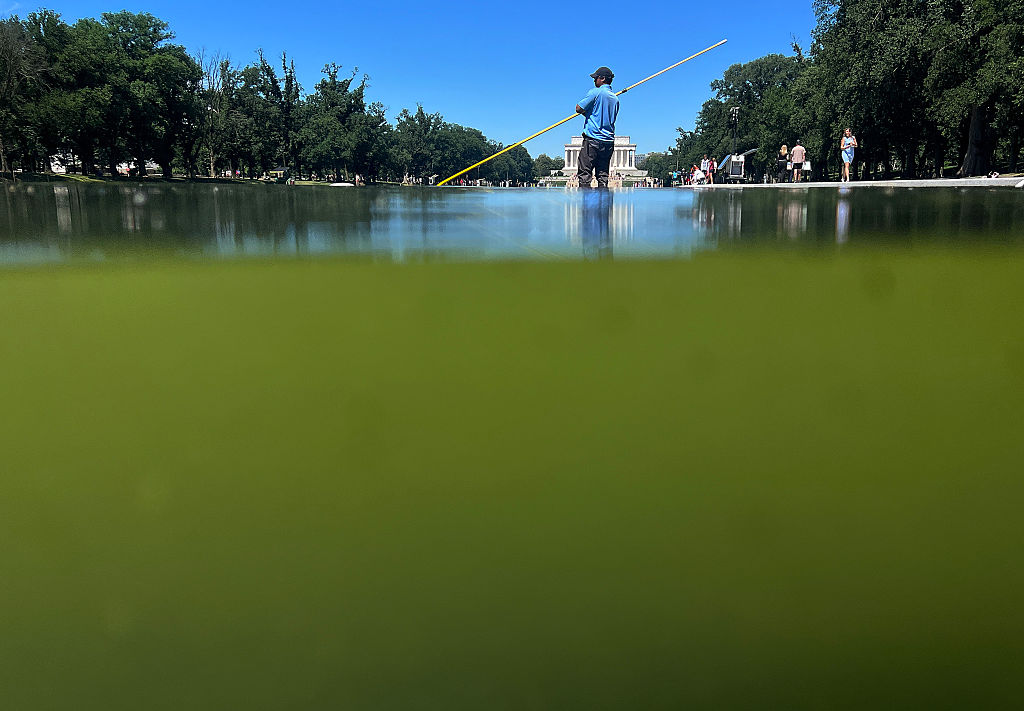
Water has a way of telling the truth, even when human public relations campaigns try to dictate the narrative. When the reflecting pool at the Trump International Hotel in Washington, D.C.—a property that once symbolized a specific brand of golden, high-gloss patriotism—was first unveiled, it was promised to be a pristine shade of "American flag blue." It was a deliberate choice, a color meant to evoke strength, purity, and exceptionalism. But water left to stagnant reality undergoes a chemical transformation that no amount of branding can arrest. Over time, the brilliant blue dissolved into a thick, murky, boggish green.
The shift from a carefully manufactured patriotic hue to a stagnant pond is more than a failure of facility maintenance. It is a physical manifestation of what happens when the optics of leadership clash with the grueling, unglamorous work of upkeep.
Consider a hypothetical groundskeeper assigned to a property of this scale. Let us call him Arthur. Arthur knows that water is alive. He understands that a reflecting pool is not a static painting; it is an ecosystem fighting against nature. To keep a pool looking like a slice of the American flag requires constant vigilance. It demands functioning filtration systems, the precise application of chemicals, consistent skimming of debris, and an underlying infrastructure that works tirelessly behind the scenes.
When the pumps stop humming, nature moves back in.
Algae does not wait for permission. It thrives on neglect. The moment the filtration slows, microscopic spores find a home in the standing water, feeding on the intense summer heat and the sunlight. Within days, the crisp blue tint—often achieved through artificial dyes or specific lining materials—is overwhelmed by a chlorophyll explosion. The water thickens. It loses its transparency. The reflection of the grand architecture above becomes warped, distorted by a layer of scum that sits heavily on the surface.
For the passersby looking through the iron gates, the sight brings a sudden, sharp realization. The contrast between the promised luxury and the green reality is jarring. It forces a question that goes beyond the perimeter of a hotel property: how much of what we are sold is just a coat of paint?
The psychology of color in public spaces is a powerful tool. True blue is a color associated with stability, trust, and order. It is the color of authority and calm. Green, in its natural state, represents life and growth. But boggish, stagnant green is different. It is the color of decay, of standing still, of things forgotten in the dark. When a symbol designed to project power turns into a breeding ground for mosquitoes, the message flips entirely. The illusion breaks.
But the real problem lies elsewhere, far deeper than a clogged filter or a broken pump.
This transformation speaks to a broader human habit of prioritizing the launch over the legacy. We see it in corporate boardrooms, in civic projects, and in our own personal lives. It is easy to cut a ribbon. It is thrilling to announce a grand vision with a splash of vibrant color and a crowd of cheering onlookers. The initial splash gets the headlines. It captures the imagination.
The next day, however, the crowd leaves. The cameras are packed away into black canvas bags. The speeches end, and all that remains is the quiet, relentless passage of time.
True authority is found in the maintenance. It is found in the invisible routines that nobody applauds. The tragedy of the green pool is that it exposes a fundamental truth about human endeavors: without a commitment to the daily grind of preservation, even the most aggressively promoted symbols will eventually succumb to the elements.
This is not a phenomenon unique to one specific property or one political figure. Walk through any aging city and you will see the ghosts of grand promises. You will find oxidized copper statues bleeding green streaks down stone pedestals, fountains filled with dead leaves and concrete cracks, and plaques commemorating historic achievements that are now illegible under a layer of grime. We are a species obsessed with building, but we are chronically allergic to maintaining.
The human cost of this neglect is a slow erosion of trust. When citizens, visitors, or customers are repeatedly promised a standard of excellence and are instead presented with a swamp, a quiet cynicism sets in. People begin to expect the decay. They look at a new project not with excitement, but with a calculated countdown toward its eventual abandonment.
Think about the children looking through that fence. They do not understand the complex financial structures, the political battles, or the branding strategies associated with the name on the building. They simply see a pool that looks dirty. They see a place where they wouldn't want to drop a coin or dip a finger. Their immediate, unvarnished reaction is one of disappointment.
Fixing a stagnant pool is not a mystery. It does not require a breakthrough in modern science. The solution is remarkably simple, grounded in basic plumbing and chemistry. You flush the stagnant water. You scrub the algae from the concrete walls. You repair the mechanical heart of the system so that oxygen can circulate, preventing the suffocating stillness that allowed the green to take over in the first place. You commit to the work.
But that requires turning the focus away from the cameras and toward the pipes. It requires acknowledging that the initial promise was not self-sustaining.
As the afternoon shadows lengthen across the pavement, the green water catches the final rays of the sun, casting an unhealthy, dull glow against the stone facade. A single plastic bottle floats lazily near the edge, trapped in a patch of duckweed. The grand vision remains etched in the promotional materials, crisp and unchanging on glossy paper. On the ground, the water remains still, heavy, and stubbornly green, a quiet reminder that nature always bats last when the caretakers walk away.