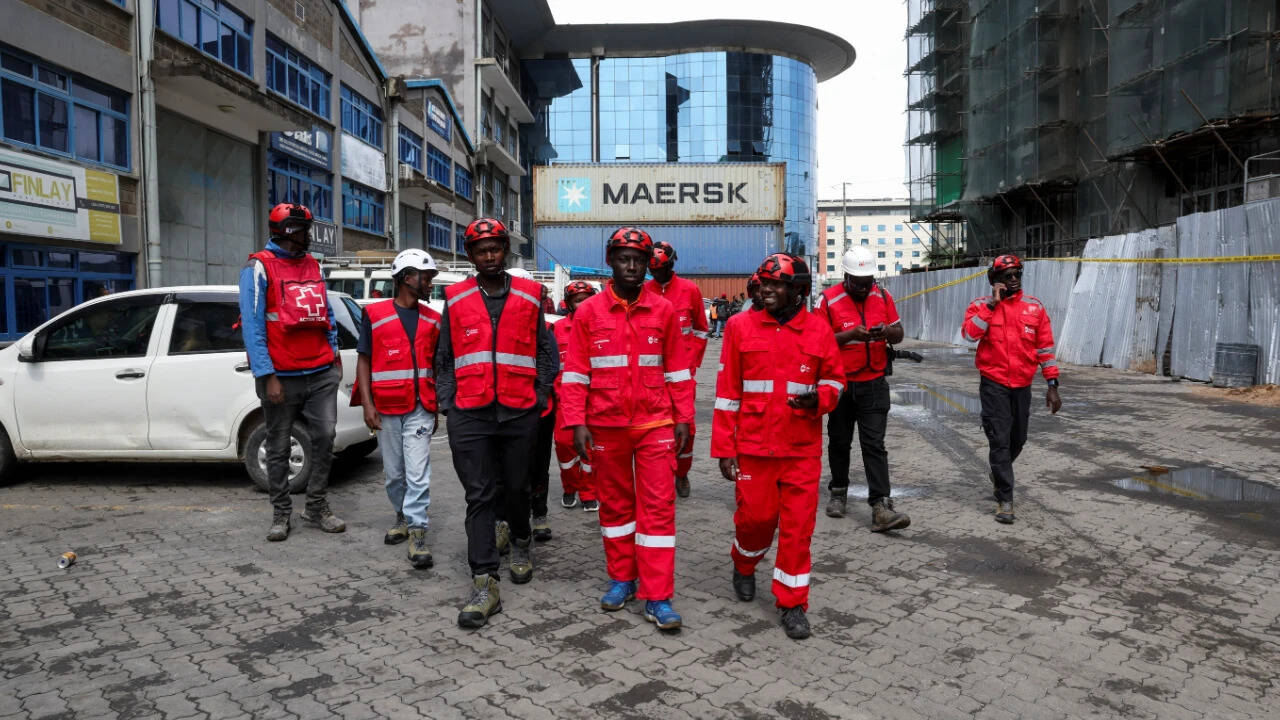
At 9:51 a.m. on a Friday morning in Syokimau, the air along the access road to the Standard Gauge Railway terminus smelled of diesel exhaust, wet cement, and dust. One minute later, at 9:52 a.m., the sound of eight stories of freshly poured concrete failing all at once drowned out the morning traffic on the Nairobi–Mombasa highway.
Silence followed. Then came the screaming. Meanwhile, you can explore related stories here: Inside the Tunisia Insect Farming Crisis Nobody is Talking About.
By the time the Nairobi City County fire teams, the Kenya Red Cross, and specialized Urban Search and Rescue units had stretched yellow cordon tape around the jagged mountain of rebar and pulverized stone, six people were dead. Five others were pulled alive from the gray haze, bleeding, broken, and coated in the very mortar they had been paid a daily wage to mix.
If you read the standard wire reports about November 13, 2026, you get the tidy arithmetic of tragedy: six dead, five rescued, an unfinished eight-story building in Syokimau, a brief mention of a similar collapse three weeks earlier in Eastleigh. The numbers sit neatly on the screen. They do not cough up limestone dust. They do not wait outside a hospital ward in Machakos or Nairobi clutching a worker's worn National ID card. To explore the bigger picture, we recommend the excellent report by USA Today.
To understand why buildings keep folding like wet cardboard on the outskirts of Kenya's capital, you have to step past the cordon tape and look at the invisible math happening inside the concrete.
The Anatomy of a Morning Shift
Consider a hypothetical mason—let us call him David—arriving at a site like Syokimau at seven in the morning. David does not have a salaried contract, a pension, or an engineering degree. He has a trowel, a pair of worn boots, and a family counting on the thousand or fifteen hundred shillings he will earn before dusk. When David climbs the wooden scaffolding to the seventh or eighth floor, he is placing absolute, blind faith in the men who stood on the ground floor six months earlier.
He is trusting that the foundation trenches were dug down to solid bedrock rather than resting on the treacherous black cotton soil that swells and shrinks with every rainy season across the Athi plains. He is trusting that the steel reinforcement bars inside the columns are thick enough to hold the crushing weight above his head, and that the concrete poured last week was allowed enough days to cure before the next heavy slab was stacked on top of it.
A building does not fail out of malice. It fails because of physics.
Think of a multi-story concrete frame like a human skeleton standing upright while carrying an increasingly heavy backpack. The steel rebar acts like the tendons and ligaments, absorbing tension and keeping the limbs from snapping outward when the wind blows or the ground shifts. The concrete acts like the bone, resisting the downward crush of gravity. If you water down the cement mixture to stretch a budget, you are giving that skeleton brittle bones. If you swap out high-tensile steel for thinner, cheaper rods, you are replacing thick tendons with sewing thread.
At first, nothing happens. The first three floors go up. The developer sees a return on investment taking shape against the sky. Four floors. Five floors. Six. The skeleton holds, groaning silently in microscopic fractures hidden behind fresh plaster. Then, on a Friday morning at 9:52 a.m., someone pours one more slab, or a heavy vibrator rattles the formwork on the eighth floor. One compromised column on the ground floor buckles by a fraction of an inch.
Gravity does the rest in under four seconds.
Three Weeks Between Funerals
What makes the Syokimau collapse impossible to dismiss as a freak accident is the calendar.
Just twenty-one days earlier, on Friday, October 23, 2026, another under-construction high-rise in Nairobi's densely packed Eastleigh neighborhood gave way, killing eight people. Between January and mid-November of 2026 alone, Kenya recorded twenty-five separate building collapses, claiming thirty-eight lives.
Twenty-five collapses. That is roughly one every twelve days.
Anyone who has walked through Nairobi's booming satellite towns over the last decade has felt the frantic, breathless pace of this real estate gold rush. Places like Syokimau, Mlolongo, Ruaka, and Kitengela were once quiet stretches of scrubland and commuter outskirts. Today, they are forests of cranes and raw gray concrete. Driven by a massive housing deficit and the magnetic pull of new infrastructure like the expressway and the Standard Gauge Railway terminus, land prices surged.
Suddenly, building a four-story apartment block no longer made financial sense to impatient investors. To maximize rent per square foot, four stories became eight. Eight became twelve. Twelve became eighteen.
I have stood on the dusty perimeters of half-built sites along the Mombasa Road corridor and watched the quiet corners being cut in broad daylight. You see bags of cement stacked directly on damp earth, losing their binding strength before they ever touch water. You see aggregates—the crushed stone and sand mixed into concrete—delivered unwashed, coated in silt and clay that prevent the cement paste from gripping the rock. Ask a site foreman about curing times, and you will often get a weary shrug. Every day a building sits idle waiting for concrete to reach its full twenty-eight-day strength is a day the developer is paying interest on a bank loan without collecting rent.
Speed becomes currency. Safety becomes overhead.
The Paper Shield of Oversight
Whenever the dust settles and the cameras arrive—as they did when Mavoko Member of Parliament Patrick Makau posted on social media that "every second counts" during the Syokimau rescue—the conversation turns immediately to regulation.
On paper, Kenya does not lack laws. To put up an eight-story structure legally, a developer must navigate a labyrinth of approvals from the county government, the National Construction Authority, and the National Environment Management Authority. Registered architects must sign off on the drawings. Structural engineers must calculate the loads. Quantity surveyors must cost the materials.
Yet the Kenya Institute for Public Policy Research and Analysis, a state-run research body, has repeatedly pointed to the exact same four culprits behind these disasters: poor workmanship, substandard materials, faulty structural designs, and weak supervision.
How do all four slip past a system built specifically to stop them?
The gap lives between the blueprint and the building site. In a troubling number of projects, a developer pays a qualified engineer to stamp the initial plans so the county council will issue a permit. Once the permit is taped to the gate, the qualified engineer is dismissed to save fees. An unqualified contractor—or the developer himself—takes over daily supervision. If the approved blueprint calls for twenty-millimeter steel bars in the load-bearing columns, the person buying the materials quietly downgrades them to sixteen-millimeter bars to shave a few hundred thousand shillings off the hardware bill.
Inspectors from municipal offices and national authorities are stretched thin across thousands of active sites sprawling outward from Nairobi. Worse, corruption acts as a solvent that dissolves the enforcement chain. A quiet handshake at the gate turns a red "stop work" notice into a mild suggestion. Work continues at night or behind high corrugated-iron sheets, shielded from public view until the structure grows too heavy for its own bones.
The Invisible Stakes of Who Survives
There is a grim, unspoken class divide built into Kenya's construction crisis.
When an unfinished building collapses during working hours, the people buried beneath the rubble are almost exclusively casual laborers. They are the young men and women who mixed the mortar, carried the blocks, and tied the steel. They rarely appear on formal employment registries. When rescue teams dig through the pancaked slabs—lifting tons of broken concrete with hydraulic jacks and bare hands—officials often struggle just to confirm how many people were actually inside when the floor dropped.
Meanwhile, the people who commissioned the shortcuts rarely set foot on the upper scaffolding.
And what of the buildings that do not collapse during construction? That is the question that keeps structural engineers awake at night. A poorly built apartment block that survives its final coat of paint does not suddenly become safe. It simply becomes a ticking clock occupied by families, children, and small shopkeepers who assume that a tiled lobby and fresh exterior paint equal structural integrity. History in Nairobi has shown us what happens when occupied residential buildings fail—the horror of Huruma in 2016, where fifty-one people died after heavy rains undermined a substandard tenement, or the school collapse in Dagoretti that killed eight children.
We tend to look at a building collapse as a sudden, violent event. In reality, it is a slow crime committed in increments—one watered-down bag of cement, one skipped inspection, one unapproved extra floor at a time.
Breaking the Cycle Before the Next Pour
It is easy to feel helpless watching the cycle repeat every few weeks: the sirens, the yellow tape, the promises of stern action, and then the quiet return to business as usual. Knowing how deeply profit motives and weak enforcement are entangled makes any quick fix sound naive.
Yet the engineering world already knows how to stop buildings from falling down. There is no mystery in structural mechanics.
First, accountability has to become personal and inescapable. When a structure fails, criminal prosecution cannot stop at a low-level site foreman while the property owner and the engineer whose stamp authorized the project disappear behind shell companies. In jurisdictions that have curbed construction fatalities, mandatory professional indemnity insurance and strict criminal liability force engineers and owners to police their own sites—because a single collapse means financial ruin and prison.
Second, digital transparency can strip away the secrecy behind corrugated-iron fences. Imagine if every active construction site in Nairobi and Machakos counties were required to display a weather-proof QR code at the gate, linked directly to a public National Construction Authority database. Any worker, neighbor, or passing journalist could scan that code on a basic smartphone to see the approved number of floors, the name of the supervising structural engineer, and the date of the last mandatory concrete strength test. If the sign says five floors and the workers are pouring the eighth, the violation is visible to everyone on the street before the concrete even sets.
Finally, independent material testing must happen on-site, unannounced, using core-drilling and ultrasonic pulse velocity tools that test actual hardened columns rather than trusting paper receipts from a hardware supplier.
Until those walls of accountability go up, the men and women climbing the wooden ladders in Syokimau, Eastleigh, and a hundred other booming neighborhoods will keep making the same silent bargain every morning at seven o'clock.
Somewhere along the Mombasa Road corridor tonight, under the glare of floodlights, a fresh batch of wet cement is being poured into wooden forms, eight stories above the dark earth, waiting to see if it will hold.