The silence in Myanmar’s capital does not feel like peace. It feels like a breath held too long.
Driving down a twenty-lane highway with absolutely no other cars in sight does something strange to your perception of reality. The tarmac stretches out like a black desert, built to handle massive military parades or perhaps a sudden invasion, but today it plays host only to the shimmering heat distortion of the afternoon sun. This is Naypyidaw. A city constructed from scratch in the mid-2000s by a secretive military junta that decided, almost overnight, to abandon the historic, bustling coastal hub of Yangon. They carved this surreal metropolis out of sugar cane fields and scrub jungle, spending billions of dollars to build an artificial oasis of grand monuments, luxury hotels, and cavernous government buildings.
Yet, nobody lives here. Not really. The official statistics claim a population over one million, but walk the streets and the numbers crumble into myth. The sprawling villas zoned for government officials sit behind high walls, silent. The massive shopping malls host more security guards than shoppers. It is a city designed for control, not for community.
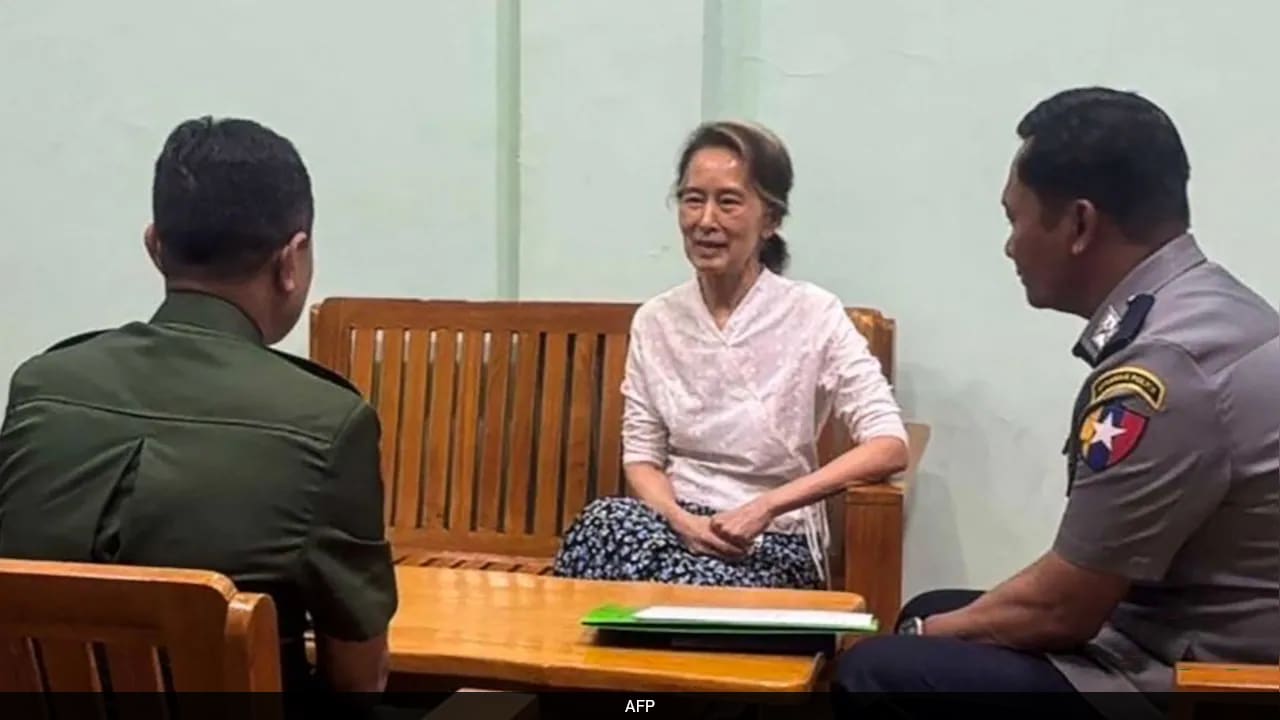
And somewhere within this concrete labyrinth of isolation, Aung San Suu Kyi is fading from the world.
To understand the tragedy of modern Myanmar, you have to look past the political communiqués and stand in the dust of this ghost capital. The city was designed specifically to isolate the rulers from the ruled, making the government immune to the popular uprisings that regularly shook Yangon. If a protest erupts in a traditional city, the streets choke with people, blocks are gridlocked, and the sheer human mass becomes a political force. In Naypyidaw, a crowd of ten thousand would be swallowed whole by a single intersection, easily surrounded by mechanized infantry before they could even march past a single ministry building.
This architecture of isolation became the ultimate trap. When the military launched its coup in February 2021, arresting Suu Kyi and overturning the democratic elections, they didn’t have to spirit her away to a remote island fortress. They just kept her here. In a city that is itself a cage.
Consider the sheer scale of the disconnect. In Yangon, life is loud. It smells of frying garlic, diesel exhaust, and wet monsoon earth. Monks weave through early morning markets, and the tea shops hum with political gossip whispered over sweet, condensed-milk brew. Yangon is alive, messy, and deeply human. Naypyidaw, by contrast, smells of nothing but hot concrete and freshly watered golf courses. The military generals built a replication of a modern city without understanding that a city requires a soul. They built a stage set, stepped onto it, and pulled the curtains shut on the rest of the population.
For the traveler who ventures here, the experience induces a form of low-grade vertigo. You check into a hotel that looks like a palace, featuring glittering chandeliers and marble floors, only to find you are the sole guest. The staff outnumbers you ten to one, standing in hushed clusters, their footsteps echoing down corridors that feel miles long. When you ask about the destination of the main road, or where the heart of the town is, the answers are polite but entirely hollow. "The ministries are that way," they say, gesturing toward a horizon of identical blue-roofed compounds.
Everything is zoned by hierarchy. The military elite live in one sector, civil servants in another, foreign diplomats kept at a careful distance. It is a physical manifestation of a caste system, frozen in cement.
But a city built on fear cannot escape it. The paranoia of the regime is baked into every monument. The Uppatasanti Pagoda, a massive golden dome that dominates the skyline, is an almost exact replica of Yangon’s ancient, sacred Shwedagon Pagoda. But while Shwedagon is built on a natural hill and feels rooted in the spiritual marrow of the country, Uppatasanti is built on an artificial mound, hollow and cold. It is an exercise in manufactured legitimacy. The generals even imported white elephants, traditional symbols of royal power, keeping them in a shaded pavilion nearby. The majestic beasts pace back and forth on short chains, their tusks stained, looking as captive and out of place as the democracy the country briefly tasted.
The hunt for news of Suu Kyi in this environment feels like chasing smoke. In the years following her arrest, her trials were held in absolute secrecy inside a special court constructed within the capital's sprawling prison complex. No journalists were permitted. Her lawyers were slapped with gag orders, forbidden from speaking to the public or the press. The woman who once drew crowds of hundreds of thousands, whose voice could mobilize an entire generation, was systematically reduced to a series of legal line items issued by state-run media. Nineteen cases. Thirty-three years of initial sentences, later shaved down slightly in a cynical show of clemency.
The silence from her compound is deafening. Rumors filter out occasionally through diplomatic channels or underground networks—whispers about her failing health, her dental problems, her isolation from medical care—but nothing can be verified. The regime holds all the cards, and the capital is their vault.
The real tragedy is how this engineered isolation mirrors the fate of the country itself. Myanmar’s brief decade of openness, from roughly 2011 to 2021, felt like a awakening. Cell phones, once a multi-thousand-dollar luxury controlled by the state, suddenly became ubiquitous. Young people in Yangon and Mandalay learned to code, started indie rock bands, and engaged in open political debates on Facebook. The economy surged. The world knocked on the door, and Myanmar answered with vibrant enthusiasm.
All of that was pulled back into the shadows. Today, the internet is heavily censored, VPNs are criminalized, and the economy is in freefall. The young people who once dreamed of tech startups are now hiding in the jungles along the Thai border, learning how to clean automatic rifles as part of the People's Defence Forces. The middle ground has been completely incinerated.
As you leave Naypyidaw, heading back toward the chaotic, broken, yet resilient reality of Yangon, you pass one final military checkpoint. The soldiers look young, tired, and deeply suspicious. They search the car with practiced monotony, looking for weapons, underground newspapers, or anything that threatens the fragile illusion of control.
Behind them, the twenty-lane highway vanishes into the haze, completely empty. The sun sets behind the artificial hills, casting long, distorted shadows across the empty pavement. The generals remain up there in their fortress, surrounded by miles of empty space, convinced that they have secured their victory because they have silenced the room. They do not see that a city without people is just a tomb, and a nation ruled entirely by fear is a fire waiting for a spark.