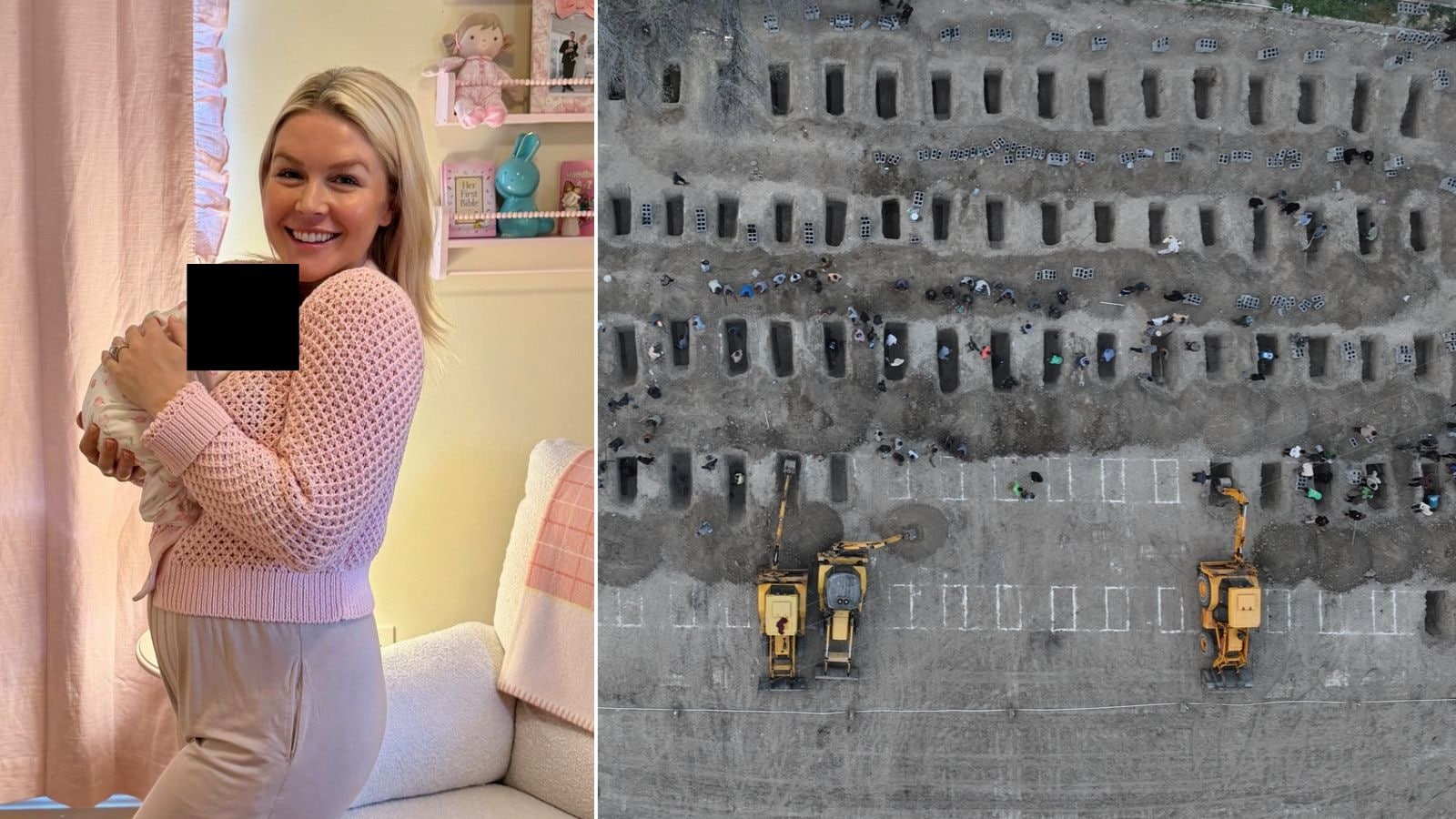
The light in a nursery is different from the light in a war room. In a nursery, the glow is soft, filtered through cotton curtains and the promise of a life just beginning. In a war room, the light is cold, blue, and sharp, reflecting off monitors that track the movement of drones and the shifting boundaries of geopolitical chess. These two worlds are never supposed to touch. One is built on the fragile hope of the future; the other is forged in the hard realities of the past.
When Karoline Leavitt, the White House Press Secretary, shared the news of her newborn child, the world briefly paused to acknowledge a universal human milestone. A birth is a rare moment of bipartisan grace. It is a biological victory. But for the Iranian government, this intimate moment of American domestic joy was not a reason for celebration. It was a tactical opening.
They looked at the image of a sleeping infant and saw a weapon of rhetoric.
The Mathematics of Grief
In the city of Minab, located in the southern reaches of Iran, the air carries the scent of date palms and the humidity of the Persian Gulf. It is a place far removed from the briefing room of the White House. Yet, the Iranian Foreign Ministry bridged that distance with a single, chilling statement. They didn't send congratulations. They sent a reminder of the 168.
These 168 were children too.
They were referring to the casualties of Flight 655, a civilian airliner shot down by the USS Vincennes in 1988. It is a wound that has never closed in the Iranian psyche. By invoking this tragedy in response to Leavitt’s baby news, the Iranian state apparatus attempted to create a moral equivalence between a modern birth and a historical massacre. They wanted to strip the "human" from the human interest story.
This is how modern propaganda functions. It doesn't just argue; it hijacks. It takes the most vulnerable, sacred aspects of the human experience—the birth of a child—and uses it as a mirror to reflect historical trauma. It is a deliberate attempt to ensure that no American official can ever be seen as just a parent. They must always be seen as the face of a machine.
The Invisible Stakes of a Nursery Photo
Consider the psychological weight of this exchange. On one side, you have a young mother navigating the grueling demands of a high-pressure career while caring for a literal new life. On the other, you have a state-run social media machine that views that mother’s joy as an affront to their historical suffering.
The stakes are not just political. They are deeply, uncomfortably personal.
When a government targets an individual’s family life, they are attempting to break the barrier between the office and the person. They are saying: You have no private joy that we cannot touch. It is a form of digital haunting. They want the ghost of Minab to sit in the corner of that well-lit nursery in Washington.
Imagine, for a moment, the perspective of a citizen in Minab today. They live in a country where the memory of 1988 is curated and sharpened by the state. They are taught that the West sees their children as statistics, as "collateral damage" in a larger game of containment. When they see their leaders lash out at an American Press Secretary, they aren't seeing a diplomatic faux pas. They are seeing a defense of their own lost sons and daughters.
The tragedy is that both sides are trapped in a loop of perceived inhumanity. The American public sees the Iranian comment as a cruel, classless attack on a new mother. The Iranian hardliners see the American celebration as a callous display of privilege by a nation that has never fully apologized for the blood in the water of the Strait of Hormuz.
The Architecture of the Grudge
Grudges of this magnitude are not built overnight. They are engineered. They require constant maintenance.
The shooting down of Flight 655 was a catastrophic error of the Aegis combat system, a failure of technology and human judgment that resulted in 290 deaths. Among them, those 168 children. The United States eventually expressed "deep regret" and paid over $60 million in compensation, but a formal, televised apology never came.
In the world of international relations, an apology is more than words. It is a transfer of power.
Because that transfer never happened to the satisfaction of the Iranian state, the event has been fossilized. It is pulled out of the cabinet whenever the United States claims the moral high ground. By targeting Leavitt, Iran is attempting to perform a sort of "moral audit." They are asking the world: Why is this one baby’s life a headline, while our 168 are a footnote?
It is a powerful question. It is also a cynical one.
Using a living, breathing infant as a prop to score points on X (formerly Twitter) does nothing to honor the dead of 168. It only ensures that the cycle of bitterness continues. It turns the memory of those children into a recurring debit in a geopolitical ledger. It prevents healing because healing would mean the loss of a potent political tool.
The Human Shield of Rhetoric
There is a specific kind of exhaustion that comes with being the target of a state-level grievance. Karoline Leavitt is the youngest person to ever hold her position. She is already a lightning rod for domestic criticism, a role she accepted when she took the job. But she did not sign up to have her child’s birth used as a rebuttal for a tragedy that occurred before she was even born.
This is the "human-centric" reality of 21st-century diplomacy. The internet has removed the buffers. In the past, a foreign ministry might issue a stern communiqué to the State Department. Today, they post directly to the timeline of a woman who is likely still counting the hours between feedings.
The cruelty is the point.
By aiming at the nursery, the Iranian government is signaling that there are no "non-combatants" in the information war. Everyone is a target. Everything is fair game. Even the quiet, rhythmic breathing of a newborn.
The Echo in the Briefing Room
When Leavitt stands behind that famous podium, she isn't just speaking for a President. She is representing an entire narrative of American exceptionalism, power, and, occasionally, fallibility. The Iranian response is a reminder that the rest of the world has a very long memory.
They remember the mistakes. They archive the errors. They wait for a moment of vulnerability—a moment of human warmth—to strike.
But what happens if we refuse the bait?
What happens if we recognize that the grief of a mother in Minab in 1988 and the joy of a mother in D.C. in 2024 are not competing forces? They are the same force. They are the same pulse. The tragedy of Flight 655 is real. The innocence of a new child is real. One does not negate the other.
The Iranian government wants us to choose. They want us to believe that to care about one, we must dismiss the other. They want to turn human empathy into a zero-sum game.
A Final Image
Picture a map. Not a map of borders or oil fields, but a map of heartbeats.
On one side of the world, a woman is rocking a cradle, wondering what kind of world her child will inherit. On the other side, a family sits in the shade of a palm tree, still feeling the empty space where a child should have been for nearly forty years.
The politicians and the press secretaries and the foreign ministers want to draw lines between these two scenes. They want to build walls of text and barricades of "whataboutism." They want to convince us that the nursery and the war room are the same place.
But they aren't.
The nursery is the only place where the future can actually begin. The war room is where the past goes to repeat itself. As long as we allow the ghosts of 1988 to be used as weapons against the babies of today, we are all just residents of the war room, staring at the blue light, waiting for the next move in a game that no one is ever going to win.
The baby sleeps, unaware that he is a focal point of a decades-old blood feud. He is the only one in this story who is truly free.