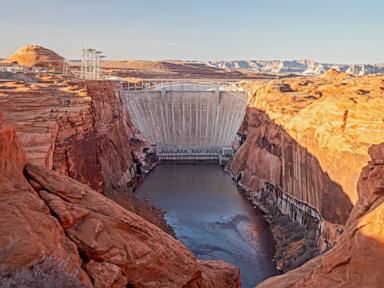
The silence of a dying reservoir doesn’t sound like a crash. It sounds like a whisper. It is the soft, hollow scraping of a fiberglass boat hull against bleached sandstone that, for decades, sat sixty feet beneath the surface of the American Southwest.
If you stand on the edge of Wahweap Marina today, the first thing that hits you isn't the heat. It is the scale of the white stripe. The locals call it the bathtub ring. A massive, chalky band of calcium carbonate deposits wraps around the red rock canyons of Lake Powell, marking exactly where the water used to be. It towers over you like a monument to a vanished civilization. Except it isn’t ancient history. It’s our water supply.
For generations, we treated the Colorado River like an infinite checkbook. We built cities in the desert, greened up golf courses in the blistering sun, and assumed the massive concrete wall of the Glen Canyon Dam would always hold back a reliable, deep blue inland sea. But the numbers coming out of the Bureau of Reclamation aren't just dry statistics anymore. They are a ticking clock.
Lake Powell has plummeted to its lowest level since it was filled in the 1960s. It is hovering dangerously close to 3,525 feet above sea level. To the casual tourist, that sounds like a meaningless abstract measurement. To the engineers who operate the dam, it is a threshold of absolute terror.
Let’s look at a hypothetical boat captain named Jim. He has run charter tours on this water for forty years. Jim used to navigate deep, wide channels with hundreds of feet of water beneath his keel. Today, he steers through tight, treacherous slot canyons that didn't exist a decade ago. Every week, new islands emerge from the depths like breaching whales. Entire slot canyons have been choked off by mud and silt. Jim isn't looking at charts anymore; he is watching the depth finder with white knuckles. If the water drops another twenty-five feet, his livelihood is over. The marinas will be completely stranded from the main body of water, left sitting on dry mud flats.
But Jim’s lost income is the least of our worries. The real crisis is happening inside the concrete heart of the dam itself.
Consider what happens next if the decline continues. At 3,490 feet, the reservoir hits what is known as minimum power pool. The massive turbines that generate electricity for millions of homes across Wyoming, Utah, Colorado, Nevada, Arizona, and New Mexico will begin to draw in air. They will cavitate, vibrate violently, and automatically shut down to prevent self-destruction. The grid loses enough clean, hydroelectric power to light up a major metropolis overnight.
And if it drops further? We enter the realm of dead pool.
Imagine a giant bathtub where the drain is located halfway up the wall. Once the water falls below the level of the intake penstocks, the water simply cannot flow through the dam anymore. The Colorado River, the lifeblood of 40 million people and billions of dollars of agriculture, would effectively stop.
How did we get here? It is easy to blame a single bad winter or a sudden heatwave. That is a comforting lie because it suggests a quick fix. The truth is far more unsettling. We are living through a twenty-four-year megadrought, the worst the region has seen in twelve centuries. But the drought is only the trigger; the underlying disease is our math.
The Colorado River Compact was signed in 1922. It allocated a specific amount of water to seven basin states based on data collected during what we now know was the wettest century in the last millennium. We legally divided up more water than the river actually produces. We have been overdrawing our account for a hundred years, and the bank is finally calling in the debt.
The crisis forces a brutal realization. You can feel the anxiety in the small towns that border the lake, places like Page, Arizona. In the local diners, conversation doesn't revolve around politics or sports. It revolves around the daily feet-above-sea-level metrics posted online. The people here understand a fundamental truth that city dwellers hundreds of miles away have luxury to ignore: you cannot drink money. You cannot irrigate fields with promises.
The solutions on the table are painful. They require massive, unprecedented cuts to water usage across the West. Farmers who have grown alfalfa for generations are being asked to leave their fields fallow. Cities are tearing up lawns and criminalizing ornamental grass. Yet, even as these measures roll out, the reservoir continues its slow, agonizing retreat.
Walk down one of the extended boat ramps that now stretches hundreds of feet past its original concrete terminus, tracking the receding shoreline into the mud. You can see rusted soda cans from the 1970s, dropped sunglasses, and forgotten anchors resting on the newly exposed dirt. The lake is coughing up its secrets, revealing the drowned canyons it swallowed when the dam was built.
It feels like watching a giant take its final, shallow breaths. The red rocks don't care about our legal frameworks, our political debates, or our desperate hope for a miracle snowpack in the Rockies. The stone simply records the truth in that stark, white ring.
As the sun sets, casting a deep crimson glow over the exposed mudbanks, the water reflects a sky that feels immense, beautiful, and utterly indifferent to our thirst. The river is reclaiming its old path, reminding us that nature always bats last. Each inch the water line drops isn't just a loss of volume. It is a slow, quiet unravelling of the American West.