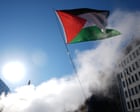
The shadow that has loomed over the Middle East for nearly four decades has finally lifted, but the vacuum it leaves behind is far from empty. On February 28, 2026, a joint U.S.-Israeli strike targeted the heart of the Islamic Republic’s power, killing Supreme Leader Ayatollah Ali Khamenei and dozens of top officials. This was not a mere tactical hit. It was a decapitation of the most sophisticated "deep state" ever constructed in the modern era. While many Western observers have spent years wondering how Khamenei transformed Iran from a revolutionary fervor into a regional juggernaut, the answer lies in a deliberate, cold-blooded restructuring of the state into a self-sustaining military-industrial complex that may now outlive its creator.
Khamenei’s true legacy is not found in his sermons or his poetry, but in the total militarization of the Iranian economy and the elevation of the Islamic Revolutionary Guard Corps (IRGC) from a ragtag militia into a sovereign entity that owns the country it supposedly serves. He didn't just rule Iran; he rewired its DNA to ensure that the "Supreme Leader" became a title supported by a massive, inescapable web of business interests, parallel intelligence agencies, and a "shadow fleet" of oil tankers that effectively rendered traditional diplomacy obsolete.
The Engineering of a Parallel State
When Khamenei took the mantle from Ayatollah Khomeini in 1989, he lacked his predecessor’s charismatic authority and religious credentials. He was a compromise candidate, a "minor" cleric thrust into a major role. To survive, he had to build a power base that didn't rely on holiness, but on cold, hard leverage.
He achieved this through the expansion of the Bonyads, nominally charitable foundations that evolved into multi-billion-dollar conglomerates. Under Khamenei, these entities—like the Bonyad-e Mostazafan (Foundation of the Oppressed)—became the primary vehicles for "clerical crony capitalism." They operate outside the reach of the civilian government, pay no taxes, and answer only to the Office of the Supreme Leader. By 2026, estimates suggested these foundations, alongside the IRGC, controlled upwards of 60% of Iran’s GDP.
This wasn't just corruption. It was a survival strategy. By embedding the military and his personal office into every sector from dam construction to telecommunications, Khamenei made the regime "coup-proof." If you wanted to build a road, buy a SIM card, or export fruit, you were, in some way, transacting with the Praetorian Guard. This created a class of "military-entrepreneurs" who had everything to lose if the system collapsed.
The IRGC as a Sovereign Corporation
The most significant transformation occurred within the IRGC itself. Under Khamenei, the Guard stopped being just a military wing and became a state within a state. He allowed them to develop their own intelligence branch—the IRGC Intelligence Organization—which eventually rivaled and often eclipsed the official Ministry of Intelligence.
This parallel structure ensured that no single point of failure could take down the system. Even as the 2026 strikes eliminated the high command, the IRGC's decentralized business units and provincial commands remained intact. They are the ones currently holding the line in Tehran, not the "Interim Leadership Council" mandated by the constitution. The Guards are no longer just protecting the revolution; they are protecting their balance sheets.
The Axis of Resistance as a Logistics Network
We often view Iran’s regional proxies—Hezbollah, the Houthis, and various Iraqi militias—through an ideological lens. But for Khamenei, the "Axis of Resistance" functioned as a sophisticated logistics and sanctions-evasion network.
- Drone Proliferation: Iran didn't just give drones to its allies; it turned them into local manufacturers, creating a redundant "threat web" that could function even if Tehran was under fire.
- The Shadow Fleet: Using a ghost fleet of aging tankers, the IRGC moved sanctioned oil across the globe, funding its regional ambitions with cash that never touched a Western bank.
- Technological Asymmetry: Khamenei prioritized low-cost, high-impact technology over conventional hardware. While the West focused on F-35s, Iran focused on cyber-warfare and swarming boat tactics in the Strait of Hormuz.
The Myth of the Reformist Opening
For decades, Western policymakers held onto the hope that "reformists" within the system would eventually moderate Iran’s stance. Khamenei spent his entire career systematically dismantling this possibility. He used the Guardian Council to vet every candidate for office, ensuring that "reform" was only ever a stylistic choice, never a structural one.
The 2022 Mahsa Amini protests and the subsequent 2025-2026 uprisings proved that the gap between the people and the state had become an abyss. Khamenei’s response was never to negotiate, but to "harden" the system. He replaced aging bureaucrats with younger, more radical IRGC veterans. The result is a governing class that has no memory of pre-revolutionary Iran and no interest in reintegration with the global community.
The Succession Crisis of 2026
The death of Khamenei has triggered a crisis because he was the sole arbiter between the various factions of the "military-bonyad complex." Without his final word, the competition for resources and authority among the IRGC leadership, the clerical elite in Qom, and the remaining political figures like Ali Larijani or Masoud Pezeshkian is turning into an internal cold war.
The Iranian Constitution points to a three-person council and an election within 50 days. But in a country currently under military strike and facing a massive internal uprising, the law is a secondary concern. The real question is whether the IRGC will allow a new cleric to take the throne, or if they will finally dispense with the "theocratic" veneer and move toward an explicit military junta.
The "Khamenei system" was designed to survive the loss of a leader, but it was not designed to survive the loss of its legitimacy and its commander at the same time. The infrastructure of control—the surveillance cameras in the subways, the Basij militias in every neighborhood, the internet kill-switches—remains active. But the man who held the remote is gone.
The irony of Khamenei’s transformation of Iran is that he made the state so resilient that it no longer needs a "Supreme Leader" to function. It only needs an enemy. As the joint U.S.-Israeli operation continues, the IRGC is likely to use the external threat to justify a total lockdown, effectively completing the transition from a "Republic" to a "Garrison State."
Would you like me to analyze the current composition of the IRGC's "Interim Security Directorate" and its impact on the 2026 succession?