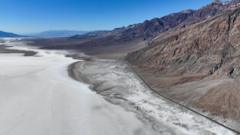
A 71-year-old French tourist died in Death Valley National Park after his vehicle became stuck in thick mud during a remote desert excursion, exposing the lethal combination of extreme geography, cellular dead zones, and a false sense of security provided by modern GPS mapping software. The incident, which unfolded far from the main tourist corridors, highlights a recurring hazard in America's most punishing national park: standard navigation tools frequently direct unsuspecting drivers onto primitive, unmaintained tracks that turn impassable during rare desert precipitation events.
Weather patterns in the Mojave Desert defy simple intuition. When rain arrives, it rarely brings gentle showers. Instead, cloudbursts unleash flash floods that transform dry lake beds and salt pans into treacherous mud pits. Heavy sedans and standard rental vehicles lack the ground clearance and four-wheel-drive capabilities required to navigate these environments. Once a vehicle's tires sink past the tread, the alkaline clay creates a vacuum effect, trapping rubber and metal with incredible suction. For a more detailed analysis into this area, we recommend: this related article.
Park rangers recover multiple stranded motorists every year, but survival statistics take a grim turn when drivers abandon their disabled vehicles to search for help. High temperatures, even during milder months, accelerate dehydration to dangerous levels. Walking out of the desert without adequate water supply or directional awareness is a fatal miscalculation.
The Navigation Trap
Standard consumer navigation applications prioritize distance and speed. They do not account for road surface quality, seasonal washouts, or the distinction between paved scenic byways and gravel mining tracks dating back to the nineteenth century. To get more information on this issue, detailed reporting can be read at Travel + Leisure.
When a driver inputs a remote destination into a smartphone, the algorithm frequently selects the most direct geographical vector. In Death Valley, that vector often crosses remote wilderness boundaries where mobile phone towers are entirely absent. A driver loses cellular connectivity miles before hitting trouble. When the car bogs down in the mud, the panic sets in. There is no signal to call emergency services, no passing traffic to flag down, and no immediate shelter from the punishing solar radiation.
Car rental agencies issue strict warnings regarding off-road driving, yet tourists frequently underestimate the definition of an unpaved road. A graded gravel road might seem manageable until a localized thunderstorm deposits inches of slurry across the path. The surface looks solid from a distance, but under the weight of a multi-ton vehicle, it acts like quicksand.
Environmental Extremes and Human Physiology
Death Valley is a paradox of scale and severity. Visitors accustomed to temperate climates fail to comprehend how quickly the human body deteriorates in arid heat.
The Illusion of Distance
Human depth perception fails entirely across flat desert expanses. A mountain range that looks two miles away might actually be twenty miles distant. Walking toward a perceived landmark under a relentless sun consumes vital moisture stores within hours.
Sweat evaporates so rapidly in the dry air that victims often fail to realize they are sweating until severe dehydration symptoms manifest. Dizziness, confusion, and cessation of perspiration follow quickly. Once cognitive function degrades due to heatstroke, rational decision-making becomes impossible. The victim abandons shade, walks in random directions, and exhausts their remaining energy reserves.
Search and rescue professionals emphasize a cardinal rule for desert survival. Stay with the vehicle.
A car provides shade, reflects heat, and acts as a massive visual marker for aerial search teams. A lone human being walking across a mud flat or salt pan blends seamlessly into the beige and gray tones of the desert floor, making them virtually invisible from a helicopter.
Infrastructure Gaps in National Parks
National Park Service administrators face a nearly impossible management challenge. Death Valley spans over three million acres. Monitoring every remote dirt track is financially and logistically unfeasible. Warning signs posted at main entry points are frequently ignored or missed by drivers distracted by the novelty of the landscape.
Cellular infrastructure inside the park remains intentionally limited to preserve the remote character of the wilderness and due to the sheer lack of commercial viability for telecom providers. While satellite emergency communication devices like personal locator beacons have become more affordable, the average international tourist rarely rents or purchases one before visiting a national park.
Rental car companies also bear a share of responsibility. While contracts forbid off-road use, vehicles rarely feature physical blockades, geofencing disablement, or mandatory satellite tracking that could alert authorities the moment a vehicle strays into restricted zones.
Preventing Future Tragedies
Mitigating these fatalities requires a systemic shift in how remote areas are marketed, mapped, and accessed.
Digital mapping companies must integrate real-time park service hazard data into their routing algorithms. If a route traverses a primitive backcountry road in an extreme environment, the software should require explicit user confirmation or block the route entirely during adverse weather warnings.
Rental agencies operating in gateway cities like Las Vegas need mandatory safety briefings for international travelers, utilizing visual aids that demonstrate the terrifying speed of desert weather changes and the deadly reality of alkaline mud.
Until these safeguards become universal standards, the vast expanses of the Mojave will continue to claim lives, reminding humanity that nature maintains absolute dominion over those who underestimate its silent margins.