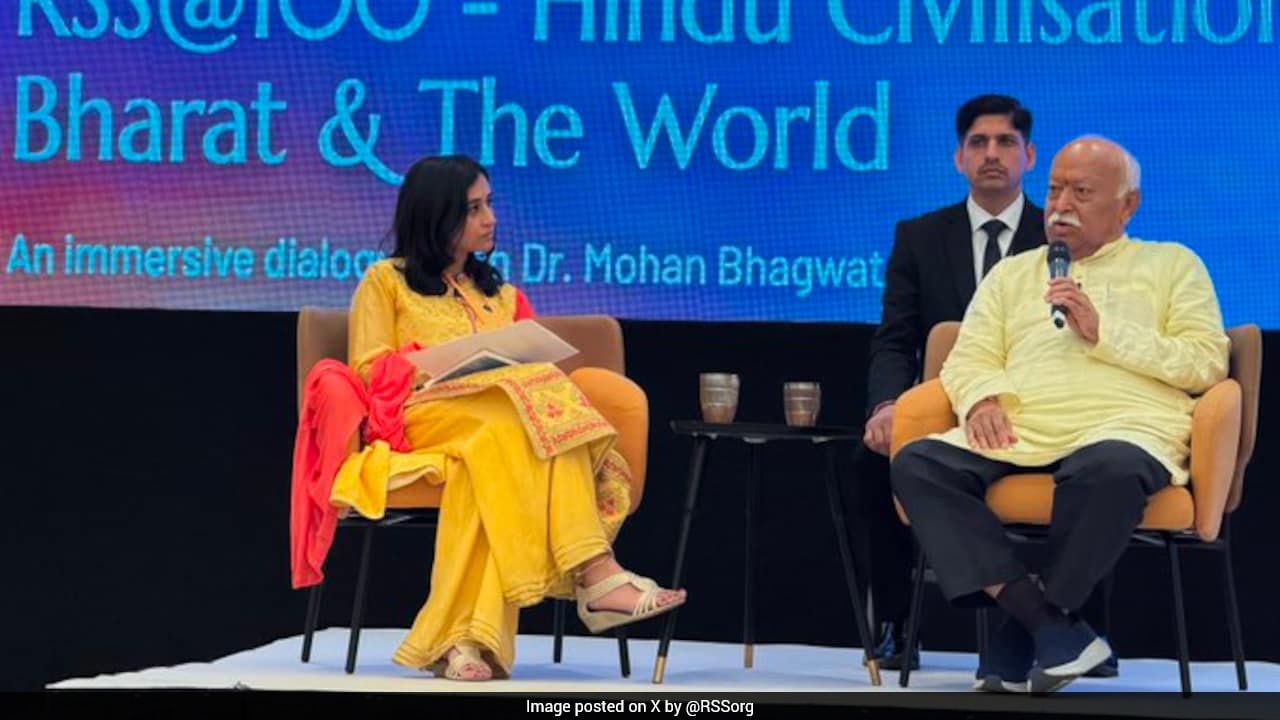
Mass ideological movements scale through emotional branding rather than policy documentation. When organizations cross international borders to justify their foundational mechanics, they execute a precise brand repositioning campaign. The recent discourse surrounding the centenary outreach of the Rashtriya Swayamsevak Sangh in London highlights a recurring operational necessity: translating domestic political friction into universal philosophical principles. Analyzing this strategy requires stripping away rhetorical flourishes to examine the structural mechanics of how large social networks manage reputational risk, build systemic loyalty, and project soft power across diaspora populations.
The Operational Mechanics of Belonging
Public-facing entities facing intense polarization rely on what operational strategists call emotional inversion. Critics frequently define the core driver of such organizations through the lens of exclusionary friction, targeting the mechanics of opposition. The organizational response characteristically bypasses defensive policy debates, substituting an alternative motivational vector labeled as pure, unconditioned affection—expressed in traditional nomenclature as shuddha saatvik prem and apnapan.
This conceptual pivot serves a distinct strategic purpose. By shifting the foundational input from political agitation to universal kinship, the organization alters its public cost-benefit equation.
- The inward-facing utility: Binds members through familial obligations, transforming an ideological commitment into an existential identity.
- The outward-facing utility: Disarms international critics by anchoring the movement's output in ecological harmony, coexistence, and non-antagonistic diversity.
This creates a self-sealing logic. Any external criticism regarding aggressive socio-political friction is categorized by the network as a fundamental misinterpretation of its underlying emotional baseline.
The Architectural Logic of Civilizational Identity
To understand how a decentralized network maintains coherence across global nodes, one must examine its core civilizational framework. The conceptual architecture relies on reconciling inherent societal diversity with a singular existential baseline. In strategic terms, this is an exercise in managing complex hierarchies without fracturing central command structures.
When leadership asserts that existence is fundamentally unified despite visible diversification, it constructs a philosophical umbrella broad enough to absorb internal contradictions.
[Underlying Unity] --> [Visible Diversification] --> [Coexistence Protocol]
This structural flow dictates that local variations in worship, thought, or lifestyle are not threats to the core system, but decorative elements of a single underlying reality. However, this model introduces a systemic vulnerability: the boundary between accepting diversity and enforcing a centralized definition of that unity remains persistently ambiguous. The strategic genius of the framework lies in leaving this boundary undefined, allowing local operators to project whichever interpretation suits their immediate demographic environment.
Generational Succession and Institutional Longevity
Centennial institutions face a critical operational bottleneck: institutional sclerosis. As organizations age, their leadership tiers accumulate operational caution, resulting in risk-averse behaviors that alienate younger cohorts. To counteract this decay function, senior leadership frequently pivots toward empowering newer demographics, provided those demographics operate within pre-set parameters.
Recent commentary regarding younger cohorts—specifically Generation Z and Generation Alpha—highlights a calculated shift in succession planning. The structural directive given to veteran leadership is stark: define the macro goal, but completely relinquish control over the micro methodology.
- Older tiers supply historical data, institutional memory, and accumulated risk assessments.
- Younger tiers supply unburdened execution speed, operational agility, and a lower threshold for friction.
This division of labor allows legacy organizations to harness the disruptive energy of youth without diluting foundational ideologies. By framing youthful dissent not as structural rebellion, but as a valid form of internal dialogue, the leadership neutralizes potential fractures before they can manifest into independent opposition movements.
Strategic Execution and Systemic Forecast
The international expansion of ideological networks into Western diaspora hubs is a calculated market-penetration play. By institutionalizing cultural touchpoints under the guise of civic dialogues and celebrations of oneness, these entities secure social license within foreign jurisdictions.
The forward trajectory of such movements depends entirely on their ability to maintain this dual-track positioning. As long as domestic political actions inside source nations align with the sanitized, universalist rhetoric presented on international stages, the brand equity will compound. If the friction between operational reality and philosophical branding widens beyond a tolerable threshold, the cost of maintaining this conceptual framework will escalate rapidly.
The ultimate strategic play for the organization involves codifying its decentralized local units into permanent cultural infrastructure abroad, ensuring that membership becomes an inherited social norm rather than an active political choice.