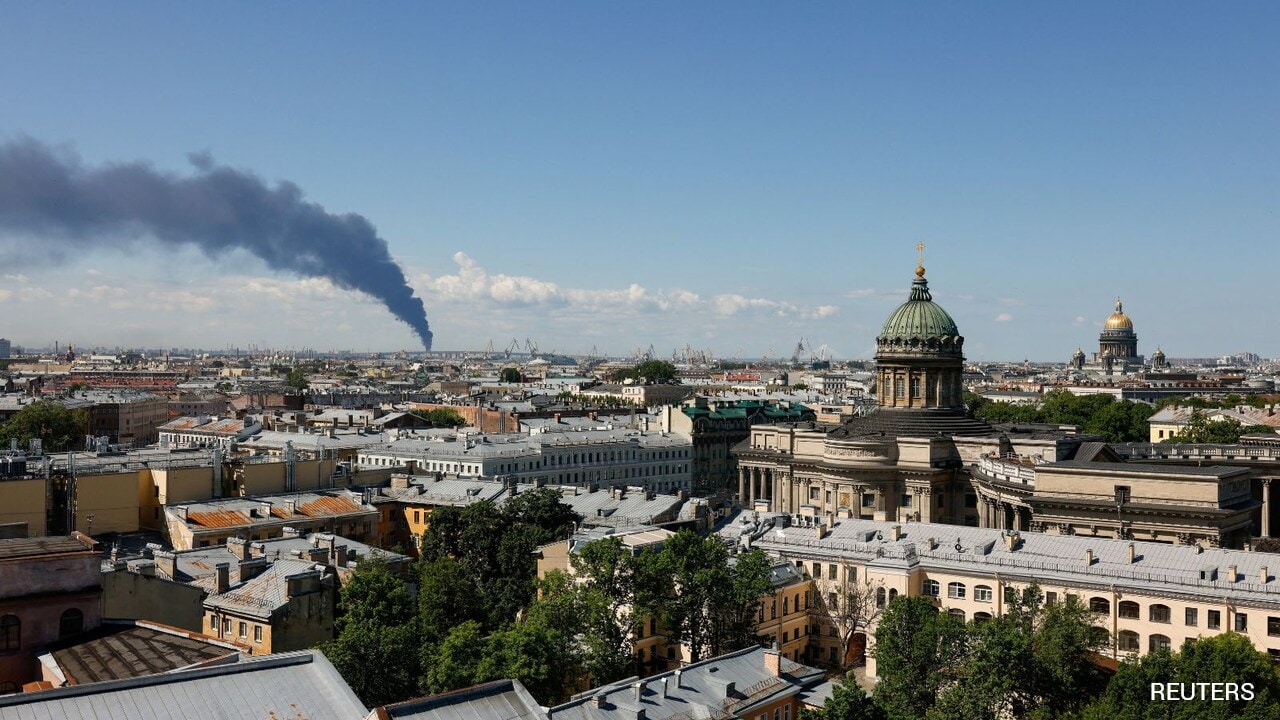
The interception of scores of Ukrainian uncrewed aerial vehicles (UAVs) over the Leningrad region underscores a structural shift in the geography of the war. By extending the operational envelope deeper into sovereign Russian territory, Ukraine is moving away from purely tactical battlefield interdiction toward a long-range attrition strategy. The primary mechanism of this campaign is not the immediate reclamation of territory, but the systematic degradation of Russian financial centers, energy logistics, and domestic political stability.
Evaluating this escalation requires a framework that looks beyond raw interception counts provided by local authorities. The true efficacy of these strikes is measured by the economic friction, operational displacement, and defensive resource diversion they impose on the state apparatus.
The Tri-Fold Strategic Framework of Deep Penetration Strikes
Long-range UAV operations over 1,000 kilometers from the Ukrainian border are governed by three primary strategic imperatives.
1. Macro-Economic Disruption of High-Value Infrastructure
The Leningrad region houses critical export nodes for Russian hydrocarbons, including major Baltic port facilities and refined oil complexes. Forcing operational shutdowns, even temporarily, acts as a direct tax on the state's primary revenue generation mechanism. When a strike hits an oil terminal, the real damage is not just the destroyed storage capacity, but the broader cascading costs:
- Demurrage Fees: Tankers delayed in port due to safety shutdowns accumulate significant hourly penalties.
- Insurance Premia: Maritime insurers adjust risk profiles for the Baltic zone, driving up shipping costs.
- Supply Chain Volatility: Localized shutdowns disrupt internal product pipelines, causing localized fuel price spikes or distribution bottlenecks.
2. Physical and Kinetic Diversion of Air Defense Assortments
To protect deep-theater assets like Saint Petersburg, the Russian Ministry of Defense must make difficult resource allocation tradeoffs. Deploying short- and medium-range air defense systems, such as the Pantsir-S1 or S-400 Triumf, to guard regional industrial centers directly depletes the inventory available to protect forces along the active 1,000-kilometer front line. Ukraine exploits this defensive asymmetry: cheap, mass-produced long-range strike drones force the expenditure of expensive, finite surface-to-air missile (SAM) interceptors or the repositioning of vital radar units.
3. Political Signalling and Psychological Contradiction
The Kremlin’s baseline narrative relies on keeping the conflict distant from major domestic population centers. Mass drone incursions into Russia's second-largest city break this insulation. Disruptions to local mobile internet networks (frequently deployed to jam UAV satellite navigation signals) and the grounding of commercial flights directly expose civilian populations to the reality of the war. Executing these strikes during high-profile diplomatic and investment events, like the Saint Petersburg International Economic Forum (SPIEF), imposes an acute reputational cost by demonstrating that the state cannot guarantee absolute security even within its premier economic showcases.
The Asymmetrical Cost Function of Drone Attrition
A rigorous evaluation of these air defense actions must weigh the economic inputs of the attacker against those of the defender. Air defense dynamics are inherently asymmetrical, favoring the attacker in high-volume, low-cost saturation campaigns.
The unit economics of a standard Ukrainian long-range strike UAV range between $20,000 and $50,000. These platforms are built using off-the-shelf components, commercial GPS guidance systems with inertial backup navigation, and fiberglass or carbon-fiber airframes powered by basic internal combustion engines.
Conversely, the cost function for the defending air defense network is multiple orders of magnitude higher. A single interceptor missile from a Pantsir-S1 system costs approximately $100,000, while larger S-300 or S-400 interceptors cost over $1 million per launch. When a saturation wave is deployed, the defender must engage every tracked inbound target to mitigate risk to high-value infrastructure.
$$Cost\ Asymmetry\ Ratio = \frac{\sum (Intercept\ Missiles \times Unit\ Cost) + Kinetic\ Collateral\ Damage}{\sum (Attacking\ UAVs \times Unit\ Cost)}$$
Even if Russian air defense forces achieve a 90% interception rate, the economic and operational math remains highly favorable to Ukraine. The 10% of platforms that penetrate defenses can inflict millions of dollars in structural damage to complex refining infrastructure, such as distillation columns, which cannot be quickly replaced due to import restrictions on industrial Western machinery.
Structural Bottlenecks and Systemic Air Defense Vulnerabilities
The expansion of the air war to the Baltic coast exposes several structural realities regarding the limits of dense air defense networks:
- Radar Horizon Limitations: Low-flying UAVs terrain-masking at altitudes below 100 meters exploit the curvature of the earth, drastically reducing the detection range of ground-based surveillance radars. This creates compressed engagement windows for terminal defense systems.
- Electronic Warfare Secondary Costs: Deploying high-power GPS jamming and spoofing across entire metropolitan areas to throw off drone guidance systems inflicts severe secondary economic damage. It disrupts commercial logistics, precision agriculture, maritime navigation in the Gulf of Finland, and local telecommunications infrastructure.
- Sensor Saturation: Early warning networks face cognitive and computational saturation when tracking hundreds of low-radar-cross-section targets simultaneously, creating opportunities for low-cost decoys to clear a path for armed strike platforms.
Strategic Forecast
Ukraine's long-range strike posture will likely continue to scale in volume and frequency. Rather than relying on sporadic, opportunistic strikes, Kyiv is moving toward highly structured, synchronized saturation waves designed to exhaust Russian air defense missile inventories ahead of seasonal shifting lines on the ground.
Russia's response will dictate the next phase of this dynamic. The state will be forced to choose between leaving critical industrial installations vulnerable or further stripping the front lines of kinetic protection systems. This tactical dilemma guarantees that the Leningrad region will remain an active, contested theater of the air war, irrespective of the geographic distance from the physical battlefields.