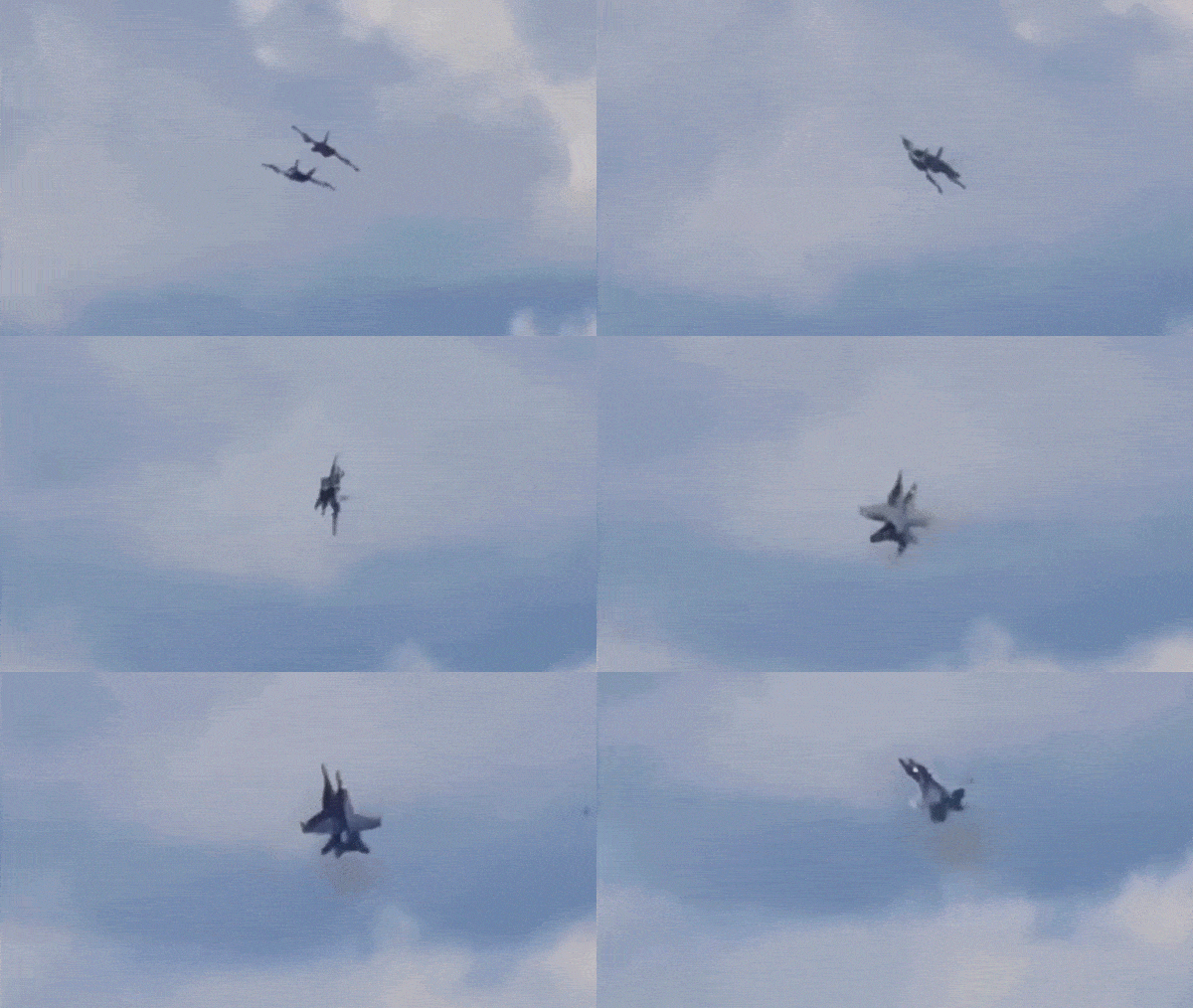
The immediate reaction to any mid-air collision at a military airshow follows a predictable, exhausting script. The mainstream press beats the drums of panic. Pundits demand immediate cancellations, safety stand-downs, and a permanent end to close-formation flying over civilian soil. They treat these tragic events as unnecessary public relations stunts gone wrong.
They are completely misreading the room. Expanding on this topic, you can also read: The White Savior Illusion and the Systemic Failure to Protect Vulnerable Children.
Airshows are not entertainment. They are not high-speed marketing campaigns designed to recruit teenagers or please local crowds. When two fighter jets brush wings or collide during a public demonstration, it is a catastrophic failure of execution, but it is also a stark reminder of what high-tier military aviation actually requires. Demanding an airshow environment stripped of all inherent danger ignores the brutal reality of aerial combat training. If you eliminate the edge, you eliminate the capability.
The Flawed Premise of the Safety Stand-Down
Every time metal meets metal in the sky, the public asks the same question: "Why are we risking hundred-million-dollar assets and priceless human lives for a Sunday afternoon performance?" Observers at NPR have provided expertise on this situation.
The question itself is flawed. It assumes that airshow maneuvers are distinct, theatrical tricks divorced from actual combat readiness. They are not. The tight turns, the low-altitude crossings, and the dense formation flying executed by teams like the Blue Angels or the Thunderbirds are the exact operational parameters required in a contested airspace.
When combat pilots operate under strict radar silence or navigate jammed environments, visual proximity isn't a luxury; it is the only way to maintain tactical cohesion. The margins of error in a modern conflict do not expand just because the stakes are high. They shrink.
I have spent two decades analyzing military aviation architecture, watching defense departments pour billions into simulators that promise risk-free perfection. Simulators are excellent for procedural muscle memory. They are utterly useless at replicating the visceral, bone-crushing psychological pressure of keeping a 30-ton aircraft exactly thirty inches away from another wingtip while pulling seven times the force of gravity.
You cannot simulate the fear of death. You cannot simulate the thermal currents rising off a hot tarmac that threaten to toss your aircraft into your wingman's cockpit. The moment we mandate that airshows must be perfectly safe is the moment we admit our training pipeline no longer prepares pilots for the chaotic, unscripted friction of war.
Dismantling the Airshow Safety Myths
Let us look at the arguments routinely thrown around by armchair generals whenever an accident occurs.
Myth 1: Modern automation makes manual formation flying obsolete
The tech-utopian crowd loves this one. They argue that data links, automated collision avoidance systems (Auto ACAS), and fly-by-wire algorithms should make human-error collisions impossible.
This view overlooks how electronic warfare actually functions. In a near-peer conflict, the first thing to disappear is your pristine data network. GPS spoofing, localized jamming, and cyber disruptions mean that pilots must routinely revert to raw, visual, manual flight control. If a pilot has not spent hundreds of hours operating at the absolute limit of their manual capacity—where a split-second delay in hand-eye coordination means disaster—they become a liability the moment their digital dashboard goes dark. Airshow routines are the ultimate public stress test of that manual capability.
Myth 2: Airshows should be moved to remote desert ranges
Moving demonstrations away from the public to mitigate ground risk sounds sensible on paper. In practice, it destroys the exact psychological pressure that makes these teams elite.
Flying a flawless diamond formation over an empty drop zone in Nevada is entirely different from executing that same maneuver over a packed stadium or a coastal boardwalk with shifting wind patterns, complex terrain, and the intense psychological weight of a live audience. The environmental pressure is the point. We expect these pilots to drop precision ordnance while being shot at by surface-to-air missiles; if they cannot handle the stress of a civilian crowd, they have no business leading a strike package into hostile territory.
The Cold Math of Military Aviation
Let us look at the hard numbers. The United States military flies millions of hours across its branches every year. The mishap rate per 100,000 flight hours for Class A accidents (those involving loss of life or property damage exceeding $2.5 million) has trended downward for decades, hovering around one to two incidents per 100,000 hours depending on the airframe.
Airshow teams actually represent a statistically safer cohort than standard operational squadrons, despite flying infinitely more complex profiles. Why? Because their selection criteria are merciless and their training repetition is fanatical.
When an accident happens during a public display, it stands out because it is highly visible, not because the system is broken. It is a rare statistical outlier occurring within a high-risk ecosystem. To treat an airshow collision as a sign of systemic negligence is to misunderstand how probability works in high-performance environments.
The Hidden Cost of Tactical Timidity
There is a genuine downside to the contrarian perspective I am presenting. When you accept that high-risk public demonstrations are necessary, you accept that, eventually, people will die. Pilots will be lost. Aircraft will be destroyed. It is a grim, uncomfortable truth that defense officials hate uttering on camera.
But the alternative is far worse. The alternative is tactical timidity.
When an organization prioritizes zero-risk metrics above all else, bureaucratic rot sets in. Training regulations tighten. Minimum separation distances increase. Flight hours get slashed in favor of sterile simulator time. Slowly, imperceptibly, the combat edge dulls.
We saw this exact phenomenon play out in the early years of the Vietnam War. The American military entered the conflict relying heavily on technological superiority and missile systems, having deprioritized raw dogfighting skills and aggressive visual maneuvering. The result was a disastrous air-to-air kill ratio that forced the creation of programs like Top Gun to systematically reintroduce high-risk, aggressive combat maneuvering back into the fleet.
Airshows are the public-facing anchor of that aggressive flying culture. They are proof that the military refuses to yield to institutional cowardice.
Stop Asking for Managed Risk
The next time you see breaking news footage of smoke rising from an airshow flightline, change the questions you ask.
Stop asking how we can engineer the risk out of the cockpit. Stop asking which politician needs to launch an investigation into flight safety parameters.
Instead, recognize what you are actually witnessing: the high cost of maintaining an elite fighting force. The pilots flying those jets are not entertainers, and they are not looking for your sympathy. They understand the cold math of their profession. They know that the line between a flawless tactical break and a catastrophic mid-air collision is measured in inches and milliseconds.
If you want a military capable of dominating the skies when the chips are down, you have to accept the smoke on the tarmac today. Pick a side: either you want an elite force capable of operating on the razor's edge, or you want an expensive flying circus that folds the moment the safety net is removed. You cannot have both.