Pixels do not bleed. They glow. They shift from hexadecimal shades of gray to blinding bursts of orange and yellow, mimicking the sudden, catastrophic fury of high-yield explosives. On a glowing monitor screen, an oil terminal does not smell of sulfur and unrefined crude; it smells of cooling fans and lithium batteries.
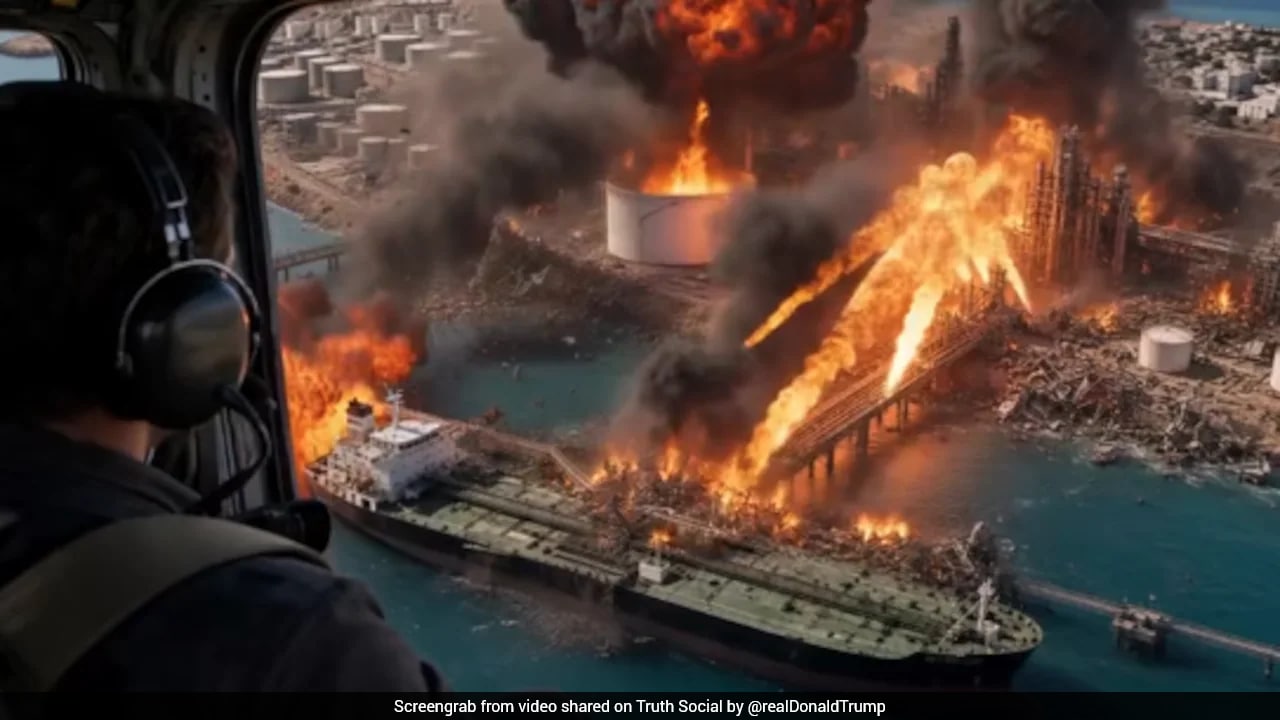
Donald Trump released a video. It was generated by artificial intelligence. In it, Kharg Island—Iran’s primary crude oil export terminal, a narrow strip of land in the Persian Gulf carrying the lifeblood of an entire nation's economy—vanished into a computer-generated mushroom cloud.
For decades, the language of war has relied on euphemism. Generals talk about kinetic strikes, degradation of assets, and strategic restructuring. Politicians speak of lines in the sand and resolute responses. But synthetic media skips the diplomatic filter entirely. It renders the unthinkable into hyper-realistic, high-definition spectacle. It hands the apocalyptic preview directly to millions of scrolling thumbs on social media feeds, bypassing the slow, tedious machinery of intelligence briefings and Congressional debates.
Consider what happens when policy becomes a trailer for a movie that nobody bought tickets for.
To understand the weight of a burning Kharg Island, you have to step away from the glowing screen and look at a map that isn't digital. Kharg Island handles roughly ninety percent of Iran's crude oil exports. It is a concrete and steel nexus sitting in the warm, shallow waters of the Gulf, anchored by miles of undersea pipelines and massive storage tanks. It is a choke point. Not just for Iran, but for the global nervous system of energy markets.
When a politician simulates the obliteration of such a facility using generative video tools, the target isn't just a military installation three thousand miles away. The target is perception. The goal is to collapse the distance between a distant geopolitical adversary and the viewer's living room, trading nuance for immediate, visceral dread.
We have entered an era where political discourse is increasingly mediated by synthetic hallucinations. Anyone with a prompt box can now conjure photorealistic footage of war crimes, economic collapses, or geopolitical assassinations before breakfast. The technology does not care about truth. It cares about coherence. It strings together pixels in a way that tricks our evolutionary wiring into believing our eyes, even when our brains know better.
When that video of Kharg Island loops on a smartphone screen, it triggers an ancient alarm. Our ancestors didn't worry about algorithmic bias or deepfake attribution; they worried about the smoke on the horizon. The human brain processes visual threat faster than text. Long before an economic analyst can explain how a strike on Iranian oil infrastructure would spike global Brent crude prices past one hundred dollars a barrel—pinching inflation-weary families from Ohio to Osaka—the image of the island's destruction has already done its emotional work.
Fear. Adrenaline. Certainty.
This is the hidden cost of synthetic political messaging. It short-circuits deliberation. In the past, manufacturing consent required massive state apparatuses, carefully vetted photographs, and hours of televised speeches. Today, it requires a powerful GPU and a creative prompt. The barrier to entry for terrifying the global public has never been lower.
Let us be entirely clear about the mechanics here. This is a hypothetical scenario, but the tools are brutally real. When a prominent political figure uses AI-generated video depicting the literal destruction of critical foreign infrastructure, they are engaging in a new form of psychological signaling. It is deniable because it is clearly synthetic, yet effective because it is visually undeniable. It whispers a threat without requiring the speaker to explicitly declare war. It says: Look how easily I can erase your economy in post-production.
Markets twitch. Diplomats scramble. Foreign ministries issue furious communiques. All over a few gigabytes of synthesized video.
The danger of this medium is not just that it lies; it is that it makes reality feel negotiable. If a digital model of Kharg Island can be blown to smithereens for a campaign ad, then the physical island ceases to be a complex geopolitical hazard involving human lives, fragile alliances, and delicate trade balances. It becomes a prop. A special effect in a high-stakes game of political theater.
We have forgotten how to be afraid of the right things. We spend our time arguing over the fidelity of the shadows or the flicker of the flames in the AI generation, missing the broader, darker transformation happening underneath. The normalization of digital violence as standard political communication.
When war is gamified, the threshold for actual conflict drops. If you can watch your future enemy's economic heartland burn in high-definition recreation over morning coffee, the real thing stops looking like a tragedy and starts looking like the logical next episode.
The servers hum in their air-conditioned rooms, quietly rendering the end of the world one frame at a time. The flames on the screen are cold, but the ash they leave behind is very real.