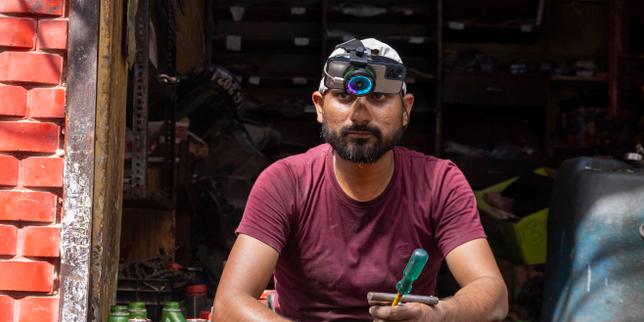
In the sweltering heat of New Delhi, a woman straps an iPhone to her forehead, angled precisely to capture the motion of her hands. She is not a vlogger documenting a lifestyle, nor an engineer performing a field test. She is a waste sorter, clearing labels from plastic bags for a few dollars an hour. She is also, unwittingly, the primary architect of her own professional obsolescence.
This is the hidden labor behind the next generation of physical artificial intelligence. While the global conversation regarding automation focuses on white-collar layoffs and office-based software, a far more direct transfer of knowledge is occurring in plain sight. In factories, warehouses, and recycling centers across India, human workers are being paid to train the very machines that will soon replace them. They are harvesting their own tacit expertise—the subtle, unteachable nuance of manual labor—and feeding it into black-box algorithms that cannot feel the weight of the objects they handle, but can eventually mimic the motion required to sort them.
The Mechanics of Replacement
The technical objective here is the acquisition of egocentric data. For decades, roboticists struggled to move machines beyond the rigid, pre-programmed environments of automotive assembly lines. The difficulty lies in the variability of the real world: the irregular shape of a scrap of plastic, the unexpected resistance of a stubborn label, the instinctual pressure applied when gripping a fragile object. These are not mathematical equations. They are lived experiences codified in muscle memory.
By capturing video from the perspective of the worker, robotics firms bypass the need to explain these nuances. They do not need to write code for every contingency. They simply show the machine thousands of hours of high-definition, first-person footage. The machine watches, learns the patterns, and internalizes the sequence. When the worker is removed from the equation, the data remains. The labor is effectively digitized, distilled, and replicated at scale.
The Consent Gap
The ethics of this data collection remain fundamentally broken. Many workers involved in these filming initiatives report a lack of clear communication regarding the purpose of the footage. They are told they are helping a tech company, or perhaps participating in a vague research project, but the direct consequence—the creation of a robotic replacement for their specific task—is rarely mentioned.
This is a departure from traditional data annotation. In the past, Indian workers were employed to label images or moderate content, processing data generated by users in the West. This current arrangement is different in kind. Here, the worker is the source material. They are handing over the proprietary knowledge of their own hands. Selling one’s labor is a standard economic contract. Selling the ability to replicate that labor forever at a rate of roughly $2.62 an hour is a one-time liquidation of professional identity.
A New Economic Reality
The macro impact on India’s economy is substantial. The nation has long served as the back office of the global tech industry, providing the cheap human labor required to train and maintain sophisticated systems. However, that model is visibly fraying. As generative AI and physical automation mature, the demand for human cognitive and manual input is shifting toward a cycle of self-cannibalization.
Consider the hypothetical case of a logistics facility that replaces 500 workers with 50 robotic units. The facility owners do not just purchase hardware; they purchase the aggregate, anonymized motion profiles of the 500 people they just let go. The workers are essentially invited to pay for their own exit package by providing the training data that justifies the capital expenditure of the new robots.
The Fragility of Technical Disruption
There is a profound irony in the haste of these companies. They are chasing a vision of fully automated labor while ignoring the human instability this creates. If the workforce is replaced too rapidly, the consumer base for the goods these robots produce will evaporate.
Furthermore, the data itself is limited by the very people it seeks to replace. If a worker is sick, distracted, or demoralized by the knowledge that their job is on the chopping block, the quality of the data suffers. The roboticists are betting that they can extract enough knowledge from the current generation to avoid needing a human for the next one. They assume the "how" of labor is static. They ignore the fact that work is an evolving, adaptive process that requires human judgment to navigate errors and supply-chain irregularities.
The camera on the forehead is not just a tool; it is a conduit for the transfer of human expertise into corporate assets. As these models get smarter, the rate of pay for the workers providing the data will not rise. It will diminish, until the human is no longer part of the chain at all. The cycle is nearly complete, and in the quiet of the warehouse, the only thing left to record is the silence where the workers used to stand.
Inside the dark world of AI training
This short video provides a glimpse into the conditions of workers in India who are recording their daily tasks to train artificial intelligence robots.
http://googleusercontent.com/youtube_content/1