Security details rarely rely on standard playbooks when real danger knocks. Behind the polished media coverage of high-profile international summits, extreme tactical deceptions happen more often than the public realizes. Recent investigative reports from outlets like The Washington Post and The New York Times revealed an extraordinary security operation involving Donald Trump. Facing a severe, credible threat originating from Iran during a NATO summit in Ankara, Turkey, the presidential security detail executed a classic shell game. They used a high-profile aircraft as a decoy while moving the president out of the country via an unassuming airport catering vehicle and a separate military jet.
Understanding how this covert maneuver unfolded requires looking past the official schedule and examining the logistical nightmare facing Secret Service and military planners on the ground. Building on this theme, you can find more in: The Ghost Flight From Istanbul.
The Anatomy of a Presidential Decoy
The Turkish trip already carried unique logistical hurdles. Trump had arrived in Ankara aboard a newly renovated Boeing 747-8 gifted by Qatar, which marked the aircraft's debut international presidential voyage. Yet, escalating geopolitical hostilities with neighboring Iran shifted security calculations from routine transport to active survival mode. Intelligence assessments flagged a credible risk targeting the president's transit, putting both the newly modified Qatari jet and standard presidential aircraft under high scrutiny.
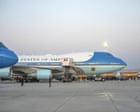
To neutralize the risk, planners designed a multi-layered deception. Trump publicly announced on social media that he would ditch the newer plane for the return leg, opting instead for an older, powder-blue Air Force One "for old time's sake" to fly toward RAF Mildenhall in Britain. Cameras flashed as the president walked up the stairs of the older aircraft, waved to the assembled press pool, and stepped inside. Analysts at NBC News have also weighed in on this situation.
It was all theater.
Minutes after the cabin doors closed, long-range cameras and standard protocols failed to capture what happened next. Instead of buckling in for the flight, Trump was covertly funneled out of the opposite side of the aircraft.
Inside the Catering Truck Operation
Moving a sitting United States president undetected requires using everyday airport infrastructure in unconventional ways. Security teams positioned a high-lift airport catering truck directly against the belly or side door of the decoy aircraft. These hydraulic vehicles, designed to load bulk food and galley supplies, feature enclosed box containers that completely isolate their interior from outside view.
Trump and a select group of aides stepped off the aircraft directly into the elevated truck container. The vehicle then lowered its lift, detached from the decoy plane, and drove across the active Ankara tarmac. It pulled up directly to a waiting U.S. Air Force C-32A—a modified military version of the Boeing 757 utilized for senior government transit.
While journalists and even several White House staff members settled into their seats on the decoy jet, completely unaware of the swap, the actual target of the trip was already boarding a different aircraft.
To maintain the illusion up in the air, reporters traveling inside the press cabin of the decoy plane were instructed to keep their window shades tightly shut for the duration of the flight. When pressed later about why the press pool was ordered into darkness, Trump offered a characteristic remark, noting they were on a dangerous flight and adding, "But if I go, you go. Right?"
Historical Precedents for Tarmac Shell Games
While Hollywood loves depicting high-tech gadgets saving leaders, low-fi operational trickery remains the gold standard of executive protection. This recent Turkish operation mirrors historic precedents designed to throw hostile intelligence agencies off the scent.
Back in March 2000, President Bill Clinton undertook a high-risk visit to Islamabad, Pakistan, amid intense regional security threats. Planners utilized an unmarked executive jet to fly the president into the country while sending a formal Air Force One as a high-profile decoy. Observers later watched Clinton step out of an entirely plain white aircraft rather than the iconic blue-and-white symbol of the presidency.
Similarly, the immediate aftermath of the September 11 attacks saw emergency transport protocols that prioritized tactical obscurity over transparency. However, unlike post-9/11 adjustments where the administration withheld locations without fabricating physical boardings, the Ankara operation actively leaned into total misdirection. Cameras recorded a staged departure to feed potential watchers bad intelligence.
The Aftermath and Geopolitical Fallout
When the flights touched down in Britain at RAF Mildenhall, the logistical loop closed seamlessly. The C-32A carrying the president arrived shortly before the decoy aircraft and the media pool landed. Observers watched as Trump eventually emerged to greet service members, appearing to have completed a standard trans-continental journey.
White House communications teams defended the intense security layers without directly confirming every minute detail of the tarmac logistics. Steve Cheung, the White House communications director, emphasized that the administration continuously utilizes every tool available—including strategic distraction—to counter persistent threats against the president's life from foreign adversaries.
The revelation underscores the volatile reality of modern executive travel. When hard intelligence points to active plots from state actors like Iran, normal diplomatic protocol goes out the window, replaced by tactical survival methods that turn routine catering trucks into vehicles of presidential preservation.