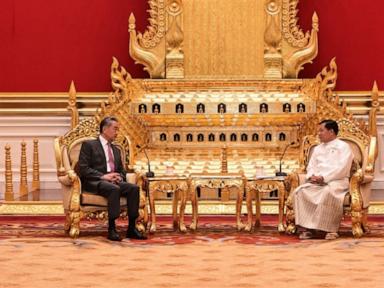
The air in Naypyidaw doesn't move like it does in Yangon. There is no scent of jasmine or street-fried samosas, only the sterile, shimmering heat radiating off twenty-lane highways that lead to nowhere. This is a city built for parades and paranoia, a sprawling monument to isolation. On a Wednesday that felt like any other sweltering afternoon in Myanmar, the silence of the capital was broken by the arrival of a man whose presence carries the weight of a superpower.
Wang Yi, China’s veteran diplomat, stepped onto the tarmac. He wasn’t there for the scenery. He was there because the ground is shifting beneath the feet of the man waiting for him: Senior General Min Aung Hlaing. If you liked this post, you might want to read: this related article.
To understand why this meeting matters, you have to look past the stiff handshakes and the gold-trimmed chairs of the presidential palace. You have to look at the map. Myanmar is currently a jagged mosaic of broken glass. Since the 2021 coup, the military—the Sit-Tat—has watched its grip slip. In the north, along the Chinese border, an alliance of ethnic armed groups has spent the last year systematically dismantling the junta’s outposts. They have taken trade hubs. They have captured generals. They have humilitated an army that once thought itself invincible.
Beijing is watching. Beijing is always watching. For another perspective on this story, check out the recent coverage from TIME.
The Butcher and the Banker
Imagine a homeowner whose house is slowly catching fire. The neighbors are yelling, the windows are shattering, and the roof is sagging. Then, the wealthiest man in the county knocks on the door. He doesn't bring a fire extinguisher. He brings a contract and a very sharp set of eyes.
China’s relationship with Myanmar’s military is not one of affection. It is one of cold, hard geography. Myanmar is China’s "west coast." It is the shortcut to the Indian Ocean, the bypass that allows Chinese oil tankers to avoid the narrow choke point of the Malacca Strait. If Myanmar collapses into a true failed state, that bridge vanishes into the smoke.
Wang Yi’s visit was a signal sent in two directions. To the world, it said that China still recognizes the junta as the hand on the wheel, however shaky that hand may be. To Min Aung Hlaing, it was a reminder of who holds the purse strings. Reports from the meeting suggest Wang Yi promised support for a "stable transition" and eventual elections.
But elections in a country where half the population is in active revolt are a fantasy. They are a political theater designed to give the junta a veneer of legitimacy. By backing this plan, Beijing isn't seeking democracy; it is seeking a predictable neighbor.
The Cost of a Handshake
While the cameras flashed in the gilded halls of Naypyidaw, consider the reality three hundred miles to the north in Lashio.
Lashio was once a bustling crossroads of trade. Today, it is a graveyard of charred trucks and abandoned homes. When the Three Brotherhood Alliance launched "Operation 1027," they didn't just win a battle; they broke the myth of military supremacy. Thousands of soldiers defected or surrendered. For the first time in decades, the ethnic minorities who have long fought for autonomy felt they were on the verge of something historic.
Then comes the diplomatic pivot.
China has played both sides of this fence for years. They maintain ties with the rebels to protect their pipelines, yet they fund the junta to maintain the status quo. It is a dizzying, cynical game of chess where the pawns are human lives. For a mother hiding in a jungle trench in Shan State, Wang Yi’s arrival in the capital isn't a "regional tour." It is a death sentence. It tells her that the world’s rising superpower is willing to bet on the man dropping bombs on her village, provided he can keep the oil flowing.
The stakes are invisible but absolute. If China manages to broker a peace that keeps the military in power, the revolution dies in the cradle. If they fail, and the junta collapses, China faces a chaotic, pro-Western or fiercely independent democracy on its doorstep.
A Gamble in the Dust
The Sit-Tat is desperate. They are losing men, territory, and, most importantly, the economy. The kyat is plummeting. Electricity is a luxury. The young people who should be building the country’s future are instead joining the People’s Defense Forces (PDF), learning to manufacture drones and landmines in the forest.
Min Aung Hlaing needs China. He needs their veto at the UN. He needs their jet fuel. He needs their technical expertise to bypass the sanctions that have strangled his inner circle.
Wang Yi, however, did not come bearing gifts without a price tag. China is frustrated. They are tired of the "scandicodes"—the massive cyber-scam centers operating along the border that have kidnapped thousands of Chinese citizens and forced them into digital slavery. These centers flourished under the protection of junta-aligned militias. China wants them gone. They want the China-Myanmar Economic Corridor (CMEC) back on track.
It is a transaction. Stability for sovereignty.
The Ghost in the Room
There is a third party in this meeting who wasn't invited: the spirit of the 2021 protests.
In the weeks after the coup, the streets of Yangon were filled with millions of people holding red balloons and signs that read "Support us, don't support the dictator." They looked to the international community for help. They looked to the UN. They looked to Beijing.
Beijing looked back and saw a business risk.
The current "regional tour" by Wang Yi is an attempt to stabilize that risk. He isn't just visiting Myanmar; he is talking to Thailand, Laos, and the rest of the Mekong neighbors. He is building a fortress of influence. The message is clear: the West can keep its sanctions and its speeches. China will provide the infrastructure and the "order."
But order is a fragile thing when it is built on top of a volcano.
The junta's promise of elections in 2025 is a hollow drum. You cannot hold a vote when you don't control the roads. You cannot hold a vote when the teachers, doctors, and engineers are either in prison or in the mountains. By legitimizing this path, China is ignoring the fundamental reality of modern Myanmar: the people have moved past the point of compromise. They don't want a "stable transition" back to military-lite rule. They want the generals gone.
The Long Shadow
As Wang Yi’s motorcade sped back toward the airport, passing through the eerie, oversized roundabouts of the capital, he likely saw a city that functioned perfectly. No protesters. No trash. No chaos.
It is a lie.
The real Myanmar is bleeding out beyond the horizon of Naypyidaw’s artificial hills. The "top diplomat" can sign all the memorandums he wants. He can pledge "all-weather friendship" and "mutual respect." But diplomacy is a conversation between governments, and in Myanmar, the government has lost its conversation with the people.
The Chinese dragon is trying to steady a falling man. It remains to be seen if the dragon will be pulled down with him.
The highways of Naypyidaw remained empty long after the diplomatic jets took off. The sun set over the white marble of the Uppatasanti Pagoda, casting a shadow that stretched for miles. It is a long, dark shadow that covers a nation waiting for a morning that Beijing seems determined to delay.
History is rarely written by the men in the gilded rooms. It is written by the ones who refuse to move when the tanks arrive. For now, the dragon has made its choice. The General has his lifeline. And the people of Myanmar are left to wonder how much more their blood must pay for the price of a neighbor's "stability."
The light in the palace windows flickered and dimmed, leaving only the sound of the wind whistling through the empty twenty-lane streets.