Dust.
In the high desert of central Nevada, dust is not merely dirt; it is the currency of survival, the texture of every morning coffee, and the visible proof of who is winning a war that has raged silently across millions of acres of public land for half a century. When the wind kicks up off the Toiyabe Range in late July, stripping the moisture from sagebrush that already looks like twisted gray wire, that dust carries the scent of crushed juniper, sun-baked alkali, and an old, bitter argument that neither side knows how to stop. Meanwhile, you can find related stories here: Inside Alexandria Ocasio-Cortez’s Political Shift and the Battle Over the Progressive Future.
A federal appeals court just handed down a decision that sounds, on paper, like a dry procedural shrug. The judges rejected a demand by Nevada ranchers to force the federal government to accelerate the removal of wild horses from public rangelands. In the sterile language of legal briefs and agency press releases, the ruling is a matter of statutory discretion, administrative timelines, and the limits of judicial intervention under the Wild Free-Roaming Horses and Burros Act of 1971.
To understand what that ruling actually means, you have to leave the marble corridors of the Ninth Circuit and stand beside a dried-up stock pond in Eureka County at five in the morning. To see the bigger picture, we recommend the recent analysis by BBC News.
The Arithmetic of a Thirsty Land
Consider a hypothetical rancher—let’s call him Hank—whose family has run cattle on the same sprawling Bureau of Land Management allotment since the Eisenhower administration. Hank is not a cartoon villain twirling a mustache while plotting the demise of America’s equine heritage. He is sixty-two years old, his knees ache before a storm, and his entire net worth is tied up in four hundred head of Black Angus cattle and a grazing permit that depends on the health of grasses most city dwellers couldn't identify.
Hank walks his fence line in the gray light before dawn and sees what the legal briefs call "forage utilization exceeding acceptable thresholds." What Hank sees is dirt. Where bunchgrass should be knee-high and golden, the ground is shaved down to the roots, pulverized by hooves into a fine powder that blows away with the afternoon gale. Nearby, a spring that used to feed both his cattle and the local sage-grouse population has been trampled into a muddy crater.
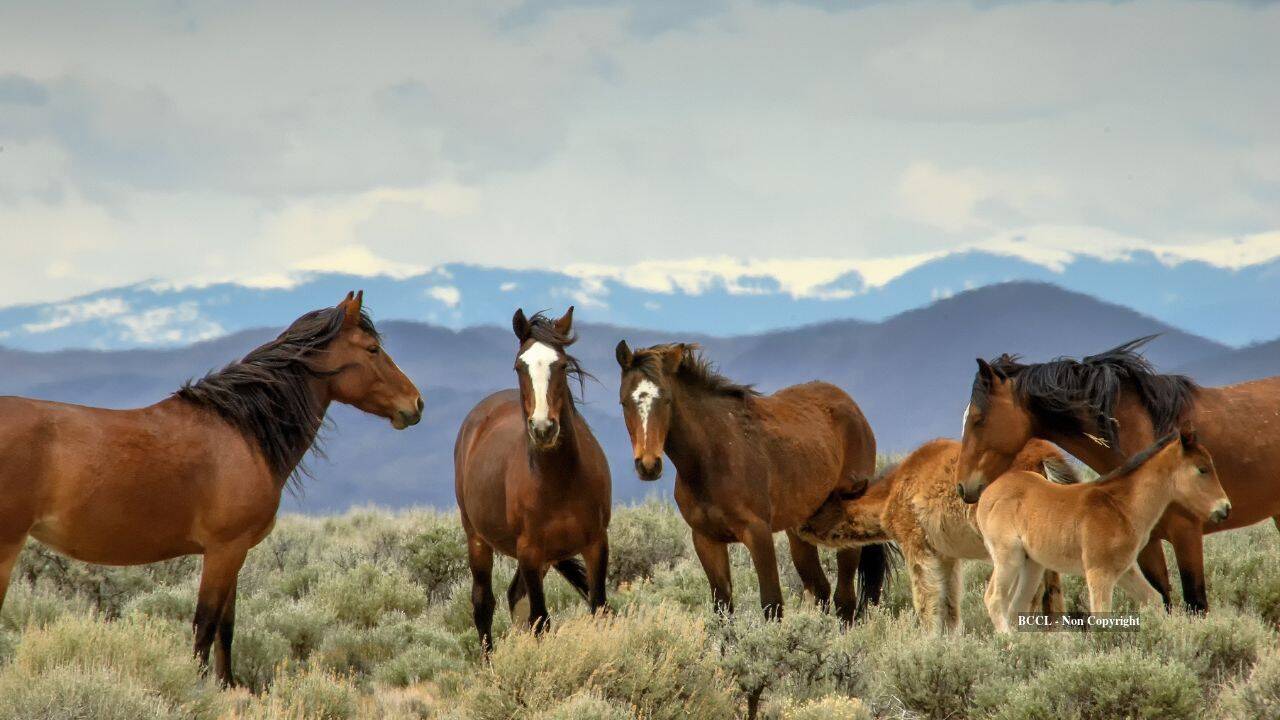
Standing on the ridge above that crater, silhouetted against the brightening sky, is a band of twenty mustangs. They are lean, ribs faintly showing beneath coats matted with burrs and dried sweat, watching him with an ancient, wary intelligence.
Here is the brutal math that keeps men like Hank awake at three in the morning. According to the Bureau of Land Management, the public lands across ten Western states can ecologically sustain roughly 27,000 wild horses and burros without destroying the fragile desert ecosystem. That number is known in bureaucratic shorthand as the Appropriate Management Level. As of recent federal counts, the actual population roaming those ranges exceeds 73,000—nearly triple what the land can support. In Nevada alone, which holds more than half of the nation’s wild herds, tens of thousands of horses compete for the same sparse blades of grass and trickles of water as native elk, bighorn sheep, pronghorn antelope, and the cattle that keep rural towns alive.
When Hank looks at those horses, he doesn't see a romantic symbol of the American frontier. He sees an invasive mathematical certainty. Wild horse populations, lacking natural predators like wolves or mountain lions in sufficient numbers to check their growth, expand by roughly fifteen to twenty percent every single year. Left unchecked, a herd doubles in size every four to five years.
For Hank, waiting another year for a federal helicopter roundup isn't an administrative delay. It is the difference between keeping his ranch or selling off his breeding stock at a loss, watching three generations of sweat evaporate because a judge in San Francisco decided the government wasn't moving too slowly.
The Architecture of a Stalemate
Why did the appeals court say no? To grasp the logic of the ruling, you have to understand the impossible tightrope Congress strung across the West in 1971.
Back then, public outrage over "mustangers"—commercial hunters who chased wild horses with airplanes and trucks, selling them for pet food and chicken feed—pushed Congress to pass the Wild Free-Roaming Horses and Burros Act unanimously. The law declared wild horses to be "living symbols of the historic and pioneer spirit of the West" and tasked the Bureau of Land Management with protecting them while simultaneously maintaining a "thriving natural ecological balance" on the range.
Think of that mandate as trying to keep a bathtub from overflowing while someone keeps turning up the faucet, and the law forbids you from widening the drain.
Over the decades, ranchers and state officials have repeatedly sued the federal government, arguing that the law’s requirement to immediately remove excess horses when overpopulation threatens the land is a hard, enforceable command. In this latest legal battle, Nevada ranchers argued that the agency’s failure to hit its own population targets constituted an unlawful withholding of action—a dereliction of duty that was actively destroying their livelihoods and the rangeland itself.
The appeals court, however, looked closely at the statutory language and reached a different conclusion. The judges recognized the severity of the overpopulation crisis, acknowledging the ecological strain on the desert. Yet they ruled that the law grants the agency broad discretion over how and when to conduct removals, constrained by budgets, logistical realities, and competing environmental mandates. Courts, the judges reasoned, cannot simply act as micromanagers of the public range, ordering the government to execute roundups on a rancher’s preferred schedule when the agency is already juggling limited holding facilities, congressional funding caps, and fierce public scrutiny.
It is a legally sound decision. It is also cold comfort to anyone living on the ground.
The Shadow on the Other Side of the Fence
If you stop the story at the ranch gate, you miss half the tragedy. Because while Hank is staring at ruined grass and wondering how to pay his feed bill, another group of people is watching those exact same hills with a very different kind of dread.
Walk into a diner in Reno or Salt Lake City and sit across from someone who has spent twenty years tracking Nevada’s wild herds—let's call her Elena, a wildlife photographer and advocate who knows individual stallions by the scars on their shoulders and the white blazes on their foreheads. Ask Elena about the ranchers’ lawsuit, and you won't get a lecture on legal standing. You’ll hear about the sound a foal makes when a low-flying helicopter separates it from its mother during a summer roundup.
To Elena and millions of Americans who regard wild horses as a sacred public trust, "accelerated removals" is a sanitized phrase for a violent industrial operation. During BLM gathers, helicopters buzz low over jagged basalt ridges, driving panicked herds for miles across rocky terrain into steel-panel traps. Horses break legs in the chaos. Older mares collapse from heat exhaustion. Families that have stayed together for a decade—a lead stallion, his mares, their yearlings—are split apart in metal chutes in a matter of minutes.
And where do they go once they are loaded onto semi-trucks?
That is the dirty secret at the heart of the entire system, and the unspoken reality lurking behind the appeals court’s refusal to force faster roundups. You cannot simply remove ten thousand horses from the Nevada desert and make them vanish into thin air. Congress strictly prohibits the Bureau of Land Management from euthanizing healthy horses or selling them for slaughter.
Instead, they go into storage.
Right now, more than 60,000 captured wild horses and burros live out their lives in off-range corrals and leased pastures across the Midwest and West—nearly as many animals in captivity as remain on the open range. Feeding, watering, and providing veterinary care for those captive herds consumes roughly two-thirds of the agency’s entire wild horse and burro budget, costing taxpayers over a hundred million dollars every single year. It is a financial black hole that leaves almost no money left over for range restoration, water development, or fertility control on the ground.
Elena points out something else, too—a truth that makes ranchers bristle but refuses to go away. On the very same public lands where wild horses are accused of destroying the ecosystem, domestic cattle outnumber mustangs by a staggering margin. Millions of privately owned cows graze on federal allotments across the West under subsidized permits that cost a fraction of private pasture rates. To advocates, blaming wild horses alone for the degradation of the Great Basin is like blaming a leaky faucet while a fire hydrant is open in the front yard.
The Invisible Casualties
I have stood on the edge of a dry lakebed in central Nevada during a drought year, watching the heat shimmer turn distant mountain ranges into floating islands. When you spend enough time out there, you realize that both sides of this fight are telling the truth, and both sides are trapped in a system designed to fail.
The rancher is right: the desert cannot support seventy-odd thousand horses reproducing exponentially while climate change turns marginal rangeland into permanent dust bowls. When horses starve on an overgrazed range, it is not a noble, romantic death. Their teeth wear down to the gums from chewing grit-covered roots; their bellies bloat with sand colic; they die slowly beside dry springs, taking native wildlife down with them.
The advocate is right: roundups are brutal, expensive, and ultimately futile if all you do is warehouse animals in feedlots while the remaining herds on the range breed right back up to capacity within a few years.
And caught directly in the crossfire are the creatures that don't have lobbyists, lawyers, or sentimental myths attached to them. The greater sage-grouse, whose elaborate spring mating dances require thick, undisturbed sagebrush cover. The pygmy rabbit, tiny enough to fit in a cupped hand, which relies on deep soils and dense brush to survive winter freezes. Native cutthroat trout gasping in streams whose banks have been sheared away to mud by thousands of heavy hooves—both wild and domestic.
When the appeals court declined to force faster removals, it didn't solve the ecological crisis on the range. It simply confirmed that the courtroom is the wrong tool for fixing a broken biological equation.
Beyond the Helicopter and the Gavel
If lawsuits won't save the range, and endless roundups only fill more feedlots at taxpayer expense, what actually breaks the cycle?
Quietly, away from the television cameras and the shouting matches at public hearings, a handful of ranchers, scientists, and horse advocates have begun doing something radical: talking to each other on the ground.
In pockets of Nevada, Colorado, and Montana, small coalitions have started treating wild horse management less like a trench war and more like precision medicine. Instead of waiting until a herd explodes and requires a massive, traumatic helicopter gather, trained volunteers and range riders track individual mares and administer immunocontraceptive vaccines—such as PZP—using remote darts. It takes patience. You have to hike through brutal terrain, learn the habits of specific bands, and keep meticulous records year after year.
It isn't instant, and it doesn't work everywhere—especially across millions of roadless acres where horses rarely see a human being. Yet where it has been applied consistently, population growth slows to a crawl without tearing families apart or shipping a single animal to a holding pen. Paired with targeted, smaller-scale bait trapping and genuine grazing adjustments during severe drought years, it offers a glimpse of a future where the desert isn't loved—or grazed—to death.
None of that is mandated by the Ninth Circuit’s ruling. A judge can tell you what the law allows an agency to delay, but a judge cannot make rain fall on Eureka County, cannot make bunchgrass grow back overnight, and cannot force stubborn human beings to share a scarce resource with grace.
What Remains When the Dust Settles
Back on that ridge in central Nevada, the sun finally clears the Toiyabe peaks, flooding the valley with a harsh, clarifying light that leaves no room for illusions.
Down by the trampled spring, the band of twenty mustangs shifts nervously as a pickup truck rumbles along a distant dirt road, trailing a plume of white alkali dust that hangs motionless in the dry air for ten minutes after the engine fades. The lead stallion stamps a forehoof, snorts, and turns his herd back toward the higher draws, picking a path through the gray sagebrush where the grass is already gone.
Below him, the rancher climbs back into his cab, his boots coated in the same fine powder, facing another season of counting clouds that never quite break. The court has spoken, the law remains intact, and out across the vast, silent expanse of the Great Basin, the clock keeps ticking with every hoofbeat.


