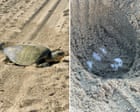
Marine biogeography operates under strict thermal parameters. Species distributions are bound by physiological limits, oceanographic currents, and historic homing fidelity. When an organism breaches these spatial thresholds, it signals a systemic disruption in environmental baselines. The documented emergence of olive ridley sea turtles nesting on Southern California beaches marks an unprecedented shift in marine ecology, forcing a re-evaluation of how climatic variables dictate migratory behavior.
Analyzing this event requires moving past superficial descriptions of rarity and examining the underlying physical drivers, physiological adaptations, and management bottlenecks that define this ecological anomaly.
The Oceanographic Engine and Thermal Baselines
The historical nesting range of the olive ridley sea turtle (Lepidochelys olivacea) is concentrated in tropical and subtropical waters, with primary Pacific rookeries located along the coast of Mexico, Central America, and occasionally the western Cape of Baja California. Latitude acts as a thermal boundary because embryonic development in sea turtles depends on specific substrate temperatures, typically ranging between twenty-five and thirty-two degrees Celsius.
The appearance of nesting females in Orange County and Ventura County indicates that thermal thresholds have shifted northward. Ongoing marine heatwaves and persistent positive thermal anomalies along the California Current have altered coastal water temperatures. These elevated temperatures reduce the thermal barrier that historically discouraged tropical chelonians from attempting reproduction at higher latitudes.
When surface water temperatures match or exceed the physiological trigger points for nesting behavior, migratory cues become decoupled from historic geographic anchors. The turtles interpret the thermal profile of Southern California waters as a viable reproductive habitat, overriding the evolutionary imprint of their natal beaches.
Behavioral Plasticity versus Homing Fidelity
Marine turtles exhibit high natal homing fidelity, returning to the exact geographic region where they hatched to deposit their own clutch, typically mediated by geomagnetic imprinting. This creates a high-friction environment for range expansion; straying individuals rarely encounter optimal terrestrial conditions or conspecifics.
However, olive ridleys possess exceptional behavioral plasticity compared to other chelonian species. This flexibility manifests in two distinct ways:
- Solitary and Aggregated Nesting Modes: While famous for synchronized mass nesting events known as arribadas, olive ridleys frequently nest as solitary individuals, lowering the behavioral threshold required to establish a novel nest site.
- Substrate Adaptation: The selection of nesting sites relies on tactile and thermal cues of the sand rather than rigid genetic maps of specific coordinates. If a beach meets moisture and temperature requirements during the nocturnal crawl, the nesting sequence is initiated regardless of latitude.
This plasticity allows the species to exploit novel environments opportunistically. Yet, this adaptation introduces severe ecological friction. Northern beaches present distinct risks compared to tropical nesting grounds, including structural erosion from high-energy winter swells, variable ambient air temperatures that skew hatchling sex ratios, and a complete absence of local predator-prey dynamics tuned to turtle eggs.
Conservation Interventions and Logistics Bottlenecks
The discovery of nests in Seal Beach and Huntington Beach forced wildlife agencies into an immediate triage scenario. Managing high-latitude marine reptile reproduction introduces strict operational hurdles.
[Environmental Trigger]
       │
       ▼
[Thermal Anomaly / El Niño Influence]
       │
       ▼
[Migratory Displacement & Nesting Initiation]
       │
       ▼
[Interagency Triage: In Situ Protection vs. Ex Situ Incubation]
       │
       ├──► In Situ: Vulnerable to high surf, erosion, and tidal inundation
       └──► Ex Situ: Relocation to Aquarium Facility (Controlled Thermal Parameters)
As tropical storms and heavy surf threatened to inundate the initial clutches, biologists faced a compressed decision window. Leaving the eggs in situ carried a near-certain mortality rate due to coastal erosion and wave action. Consequently, federal and state entities executed an emergency translocation of over two hundred eggs to the Aquarium of the Pacific in Long Beach.
This intervention highlights the cost function of conservation in altered ecosystems. Ex situ incubation protects embryos from immediate climatic hazards, but it removes natural selection pressures and introduces artificial thermal stabilization. Maintaining eggs in controlled indoor environments bypasses natural diurnal temperature fluctuations, which play a documented role in embryonic development speed and metabolic efficiency.
Furthermore, identifying distinct individuals required rigorous biometric analysis. Researchers utilized photo-identification techniques, mapping facial scale patterns, carapace scute geometries, and barnacle distributions to confirm that multiple distinct females had successfully navigated to Southern California shores. This confirms that the event is not an isolated behavioral error by a single vagrant animal, but a broader distributional probe by the population.
Demographic Vulnerability and Survivorship Curves
The long-term viability of northern nesting attempts depends entirely on the mathematics of marine turtle life-history traits. Sea turtle populations are defined by a Type III survivorship curve: high initial mortality followed by a long adult lifespan.
- The Hatchling Phase: Upon emerging from the substrate, neonates enter a critical twenty-four-to-forty-eight-hour hyperactivity phase known as the swimming frenzy, where they must clear nearshore predatory zones.
- The Pelagic Shift: Juveniles drift into pelagic gyres, where survival rates are heavily influenced by offshore food availability and bycatch mitigation in commercial fisheries.
- The Numerical Reality: Empirical models estimate that approximately one in one thousand olive ridley hatchlings reaches sexual maturity.
When these foundational events occur at the northern edge of the species' tolerance range, the developmental timeline for hatchlings is compressed or stressed by cooler ambient ocean temperatures upon entry. If coastal waters drop below critical physiological thresholds during the post-release dispersal phase, metabolic cold-stunning events can decimate the cohort before they reach pelagic refuge areas.
Predictive Outlook for Pacific Coastal Dynamics
The establishment of sustained nesting on the U.S. West Coast remains improbable as a permanent demographic shift, given the high-energy wave climate and seasonal thermal drops of temperate shorelines. However, these events function as early indicators of poleward range compression driven by long-term ocean warming.
Resource managers must transition from reactive crisis response to proactive monitoring frameworks. Establishing standardized telemetry networks, expanding public reporting infrastructure for coastal tracks, and pre-approving rapid-response protocols for egg protection will dictate the success of future conservation operations. As thermal baselines continue to fluctuate, wildlife agencies will increasingly encounter species operating outside their historical geographic envelopes, requiring agile administrative and biological strategies to manage novel ecosystems.
Rare olive ridley turtle lays eggs on Southern California beach
This video provides on-the-ground footage and local news coverage of the rare olive ridley nesting events and community conservation efforts along the Southern California coast.