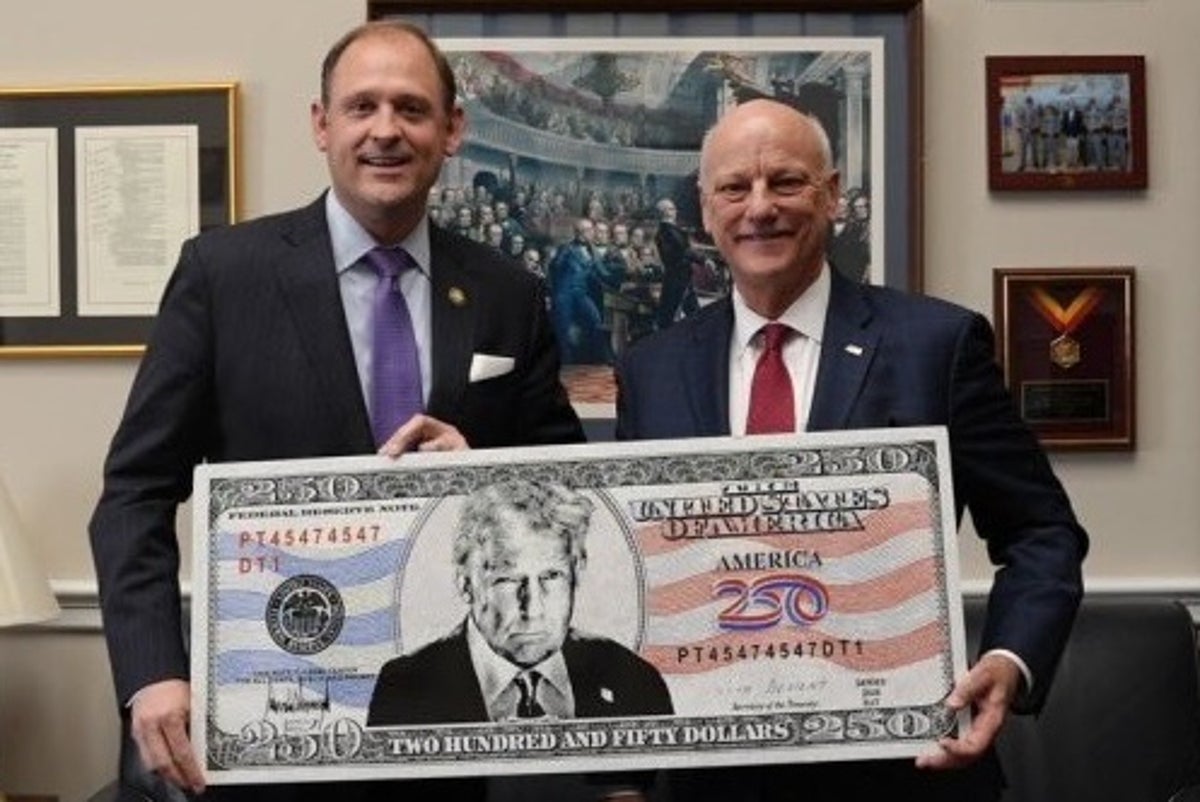
The introduction of a $250 banknote represents a significant deviation from the standard binary-coded decimal or 1-2-5 series patterns traditionally utilized by central banks to maintain currency liquidity. While public discourse focuses on the aesthetic or political implications of featuring a former president’s likeness on legal tender, the technical reality of such a proposal must be evaluated through the lenses of seigniorage, transaction friction, and monetary velocity. Under the Currency Act of 1955 and the discretionary powers of the Secretary of the Treasury, the design and denomination of paper currency are theoretically flexible, yet the operational hurdles of integrating a non-standard value into the existing financial infrastructure are immense.
The Functional Utility of Denomination Scales
To understand why a $250 bill is a structural outlier, one must examine the Triadic Denomination Principle. Most global currencies follow a 1-2-5 structure (e.g., $1, $2, $5; $10, $20, $50) because this ratio minimizes the average number of notes required to make change for any given transaction. This mathematical efficiency reduces the physical volume of paper currency that the Federal Reserve must print, transport, and secure.
Introducing a $250 note breaks this sequence. In a standard cash ecosystem, the leap from $100 to $250 creates a "dead zone" for automated systems. Cash recycling machines, ATMs, and point-of-sale scanners are hardware-calibrated to recognize specific dimensions and security features tied to the current $1 through $100 stack. A $250 denomination would necessitate a nationwide hardware overhaul, the cost of which would likely exceed the logistical benefits of the note itself.
Seigniorage and the Cost of Physical Expansion
The primary economic incentive for a government to issue higher-denomination notes is Net Seigniorage Profit. This is the difference between the face value of the currency and the cost of production.
$$Profit = V_f - (C_p + C_d)$$
Where:
- $V_f$ is the face value.
- $C_p$ is the physical production cost (printing, ink, security threads).
- $C_d$ is the distribution and lifecycle cost.
Currently, it costs approximately 17 cents to print a $100 bill. A $250 bill would likely share a similar production cost, meaning the government "earns" significantly more per note issued. However, high-value notes face a secondary cost: the Illicit Premium. Central banks have historically moved away from high-value notes—such as the €500 "Bin Laden" note or the $1,000 U.S. bill—because they facilitate the physical transport of large sums of untraceable capital. A $250 note would increase the density of value per cubic inch of luggage, inadvertently lowering the friction for money laundering and tax evasion.
Psychographic Branding vs. Monetary Policy
The proposal to place a living or recently active political figure on currency challenges the Historical Buffer Standard. Since the late 19th century, U.S. tradition (and later, federal regulation) has largely dictated that individuals must be deceased for at least two years before appearing on a security. This buffer prevents the politicization of the medium of exchange.
Currency serves three primary roles: a unit of account, a store of value, and a medium of exchange. When a denomination becomes a tool for political messaging, it risks degrading the "unit of account" function by introducing subjective value or friction. For instance, merchants in highly polarized regions might face "transactional refusal," where the physical medium of the currency itself becomes a barrier to the trade it was designed to facilitate. This creates a localized drop in monetary velocity, as the bill becomes a collectible or a protest object rather than a liquid asset.
The Infrastructure Bottleneck
The implementation of a $250 bill would trigger a cascading series of updates across three critical sectors:
- The Federal Reserve’s Cash Services: Vaults and high-speed processing equipment used to authenticate and destroy worn currency are built around current denominations. New software algorithms and physical sensors would be required to identify the unique "tactile signatures" of a $250 note.
- Retail Logistics: Most retail registers are designed with five or six bill slots. Adding a new denomination requires a physical redesign of the cash drawer or the displacement of another denomination (typically the $2 or the $50), which complicates the "making change" algorithm for human cashiers.
- The ATM Network: The vast majority of ATMs carry two to four cassettes. To stock a $250 bill, a bank must decide to stop offering $10s or $20s, which directly reduces the machine's utility for the average consumer who needs smaller amounts for daily transactions.
Strategic Inflationary Signaling
There is a subtle psychological component to denomination expansion. If the Treasury issues a higher-value note, it signals an admission of the Purchasing Power Erosion. The $100 bill, when introduced, had a purchasing power roughly equivalent to $3,000 in today's economy. As the Consumer Price Index (CPI) rises, the "need" for a larger bill grows. However, launching a $250 bill in a period of economic recovery could be interpreted by markets as a signal that the government expects long-term, high-intensity inflation.
This expectation can become self-fulfilling. If consumers believe the $250 bill is necessary because prices will continue to climb, they adjust their spending and wage demands accordingly, embedding inflationary pressure into the economy.
The Feasibility Matrix
To evaluate the success of this proposal, we must weigh the political capital against the operational friction:
- Variable: Counterfeit Risk. Higher denominations are primary targets for North Korean "Supernote" style operations. The security features on a $250 bill would need to be generational—incorporating OVI (Optically Variable Ink), micro-perforations, and perhaps even polymer integration—to prevent it from becoming a liability to the global strength of the dollar.
- Variable: Adoption Rate. For a currency to be successful, it must be "frictionless." If a $250 bill is widely rejected by vending machines and self-checkout kiosks (which are already notoriously slow to update), it remains a novelty rather than a functional tool.
The proposal functions more effectively as a branding exercise than a fiscal necessity. From a purely data-driven perspective, the United States is moving toward a digitized "FedNow" and CBDC (Central Bank Digital Currency) framework. Reinvesting in the physical printing of a non-standard denomination represents an "analog solution to a digital trajectory."
Any organization or stakeholder analyzing this move should treat it as a high-friction, low-utility event. The strategic play for investors and institutions is to monitor the potential for currency "balkanization." If a $250 bill is minted, it will likely see high velocity in private transactions but low acceptance in automated retail. This creates a two-tier cash system: one for standard commerce and one for stored value or political signaling. The operational recommendation is to maintain existing hardware standards and wait for legislative confirmation before allocating any CAPEX to denomination compatibility.