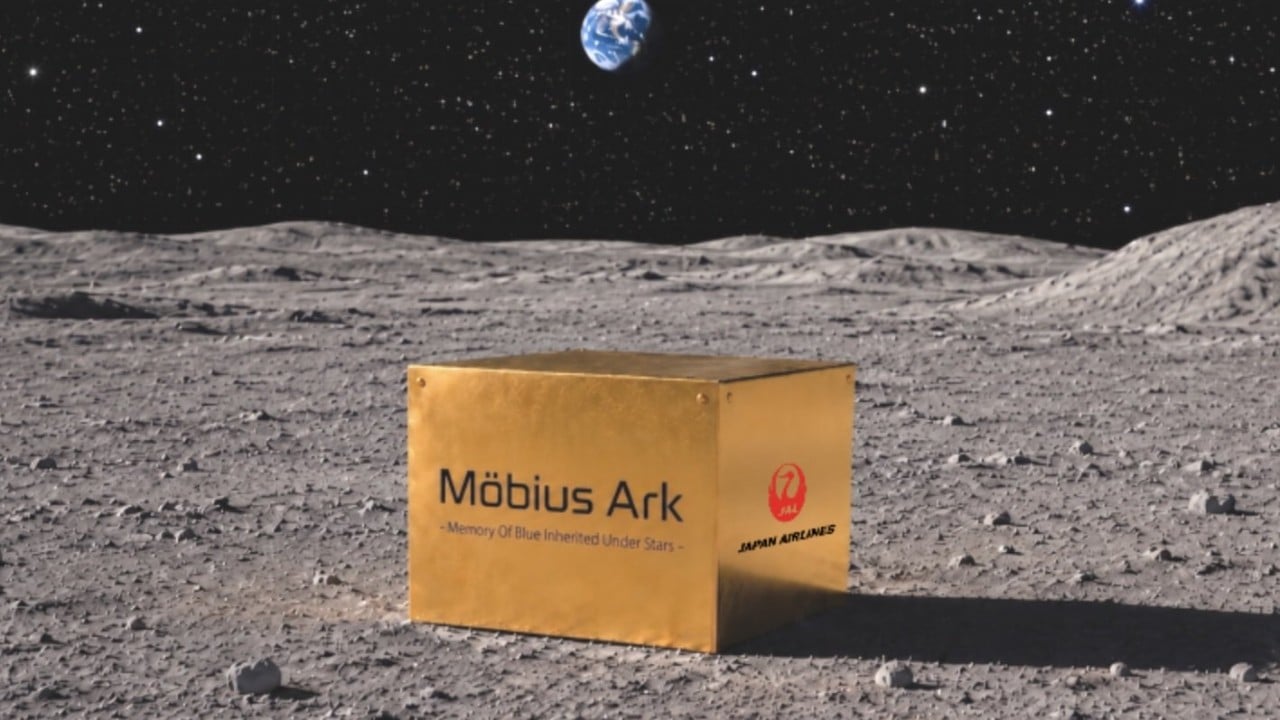
Commercial aviation operates on razor-thin net profit margins, historically fluctuating between 2% and 5% globally. Faced with systemic volatility—ranging from jet fuel price shocks to localized airspace restrictions—legacy air carriers must either diversify their operational models or succumb to secular stagnation. The announcement of the ARGO Trans-Lunar Heritage Project by Japan Airlines (JAL), in partnership with its trading arm JALUX and lunar exploration company ispace, marks a structural shift from atmospheric passenger transport to extraplanetary freight brokerage.
By purchasing cargo capacity on ispace’s Mission 3 lander—scheduled for a 2028 deployment—and reselling partitioned space to corporate and civic clients, JAL is attempting to establish the world’s first commercial airline-led cislunar logistics network. While public-facing narratives frame this initiative as a cultural preservation effort, a rigorous strategic analysis reveals a highly calculated move to capture first-mover advantages in the emerging space economy, optimize unit economics for unutilized corporate capital, and construct an entirely new B2B brand equity framework.
The Strategic Architecture of the ARGO Project
The partnership functions through a multi-tier distribution and operational framework. Rather than developing proprietary propulsion or landing systems, JAL isolates its core competency within the logistics value chain: customer acquisition, secondary packaging engineering, and brand validation.
+--------------------------------------------------------+
|                      JAL / JALUX                       |
|  (B2B Customer Acquisition & Marketing Network)       |
+--------------------------------------------------------+
                           │
                           ▼ (Aggregated Regional Payloads)
+--------------------------------------------------------+
|                "Möbius Ark" Container                  |
|  (20cm x 20cm x 10cm Secondary Packaging Engineering)  |
+--------------------------------------------------------+
                           │
                           ▼ (Integration & Freight Brokerage)
+--------------------------------------------------------+
|                  ispace Mission 3 ULTRA                |
|  (Primary Flight Operations & Lunar Landing Vehicle)   |
+--------------------------------------------------------+
The operational structure is governed by three primary execution phases:
- Capacity Aggregation: JAL and JALUX act as primary freight forwarders. They purchase bulk payload allocation from ispace and subdivide it into micro-allocations, targeting local governments and private enterprises across Japan.
- Environmental Containment: JALUX assumes responsibility for the secondary packaging system, designated the "Möbius Ark." This container, measuring approximately 20 cm × 20 cm × 10 cm, features internal structural partitioning designed to isolate individual payloads from mechanical vibration and thermal extremes.
- Primary Flight Operations: ispace provides the core infrastructure. The payload will be integrated into the ispace "ULTRA" lunar lander, executed via a commercial launch provider, and decelerated onto the lunar surface.
The Cost Function of Cislunar Freight Brokerage
To evaluate the commercial viability of the ARGO project, one must analyze the underlying unit economics of lunar transport. Historically, the cost of delivering mass to the lunar surface has been prohibitively high, restricted entirely to state-funded scientific agencies. The commercialization of low-Earth orbit (LEO) launches has introduced a downward cost trajectory that is now spilling over into cislunar space.
The cost function governing this specific mission can be expressed through the relationship between fixed launch costs, lander development overhead, and localized payload mass.
$$C_{\text{total}} = F_{\text{launch}} + V_{\text{lander}} + \sum_{i=1}^{n} (m_i \cdot c_{\text{integration}})$$
Where:
- $F_{\text{launch}}$ represents the fixed cost of the primary launch vehicle contract.
- $V_{\text{lander}}$ represents the capital expenditure associated with ispace developing and testing the ULTRA lander.
- $m_i$ represents the mass of individual client payloads.
- $c_{\text{integration}}$ represents the variable engineering cost of secondary containment and environmental protection.
The contract value disclosed for this payload service agreement stands at 1 million US dollars. Given the structural dimensions of the Möbius Ark container (4,000 cubic centimeters total volume), the physical mass allocation is severely constrained—likely limited to a few kilograms.
By segmenting this compact volume into distinct, high-margin, ultra-low-mass units (such as digitized data, micro-artifacts, or chemical formulations), JAL creates an extreme form of yield management. The airline is effectively charging a massive premium for the final stage of transport, capitalizing on the reality that while ispace operates the heavy infrastructure, JAL controls the localized distribution channels and the trust architecture required to onboard non-aerospace clients.
Material Engineering Challenges of the Lunar Surface
The public narrative surrounding the ARGO project stresses the preservation of human culture against terrestrial threats such as climate change, geopolitical instability, and natural disasters. However, transferring assets to the lunar surface replaces terrestrial risks with an exceptionally hostile physical environment. For the Möbius Ark to preserve artifacts across generations, JALUX's engineering team must mitigate three primary degradation vectors.
Extreme Thermal Cycling
The lunar day-night cycle spans approximately 28 Earth days, resulting in surface temperature swings ranging from roughly 120°C during peak illumination to -130°C (and down to -246°C in permanently shadowed regions). Without active thermal control systems—which are mass-prohibitive for a passive container of this scale—the structural integrity of the container and its contents depends entirely on passive thermal protection.
- Mechanism of Failure: Rapid expansion and contraction induce thermal fatigue, leading to micro-fractures in metallic joints and the crystallization or embrittlement of organic polymers.
- Mitigation Strategy: Utilization of multi-layer insulation (MLI) blankets consisting of alternating layers of aluminized Mylar and scrim, alongside advanced carbon-fiber-reinforced polymers with low coefficients of thermal expansion.
Unshielded Ionizing and Solar Radiation
Unlike Earth, the Moon lacks both a substantive atmosphere and a global magnetosphere. Artifacts on the surface are continuously bombarded by Galactic Cosmic Rays (GCRs) and Solar Particle Events (SPEs), alongside intense ultraviolet (UV) radiation.
- Mechanism of Failure: High-energy protons and heavy ions penetrate structural walls, causing atomic displacement in solid-state electronics, cross-linking or chain scission in plastics, and the rapid bleaching of organic pigments or storage media.
- Mitigation Strategy: Implementing high-density polyethylene (HDPE) shielding inside the container walls. HDPE contains a high concentration of hydrogen atoms, which are highly effective at absorbing and scattering ionizing radiation without generating secondary bremsstrahlung radiation.
Lunar Regolith Abrasion
Lunar soil is composed of jagged, highly abrasive silicon dioxide fragments created by billions of years of micrometeorite impacts without atmospheric weathering. Furthermore, due to solar UV exposure, these particles carry a static electrostatic charge, causing them to adhere to all exposed surfaces.
- Mechanism of Failure: Regolith infiltration can jam locking mechanisms, score protective coatings, and degrade optical surfaces or photographic components deployed to document the mission's success.
- Mitigation Strategy: Hermetic sealing utilizing specialized elastomeric gaskets engineered to retain flexibility at low temperatures, combined with indium or gold-coated sealing surfaces.
The Strategic Objectives: Beyond the Cultural Narrative
Why would a commercial airline group engage in extraplanetary logistics four years before a scheduled landing? The rationale is split into three strategic plays designed to fortify JAL's core business while establishing an early footprint in a future macroeconomic vertical.
1. High-Margin B2B Product Differentiation
Local governments and regional corporations in Japan consistently seek novel mechanisms for domestic tourism promotion and corporate branding. By offering a "lunar transport slot," JAL provides an unprecedented marketing vehicle. The scarcity of space on the Möbius Ark allows JAL to command premium pricing from corporate entities looking to anchor their brand identity to high-technology advancement. This generates immediate, high-margin ancillary revenue that is completely decoupled from the price of jet fuel.
2. Operational Upskilling for the Future Aerospace Paradigm
The line between traditional atmospheric aviation and orbital aerospace is blurring. By embedding engineers from JAL Engineering into a lunar payload lifecycle—from initial technical specifications in 2025 to integration and launch in 2028—the JAL Group builds institutional knowledge in space-grade logistics, payload integration protocols, and regulatory compliance. If suborbital point-to-point transportation or commercial space tourism scales in the late 2030s, JAL will already possess an operational playbook and a trained workforce.
3. Risk Mitigation via Asset-Light Infrastructure Selection
Developing a bespoke lunar lander requires hundreds of millions of dollars in capital expenditure and exposes an organization to catastrophic financial risk in the event of a launch or landing failure. JAL’s strategy is strictly asset-light. By executing a Payload Service Agreement with ispace, JAL transfers the primary technical risks—such as launch vehicle reliability, guidance, navigation, and control (GNC) algorithms, and propulsion mechanics—to a specialized third party. If the lander crashes, ispace bears the primary capital asset loss, while JAL's liability is capped and structurally managed via third-party aerospace insurance markets.
Strategic Playbook for Corporate and Civic Deployment
For regional governments and enterprise clients evaluating whether to purchase capacity within the Möbius Ark, participation must be treated as a strategic capital allocation rather than a philanthropic exercise. The decision framework relies on analyzing long-term marketing ROI against strict mass constraints.
The optimal strategy for a participating entity requires a three-step integration process:
- Mass Optimization and Digital Dematerialization: Because physical mass correlates directly with cost, entities should prioritize high-density data storage over physical artifacts. A single solid-state storage medium or laser-etched quartz glass disc can hold terabytes of cultural data, local historical archives, or corporate intellectual property while consuming less than 5% of a standard compartment's physical mass allocation.
- Brand Equity Liquidation: The primary return on investment occurs prior to and immediately following the launch. Organizations must structure a multi-year marketing campaign around the selection, preparation, and integration of their payload. The value is not derived from the artifact sitting silently on the Moon, but from the terrestrial narrative of technological participation.
- Risk Diversification: Given that lunar landing success rates for commercial entities remain highly volatile, corporate participants must negotiate contracts that guarantee secondary slot allocation on subsequent missions (e.g., Mission 4 or 5) in the event of an operational anomaly during Mission 3. Treat the initial payload deployment as a speculative options contract rather than a guaranteed asset delivery.