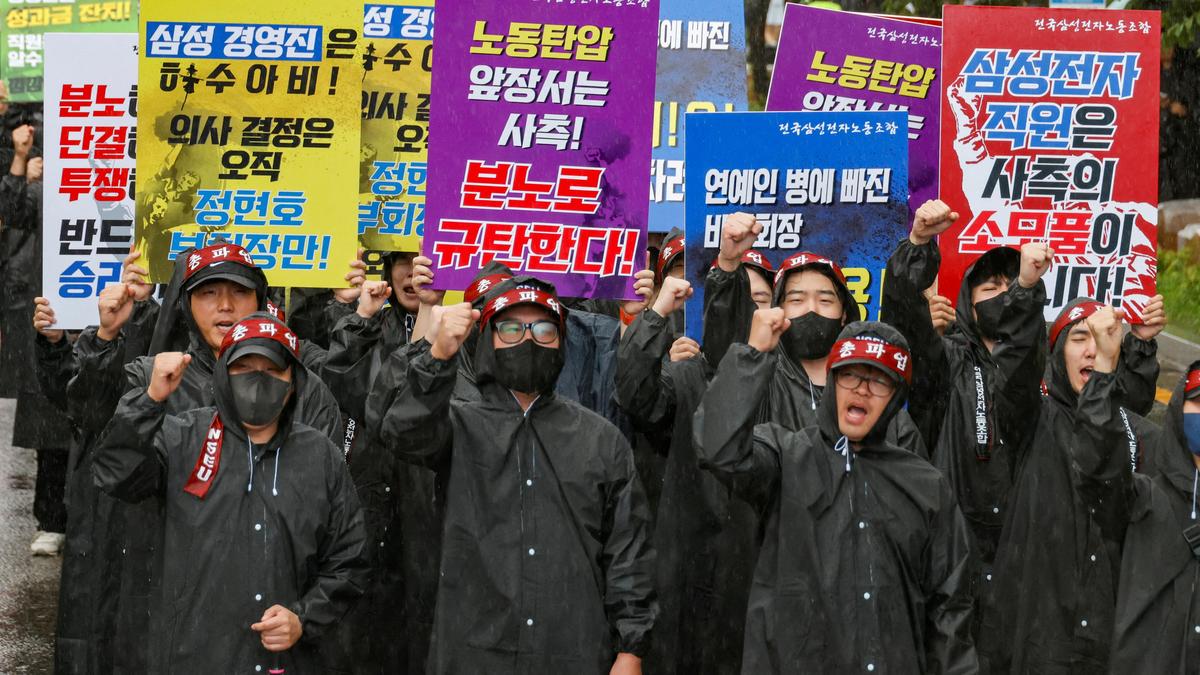
Samsung Electronics currently faces a structural breakdown in its historical labor relations model, a shift that threatens the operational stability of the world’s largest memory chip manufacturer. The mobilization of the National Samsung Electronics Union (NSEU) is not merely a localized dispute over wage percentages; it represents a fundamental pivot from the company’s decades-long "no-union" philosophy toward a collective bargaining framework that could reset the cost structures of the global semiconductor industry. Understanding the gravity of this friction requires a deconstruction of three specific pressure points: the decoupling of performance bonuses from base compensation, the logistical vulnerability of High Bandwidth Memory (HBM) production cycles, and the psychological shift in the South Korean "chaebol" labor market.
The Decoupling of Compensation and Growth
The primary driver of the current labor unrest is the perceived volatility of the Profit Sharing (PS) and Target Incentive (TAI) systems. Historically, Samsung maintained labor peace by offering lower base salaries supplemented by aggressive bonuses that could reach 50% of an employee’s annual pay during peak semiconductor cycles. This model effectively offloaded financial risk from the corporation to the workforce; in lean years, the company could drastically reduce labor costs without formal layoffs. Building on this idea, you can find more in: The $2.4 Billion Sanctuary.
This risk-sharing mechanism failed in 2023 when the semiconductor division reported record losses exceeding 14 trillion won. Employees who had calibrated their lifestyles to "peak cycle" compensation saw their take-home pay crater, even as inflation and housing costs in the Seoul metropolitan area rose. The current demand for a 6.5% base pay increase—rejected in favor of the company's 5.1% offer—is an attempt by the workforce to "floor" their earnings, shifting the financial risk back onto the corporate balance sheet.
High Bandwidth Memory and the Just-in-Time Vulnerability
The threat of a strike is most potent because of the specific timing within the AI hardware cycle. Samsung is currently locked in an existential race with SK Hynix and Micron to secure qualification for its HBM3E chips with Nvidia. Unlike traditional commodity DRAM, HBM production is a high-touch, low-yield process that requires continuous calibration and specialized engineering oversight. Analysts at CNBC have shared their thoughts on this matter.
Labor disruptions at this juncture create a three-fold technical risk:
- The Tooling Bottleneck: Modern fabrication plants (fabs) operate on a 24/7/365 basis. Even a temporary walkout by maintenance or process engineers can lead to "wafer scrap," where delicate chemical-vapor deposition or lithography steps are interrupted, rendering entire batches of silicon useless.
- Qualification Delay: If a strike impacts the engineering teams responsible for fixing yield issues, the timeline for Nvidia certification slips. In the semiconductor industry, a three-month delay in product qualification can lead to a 20-30% loss in total addressable market share for that product generation.
- Intellectual Capital Flight: The strike signals a cultural fracture. In a market where HBM engineers are in extreme demand, a public and protracted labor battle serves as a recruitment advertisement for competitors like SK Hynix or international firms.
The Geopolitical and Macroeconomic Context
South Korean labor movements are governed by a specific legal and social framework that differs from Western paradigms. The "Chaebol Risk" is a documented phenomenon where the centralization of economic power in firms like Samsung makes them primary targets for political signaling.
The NSEU, representing roughly 20-25% of the total workforce (approximately 28,000 members), is leveraging the current political environment in South Korea, where labor rights have become a central pillar of legislative debate. This is no longer an isolated internal matter. If Samsung concedes to the union’s demands for higher base pay and improved vacation time, it sets a new "labor floor" for the entire South Korean industrial sector, affecting LG, SK, and Hyundai.
The cost function of these concessions must be measured against the alternative: the cost of inaction. A full-scale strike at the Pyeongtaek or Giheung plants would disrupt the global supply of DRAM and NAND flash memory. Since Samsung controls approximately 40% of the global DRAM market, a 10% reduction in their output for even one month could trigger a price surge in the spot market, impacting everything from consumer electronics to enterprise data center builds.
Strategic Divergence in Labor Negotiation
The management’s current strategy appears to be one of "containment and exhaustion." By offering 5.1% while the union demands 6.5%, the delta is theoretically manageable. However, the conflict is not about the 1.4% difference; it is about the governance of the bonus system. The union is demanding transparency in how performance bonuses are calculated, a metric that Samsung has historically guarded as a proprietary management prerogative.
For Samsung, granting transparency is a loss of control. If the workforce can audit the profit-sharing formulas, the company loses the ability to stealthily reinvest capital into R&D during down cycles by suppressing bonuses. This creates a fundamental misalignment: management views the bonus pool as a flexible R&D fund, while the union views it as a deferred wage.
The Breakdown of Paternalistic Corporate Governance
For decades, the "Samsung Man" identity was built on the promise of lifetime employment and top-tier social status in exchange for total dedication and the absence of organized labor. This paternalistic contract is dissolving due to the "MZ Generation" (Millennials and Gen Z) in the South Korean workforce.
Unlike previous generations, younger engineers prioritize:
- Predictability over Prestige: They value high base salaries over the "lottery" of performance bonuses.
- Work-Life Calibration: The demand for an extra day of annual leave is a symbolic rejection of the "6-day work week" culture that Samsung executives recently attempted to revive for senior management.
- Fairness in Meritocracy: There is a growing resentment regarding the pay gap between the executive suite and the floor engineers who drive the actual IP creation.
Operational Risks of Collective Action
If the NSEU moves from "rallying" to a "general strike," the impact will be non-linear. In a highly automated fab, you do not need 100% of the workers to strike to stop production. You only need the 5% of specialized technicians who manage the ultraviolet (EUV) lithography machines or the chemical supply systems.
A strategic walkout of "bottleneck" personnel would allow the union to halt billions of dollars in output while only a fraction of the membership loses wages. Samsung management is likely running simulations on which segments of the workforce are mission-critical and whether they can be replaced by non-unionized contractors or management-level engineers in the event of a strike.
The Path to Resolution
To stabilize the organization, Samsung must move beyond the binary of wage percentages and address the underlying structural grievances. The resolution will likely require a multi-stage framework:
- Normalization of the Bonus Formula: Codifying a transparent, non-discretionary formula for the PS and TAI incentives to restore trust.
- The Base-Pay Pivot: Gradually increasing the base salary component while reducing the maximum variable bonus percentage. This provides employees with the financial security they demand while capping the company's "windfall" labor costs during super-cycles.
- Modernizing the Leave Policy: Granting the requested vacation time as a low-cost concession to appease the younger workforce without impacting the core CAPEX or R&D budgets.
Failure to resolve this friction within the current quarter will likely result in a "Samsung Discount" in the global markets—not because of the products, but because of the systemic instability of the production engine. The focus must remain on the HBM3E qualification window; any labor action that delays this milestone will have repercussions that last for the remainder of the decade.