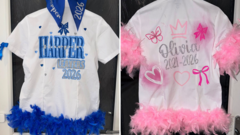
The final day of secondary education has transitioned from a localized, unstructured rite of passage into a highly coordinated, consumer-driven micro-economy. Historically, the tradition of "shirt signing"—where departing students use permanent markers to scribble farewell messages on their standard school uniforms—was spontaneous and destructive by design. Today, a structural shift has occurred: students are increasingly commissioning bespoke, pre-printed custom leavers shirts weeks before their departure. This is not merely a shift in consumer preference; it is a calculated optimization of memory preservation, social signaling, and peer-group coordination.
Understanding this phenomenon requires moving past superficial explanations about teenage sentimentality. By analyzing the market drivers, the cost-benefit trade-offs made by students and parents, and the supply-chain efficiencies that have lowered the barrier to entry, we can map the exact mechanics behind this modern school ritual.
The Three Pillars of Value Driving Custom Subventions
The migration from standard school uniforms to custom-manufactured leavers shirts rests on three distinct socio-economic pillars.
1. Optimization of the Canvas Area (The Preservation Utility)
A standard school shirt is optimized for administrative compliance, not ink retention. Traditional shirt signing suffers from high entropy: text overlaps, marker ink bleeds through cheap polyester-cotton blends, and vital signatures are lost in areas prone to high friction or poor visibility (such as the armpits or lower hem).
Bespoke leavers shirts solve this structural flaw by treating the garment as a planned data architecture. By pre-printing core information—such as a grid of all class surnames, the graduation year, and institutional branding—the available white space is maximized for high-value, handwritten messages. The custom shirt separates the structural data (the collective identity) from the unstructured data (the personal notes), increasing the long-term archival value of the artifact.
2. The Mitigation of Regret and Social Friction
The final hours of secondary school are characterized by high cognitive load and compressed timeframes. Students face a logistical bottleneck: they must secure signatures from dozens of peers within a window often limited to a single lunch break or afternoon assembly.
This environment creates two distinct social risks:
- The Omission Risk: Failing to secure a signature from a significant peer due to time constraints.
- The Quality Degradation Risk: Rushed, illegible signatures that lose meaning over time.
Pre-printed shirts mitigate these risks by ensuring that every peer’s identity is already permanently recorded on the garment via the collective class roster. The handwritten element is therefore freed from the burden of basic identification; it can instead focus entirely on qualitative sentiment.
3. Signaled Cohesion and Group Identity
Uniforms are designed to enforce institutional hierarchy and suppress individuality. The custom leavers shirt flips this dynamic. It serves as a visual marker of status—distinguishing the graduating cohort from lower-year students who remain bound by standard dress codes. It represents a brief, highly specific window of collective autonomy: a uniform created by the group, for the group, signaling the imminent transition out of the institutional framework.
The Supply-Chain Mechanics: Why Now?
This consumer shift could not exist without a corresponding shift in manufacturing economics. Twenty years ago, the minimum order quantities (MOQs) and setup costs associated with screen printing made small-batch custom apparel prohibitively expensive for a single class of students.
[Traditional Screen Printing] High Setup Cost + High MOQ = Cost Barrier for Small Cohorts
[Modern Digital Printing/DTG] Low Setup Cost + Zero MOQ = Viable Micro-Customization
The proliferation of Print-on-Demand (POD) networks, Direct-to-Garment (DTG) digital printing, and specialized sublimation techniques changed the cost function. The marginal cost of adding individualized names or complex multi-color designs has approached zero.
Furthermore, the democratization of vector design software allows students to act as their own creative directors. A student representative can aggregate peer inputs, design a layout using free templates, and interface directly with a digital apparel manufacturer. The manufacturer handles fulfillment through a dedicated online portal where parents pay individually, eliminating the historical bottleneck of a single coordinator collecting cash and tracking sizing spreadsheets.
The Cost-Benefit Equation for the Household Unit
To understand why parents sanction this expenditure, the custom shirt must be evaluated as an economic alternative to the traditional practice.
| Variable | Traditional Shirt Signing | Custom Leavers Shirt |
|---|---|---|
| Garment Source | Current active school uniform | Purpose-bought secondary garment |
| Sunk Cost Destruction | High (Destroys a wearable uniform shirt) | None (Preserves active uniform wardrobe) |
| Average Unit Cost | Equivalent to replacement shirt (£15 - £25) | Retail purchase price (£20 - £35) |
| Archival Longevity | Low (Subject to ink fade, thinning fabric) | High (Heavyweight cotton or sublimated polyester) |
| Time Investment | High stress, real-time signature hunting | Low stress, pre-registered group design |
When a student ruins a standard uniform shirt on their final day, they are effectively destroying an asset that often has residual value—either for remaining exams, future siblings, or secondary market donation. If the student has younger siblings, or if final exams require uniform compliance for several weeks after the official leaving date, destroying an active shirt forces a premature replacement purchase.
Purchasing a dedicated custom shirt preserves the integrity of the existing uniform wardrobe. The household capital expenditure remains relatively flat, while the utility of the resulting artifact increases dramatically.
Operational Hurdles and Limitations
While the trend offers clear psychological and logistical advantages, the deployment of a custom apparel strategy across a cohort introduces several operational vulnerabilities that organizers frequently overlook.
The Roster Accuracy Bottleneck
The single greatest point of failure in the production of custom leavers shirts is data integrity regarding the student roster. Class lists are dynamic, subject to mid-year transfers, withdrawals, and spelling discrepancies in administrative databases. A single missing name or misspelled surname on a pre-printed design invalidates the garment's utility as an authoritative historical record, leading to immediate reputational friction within the cohort and potential financial liability for the student organizer.
Institutional Resistance and Compliance Risk
Schools are risk-aversive institutions governed by strict behavioral and uniform policies. Many headteachers view custom shirts as a premature breakdown of discipline, particularly if the garments are worn during active instructional time or prior to the official final assembly. If a cohort commissions shirts that violate school branding guidelines, feature inappropriate inside jokes, or are donned before the sanctioned time, schools frequently confiscate the garments or bar the wearers from end-of-term celebrations.
The Inclusivity Deficit
Unlike standard school uniforms, which are sometimes subsidized or provided through low-income grants, custom leavers shirts are almost universally funded via voluntary out-of-pocket contributions from parents. If the coordination team sets a high price point or fails to establish an anonymous subsidy fund for disadvantaged pupils, the custom shirt transitions from a tool of group cohesion into a visual marker of economic exclusion on the final day of school.
The Strategic Path for Organizers and Vendors
To execute a flawless leavers shirt deployment, student committees and apparel vendors must shift from a reactive ordering model to a structured operational timeline.
Organizers must establish a hard lock on the student roster at least six weeks prior to production, requiring a signed sign-off sheet from the school's administrative office to verify spellings. To solve the inclusion dilemma, the cost of the garment should be structured with a micro-margin (e.g., adding £1.50 to each shirt price) to create a discreet subsidy pool, ensuring total cohort participation regardless of socioeconomic status.
Finally, vendors must design products that explicitly accommodate post-production personalization. This means utilizing heavyweight, ring-spun cotton (minimum 180 GSM) treated to prevent lateral capillary action—commonly known as ink bleeding—when subjected to standard permanent markers. The future of this market belongs to operators who treat the graduating day not as a sentimental milestone, but as a time-sensitive logistical event requiring rigorous data management and robust material science.