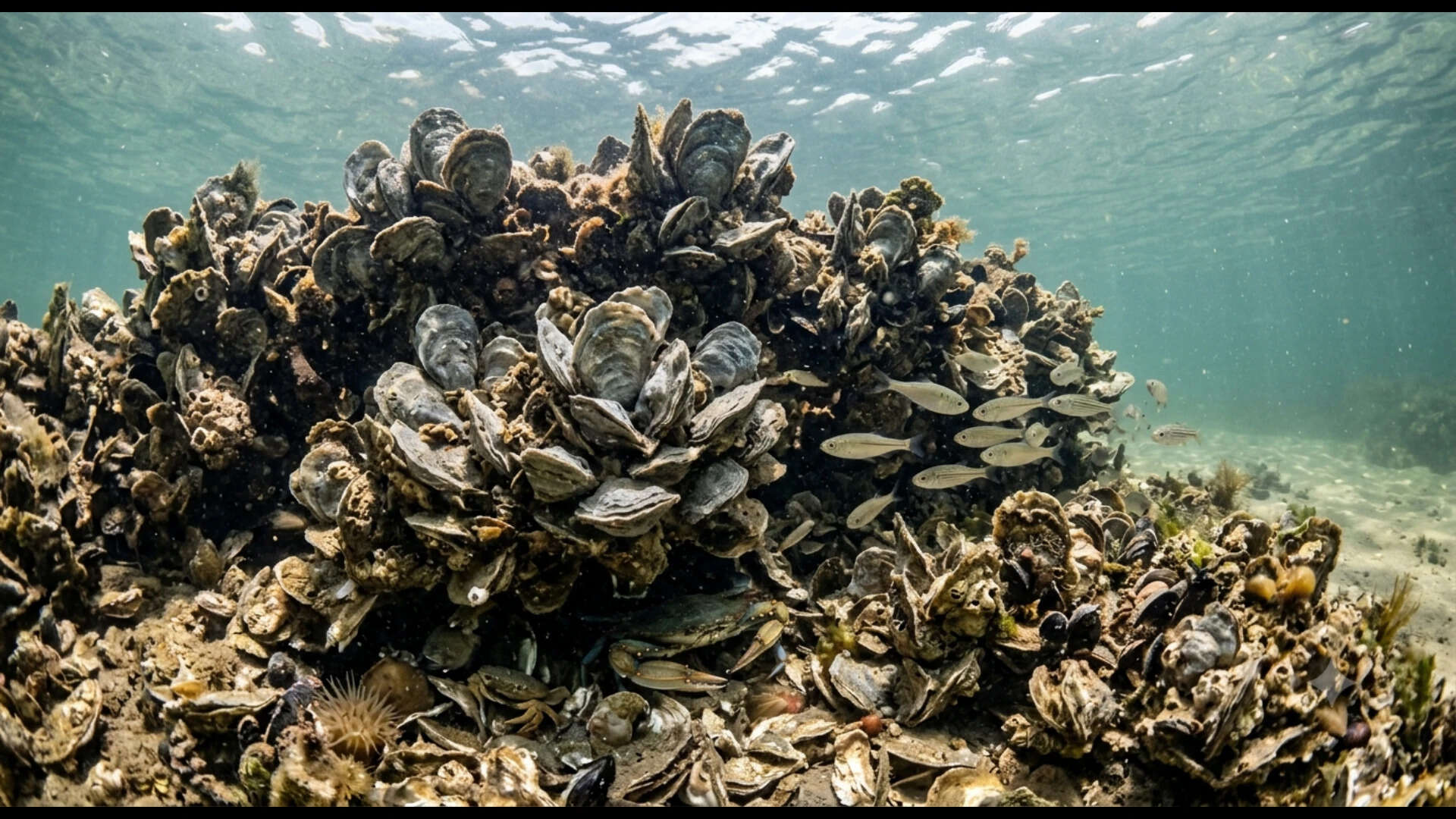
Ocean habitat restoration projects frequently fail because they treat environmental recovery as a conservation issue rather than a supply chain and structural engineering challenge. When hospitality sectors deposit organic waste—specifically calcium carbonate shells from restaurants—into coastal marine environments, they execute a dual-variable system transformation: diverting solid waste from municipal landfills while constructing dense biological substrates for apex marine predators. Evaluating this mechanism requires analyzing biological substrate deposition, marine ecological succession, and municipal cost offset dynamics.
The Tri-Stage Substrate Dynamics of Recycled Shell Reefs
The transformation of commercial seafood byproduct into self-sustaining marine infrastructure operates across three distinct mechanical phases.
Phase One: Substrate Aggregation and Chemical Stabilization
Commercial raw bars generate metric tons of Crassostrea virginica (Eastern oyster) and clam shells weekly. Landfill disposal exposes this organic material to anaerobic decomposition, generating methane. Diverting this material requires a mandatory curing process—typically exposure to sunlight and outdoor atmospheric conditions for 6 to 12 months—to eliminate residual soft tissue, pathogens, and non-indigenous biological material.
Once cured, the physical property of the shell aggregate becomes its primary utility. Calcium carbonate ($CaCO_3$) provides an ideal surface chemistry for wild oyster larvae (spat) settling. Free-swimming larvae detect chemical signatures from established calcium carbonate beds, inducing settlement and metamorphosis. Concrete rubble and artificial structures lack this chemical signaling specificity, yielding lower initial recruitment density per square meter.
Phase Two: Micro-Topographical Complexity and Larval Recruitment
A flat seabed offers zero protection against shear stress caused by tidal currents and wave action. Deposited shell matrices alter boundary-layer fluid dynamics. The interstitial spaces within shell piles create micro-refugia where velocity decreases significantly, enabling weak-swimming larvae to anchor without being swept away by hydrodynamic drag.
- Interstitial volume ratio: Shell beds maintain an irregular 3D matrix, creating high micro-surface area relative to total mass.
- Hydrodynamic drag reduction: The rough boundary layer dissipates energy, stabilizing sediment underneath the reef structure.
- Surface area expansion: Interlocking shell geometry increases available settlement surface area by factors of four to six compared to flat seabed topographies.
Phase Three: Trophic Level Amplification
Once spat establishes on the substrate, the structural transition from aggregate dump to functioning ecosystem accelerates through trophic cascading.
- Primary Producer Establishment: Microalgae, benthic diatoms, and bio-eroding sponges colonize the non-occupied shell surfaces.
- Secondary Consumer Migration: Small invertebrates, crustaceans, and juvenile teleost fish utilize the interstitial voids as shelter from apex predators, dropping juvenile mortality rates sharply.
- Apex Predator Attraction: Target species such as Sciaenops ocellatus (red drum), Cynoscion nebulosus (spotted seatrout), and Tursiops truncatus (bottlenose dolphin) exploit the high prey density generated by the structured habitat.
Quantification of Municipal Waste Diversion and Marine Yield
Converting waste management expenses into ecological capital relies on specific financial and structural metrics. Municipal waste processing operates on tipping fees per ton, while marine resource management operates on biomass density per hectare.
The financial equation balancing tipping fee avoidance against collection logistics follows a straightforward cost differential:
Total Cost Differential = (Landfill Tipping Fee per Ton - Collection and Curing Transport Cost per Ton) * Total Volume Diverted
When transport and curing operational costs remain lower than local landfill tipping fees, the supply chain achieves net-positive operational economics before accounting for secondary economic drivers like recreational fishery yields.
Biological Density Metrics Across Habitat Types
| Habitat Metric | Bare Sand Bottom | Un-Cured Concrete Debris | Cured Bivalve Shell Matrix |
|---|---|---|---|
| Larval Settlement Density (Units/m²) | Low (< 50) | Moderate (150 - 300) | High (> 1,200) |
| Interstitial Complexity Index | 1.1 | 2.4 | 4.8 |
| Benthic Invertebrate Biomass | Base Level | 2.5x Base | 8.0x Base |
| Cetacean Foraging Frequency | Periodic Transient | Moderate Seasonal | High Recurrent |
System Bottlenecks and Structural Failure Modes
Substrate deployment carries specific material and logistical risks that destroy economic and ecological return on investment if unmitigated.
Hypoxic Sediment Sinking
Deploying heavy aggregate over soft, muddy estuarine beds causes immediate structural subsidence. The mass of the aggregate forces the substrate below the oxygenated sediment surface, smothering established larval colonies and neutralizing the micro-topographical complexity. Mitigation requires pre-surveying benthic sediment density using side-scan sonar and penetrometers to establish minimum load-bearing thresholds.
Pathogen Transfer and Biosecurity Vulnerabilities
Inadequate curing cycles introduce Perkinsus marinus (Dermo) or Haplosporidium nelsoni (MSX) parasites into wild populations. Commercial shellfish transport across watershed boundaries risks introducing invasive strains or novel biological vectors into clean estuaries. Protocol mandates strict minimum thermal and duration thresholds for curing yards prior to marine deployment.
Micro-Site Selection and Hydrodynamic Displacement
High-energy coastal environments subject un-bound shell matrices to movement during major storm events. Unanchored shell beds dislodge, washing onto shorelines or suffocating adjacent seagrass beds. Structural success requires stabilizing perimeter boundaries with heavier limestone rock or contained biodegradable mesh vectors until biological cementation by living spat fuses the substrate into a monolithic reef structure.
Operational Execution Protocol for Estuarine Recovery
Municipalities and private enterprise joint ventures seeking to replicate this marine restoration framework must execute a disciplined deployment sequence.
- Supply Chain Integration: Establish daily procurement pathways with high-volume hospitality vendors, deploying food-grade, leak-proof collection bins to eliminate vector contamination at the point of origin.
- Curing Facility Operations: Secure dedicated, high-sunlight upland staging areas with impermeable containment liners to prevent runoff into local freshwater tables during the 12-month quarantine cycle.
- Site Selection Hydrodynamics: Map candidate deployment zones using multi-beam bathymetry, assessing depth, flow velocity, salinity gradient, and existing wild spat availability.
- Tiered Substrate Deployment: Lay down heavy, high-density base material (such as crushed limestone) over soft sediments, followed by a top layer of cured bivalve aggregate to maximize surface area and settlement cues.
- Post-Deployment Monitoring Protocols: Deploy quarterly acoustic fish tagging tracking arrays and fixed-quadrat benthic sampling to quantify recruitment rates, species richness, and structural stability across a five-year horizon.
To maximize capital efficiency, regional managers must stop treating restaurant shell recovery as a public relations activity and manage it as a specialized marine civil engineering pipeline. Direct resource allocation toward establishing centralized shell-curing hubs within a 30-mile radius of target deployment estuaries; exceeding this distance introduces transportation fuel costs that erase the operating margin between tipping fee savings and structural reef construction.


