Saltwater does not care about borders. It never has. It laps against the jagged concrete pillars of the border fence just as indifferently as it rolls over the fine, sun-warmed sand of Trampolin beach.
The heat hits you first. Not a friendly, Mediterranean vacation warmth, but a heavy, pressing weight that sits on your chest and refuses to lift. It smells of dead seaweed, diesel fumes from distant patrol boats, and the sharp, sour tang of unwashed bodies crowded too close together for too long. If you stand on the heights overlooking the Spanish enclave of Ceuta, perched at the very top of Morocco's jagged northern coast, the geography looks like a cruel trick. Europe is right there. You can almost taste it. You can see the white-capped ferries slicing through the Strait of Gibraltar toward Algeciras, a mere fourteen kilometers away. Fourteen kilometers. A strong swimmer could dream of it. But dreams do not cross militarized fences, and the water between here and the other side is colder and deeper than it looks.
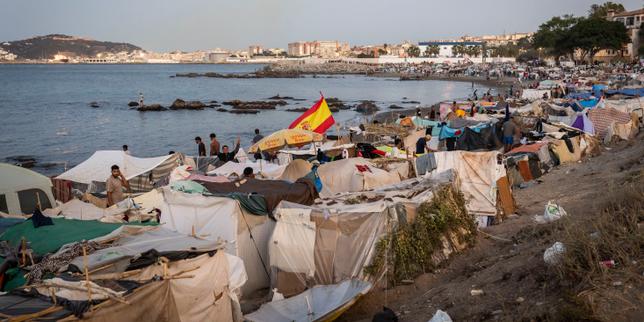
Below, on the sands of Trampolin beach, the reality of thousands of human beings reduced to waiting takes on a physical shape.
They are huddled under makeshift tents constructed from discarded plastic tarps, sun-bleached blankets, and driftwood scavenged from the shoreline. The wind off the Atlantic whips through the camp, carrying fine grit that gets into everything—eyes, teeth, the meager rations of bread, the folds of damp clothing. There are young men here who left families behind in sub-Saharan villages months ago, trading everything they owned for a whispered promise whispered by smugglers who vanished the moment the money changed hands. There are teenagers with eyes too old for their faces, staring out at the grey horizon with an unsettling, hollow fixation.
To understand what is happening on Trampolin beach, you have to strip away the sterile language of geopolitical reports and policy briefs. We talk about migrant crises as if they are weather events—hurricanes forming over the horizon, inevitable and impersonal. They are not. They are collections of individual heartbeats, each carrying a story of flight from poverty, conflict, or despair so total that the terrifying unknown of the sea felt safer than staying still.
Consider Malik.
(Note: Malik is a composite character constructed from verified testimonies collected by humanitarian workers operating in the enclave.)
Malik spent twenty-two days walking through the desert before he even smelled the ocean. When he finally reached the northern coast of Morocco, the border fence—that towering tangle of razor wire, thermal cameras, and armed guards—loomed like a concrete wall of rejection. Yet, driven by a desperation that defies rational calculation, thousands like him pushed past the barriers, sliding down the steep ravines and spilling onto the beaches of Ceuta.
Now, he sits on a patch of damp sand, using a smooth pebble to scratch patterns into the earth that he immediately rubs out.
"The waiting is worse than the walking," he says quietly, his voice raspy from salt and dust. He doesn't look up. His gaze remains fixed on a Spanish Guardia Civil vessel cutting a white furrow through the blue expanse just beyond the breakwater. "When you walk, your legs hurt, but your mind has a destination. Here, you are breathing, but your life has stopped. You are neither here nor there. You are a ghost on the sand."
The conditions on the beach are appalling. The Spanish Red Cross and local aid groups struggle to deliver basic supplies, but the sheer volume of arrivals overwhelms the infrastructure. Sanitation is virtually nonexistent. Makeshift latrines overflow near the water's edge, and freshwater is a precious commodity traded in plastic bottles that pass from hand to hand like currency. Skin infections bloom in the salt air. Coughs rattle through the crowded tents as night brings a sharp, bone-chilling drop in temperature.
Yet the most corrosive element isn't the physical filth or the lack of food. It is the absolute suspension of time.
Governments negotiate behind closed doors in Madrid and Rabat. Bureaucrats shuffle paperwork, debating quotas, security protocols, and international maritime law. Meanwhile, the tide comes in, and the tide goes out. The refugees adjust their plastic tents, move away from the rising foam, and wait for a verdict on their humanity that takes months to arrive.
Why do they keep coming?
The question is asked with weary regularity by commentators sitting in air-conditioned studios thousands of miles away. It betrays a fundamental misunderstanding of push factors. People do not risk drowning in the Strait of Gibraltar or baking in desert dust because they are curious about Europe. They come because the alternative at home is a slow starvation of the soul and the body. When your village has no jobs, no security, and no future, the impossible gamble of migration ceases to be a gamble at all. It becomes the only logical choice left to a human being who refuses to disappear quietly.
Ceuta has long been a geopolitical anomaly—a tiny fragment of the European Union physically attached to the African continent. This geographic quirk makes it a magnetic north for anyone looking to cross the threshold into Europe. But it also turns the enclave into a pressure cooker. The local authorities are caught in an impossible squeeze between humanitarian obligations and political directives from capitals thousands of miles away that view immigration primarily as a security threat to be managed rather than a human reality to be addressed.
As the sun dips toward the horizon, painting the sky in violent streaks of orange and bruised purple, the atmosphere on Trampolin beach shifts.
The daytime heat gives way to a damp, biting chill. Fires are lit using scrap wood, casting flickering orange shadows across dozens of tired faces. Voices drop to a murmur. Someone starts humming a tune from home—a slow, minor-key melody that drifts over the murmur of the surf.
Across the water, the lights of the Spanish mainland begin to twinkle, indifferent and bright.
Malik pulls his blanket tighter around his shoulders, watching those distant lights flicker against the gathering dark. He doesn't smile, and he doesn't despair. He simply watches, waiting for the dawn, and the tide, and whatever comes next.