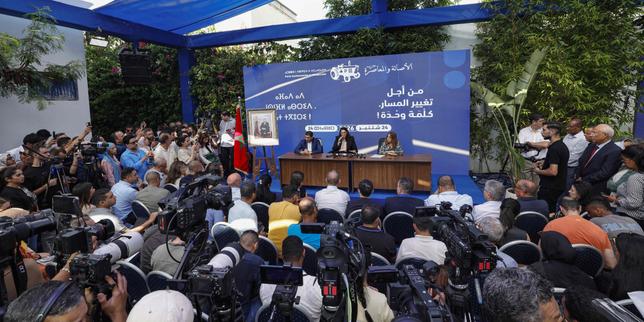
The polling stations stood remarkably quiet across Rabat, Casablanca, and Marrakech on election day. Only thirty-eight percent of registered voters bothered to cast a ballot. That single statistic exposes a profound, widening disconnect between the Moroccan public and the political institutions designed to represent them. Nearly two-thirds of the electorate chose silence over participation. This was not mere civic apathy. It was a calculated, quiet rejection of a governance model that many citizens feel has systematically left them behind.
To understand what transpired during the parliamentary elections, one must look past the superficial reshuffling of seats in the House of Representatives. The Authenticity and Modernity Party secured ninety-seven seats, positioning its leadership at the center of the executive formation talks. The National Rally of Independents dropped significantly after leading the previous administration. The Istiqlal party held steady while the Justice and Development Party engineered an unexpected parliamentary comeback. Yet focusing solely on seat counts misses the deeper structural crisis gripping the North African kingdom.
The Anatomy Of Voter Apathy
Numbers tell a harsh story. Out of more than twenty-six million citizens of voting age, fewer than sixteen million registered. Registration numbers dropped notably compared to previous cycles, even as the overall population expanded. Young citizens aged eighteen to twenty-four represented a tiny fraction of active rolls. For this demographic, political parties offer little tangible hope for employment, social mobility, or meaningful political influence.
Disillusionment runs deep across every social strata. High inflation has severely eroded purchasing power over the past several years, with essential food staples registering steep price increases that hit working-class households hardest. Public services in healthcare and education have struggled to meet basic demands, leaving citizens to shoulder mounting out-of-pocket costs. Months prior to the election, social frustrations boiled over into street demonstrations and youth-led mobilization efforts that shook urban centers. Authorities responded with both security measures and promises of reform, but the underlying bitterness remained unresolved. When citizens feel that their daily economic struggles receive scant attention from elected officials, the ballot box loses its legitimacy. Abstention becomes the loudest voice in the room.
The Ascendancy Of The Palace Party
The Authenticity and Modernity Party emerged from the ballot box as the leading political force. Founded nearly two decades ago with close institutional ties to the royal establishment, the party managed to weather public anger directed at the outgoing coalition. Its campaign focused on administrative capability, technocratic competence, and efficient management, appealing to voters who prioritize stability over ideological rhetoric.
Securing ninety-seven seats did not grant an outright majority in the three-hundred-and-ninety-five-member chamber. Coalition arithmetic immediately became the central preoccupation of political operators. The victorious party faced the delicate task of assembling a governing majority without alienating an electorate already exhausted by traditional political horse-trading. Observers noted that the prime ministerial appointment would fall naturally to the party's leadership, setting up a new administrative configuration at the head of government.
Yet governing alongside former partners who suffered heavy voter backlash presents severe risks. The National Rally of Independents took a severe beating at the polls, paying the political price for heading an executive branch burdened by economic hardship. Aligning too closely with discredited former ministers risks tainting any fresh mandate before it even begins.
The Islamist Rebound From The Margins
Few analysts anticipated the scale of the Islamist opposition's return. The Justice and Development Party surged to win fifty-four seats, marking a dramatic reversal of fortune after its crushing defeat in the preceding electoral cycle. Five years prior, voters punished the party severely after a decade leading the government, reducing its parliamentary footprint to a mere handful of deputies.
This time, the political pendulum swung back. Capitalizing on widespread public anger against the incumbent administration, the party positioned itself as an anti-corruption crusader. Its campaign messaging struck a chord with urban voters who felt betrayed by economic stagnation and broken administrative promises. Furthermore, regional foreign policy issues, including popular mobilization around diplomatic normalization agreements and solidarity movements, provided fertile ground for opposition rhetoric.
Despite this unexpected legislative resurgence, the party leadership quickly announced its intention to sit firmly in parliamentary opposition rather than join the new executive coalition. Remaining outside the government allows the party to maintain its populist critique without taking direct responsibility for intractable economic reforms. It is a calculated retreat to the sidelines, designed to preserve credibility for future electoral cycles while keeping pressure on the ruling parties.
Development At Two Speeds
Economic realities underpin every political tremor in the kingdom. The king himself previously denounced what he characterized as a pattern of development proceeding at two distinct speeds. While gleaming infrastructure projects, high-speed rail lines, and advanced industrial zones attract foreign investment in major urban hubs, rural hinterlands and peripheral urban neighborhoods experience acute neglect.
Youth unemployment remains stubbornly high, creating a reservoir of frustration that periodic economic growth statistics fail to dissolve. Millions of young people see emigration as their only viable escape hatch. When formal political structures fail to offer channels for upward mobility, economic grievances inevitably transform into social unrest. The political parties competing for parliamentary seats offered remarkably few credible blueprints to bridge this structural chasm. Instead, campaigns relied heavily on patronage networks and traditional clientelism, mechanisms that hold little appeal for a younger, more connected generation.
The Looming Shadow Of The World Cup
Administrative pressure on the incoming government is immense. The country is preparing to co-host the twenty-thirty global football tournament alongside Spain and Portugal. This massive international showcase represents both an extraordinary economic opportunity and a high-stakes governance test. Billions of dollars are flowing into stadium construction, transport networks, and hospitality infrastructure.
However, mega-events often exacerbate domestic economic inequalities if the wealth generated fails to trickle down to ordinary citizens. Public scrutiny will be unrelenting. The incoming administration must deliver visible improvements in public services, healthcare accessibility, and job creation while managing massive infrastructural transformations. Failure to meet these domestic expectations under the international spotlight would amplify public cynicism to dangerous levels.
A Fragile Mandate
The parliamentary election concluded with a government majority mathematically intact on paper, yet politically fragile in reality. Winning an election with a thirty-eight percent turnout rate provides no mandate for sweeping structural transformation. The real challenge facing the political class lies beyond coalition arithmetic.
Restoring faith in democratic representation requires radical transparency, accountability, and tangible improvements in the daily lives of ordinary citizens. Without these fundamental changes, the silent majority will remain silent, waiting for another moment to express its profound discontent. For further context on how these dynamics played out during the polling stations' opening hours, watch this overview on Moroccan legislative elections analysis. This video provides a direct look at the low turnout and the shifts that reshaped the parliament.