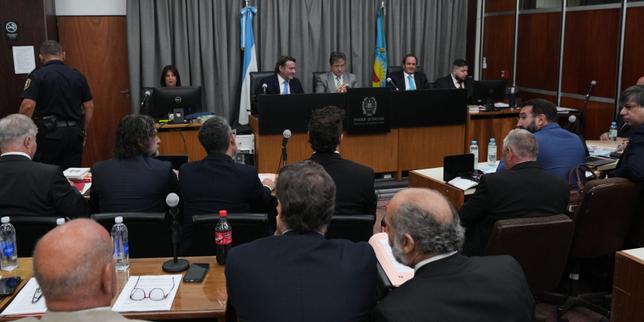
The air in the San Isidro courtroom doesn’t smell like grass or expensive cigars. It smells of floor wax and old paper. There is a specific, heavy silence that settles over a room when the person everyone is talking about is the only one who cannot speak. Outside, the heat of Buenos Aires presses against the windows, and the ghosts of a thousand Sunday afternoons at La Bombonera seem to hover just out of reach.
Diego is gone. But in this room, he is a file. He is a series of medical charts. He is a collection of testimonies from people who were supposed to be his shield and are now his accused. Read more on a related topic: this related article.
The setting feels like a glitch in time. One year has passed since the last major hearing, yet as the lawyers take their seats, the scene is an eerie carbon copy of the previous gathering. The same faces. The same sharp suits. The same grief-stricken eyes of his daughters, Dalma and Gianinna, who sit like statues, mourning a father while the world continues to autopsy a myth. It is a carousel of justice that seems to spin without moving forward.
The Myth vs. The Man
To understand why this courtroom feels so claustrophobic, you have to look past the "Hand of God." Forget the goal against England for a moment. Forget the trophies. To the world, he was a god. To the eight medical professionals facing "simple homicide with eventual intent," he was a patient. To himself, toward the end, he was a tired man in a house in Tigre that felt more like a cage than a sanctuary. More journalism by CBS Sports delves into similar views on the subject.
The legal battle isn't just about a heart that stopped beating on November 25, 2020. It is about the days leading up to that silence. The prosecution argues that the care provided—or lack thereof—was "reckless" and "deficient." They describe a scenario where a man who had given everything to his country was left to fade away in a room that wasn't even equipped with the basics of home hospitalization.
Imagine being the most famous person on the planet and feeling utterly alone.
The defense counters with the image of an "ungovernable" patient. They paint a picture of a Diego who refused help, who chased doctors away, who was the master of his own decline. This is the central tension of the trial: where does the autonomy of a legend end and the responsibility of his keepers begin?
A House Without a Pulse
The details that emerge from the case files are haunting because they are so mundane. We aren't talking about grand conspiracies or cinematic betrayals. We are talking about missed check-ups. We are talking about a heart that was doubling in size while the people in the next room argued over who was in charge.
Consider the "home hospitalization" setup in Tigre. In a standard medical facility, a patient with Diego’s history of cardiac issues and substance withdrawal would be monitored by a battery of machines. There would be the rhythmic chirp of a heart monitor, the presence of a defibrillator, the constant oversight of specialized nurses.
In Tigre, there was a bed. There was a portable toilet. There was a man who had become a shadow of the athlete who once danced through the Italian defenses in Naples.
The prosecution’s narrative is one of "abandonment." They suggest that the medical team—including neurosurgeon Leopoldo Luque and psychiatrist Agustina Cosachov—knew the risk of death was high and did nothing to prevent it. It’s a chilling thought. It suggests that the very people hired to keep the light burning were the ones who let the room go dark.
The Weight of the Evidence
The trial moves with the agonizing slowness of a heavy tide. There are more than 130 witnesses. There are thousands of pages of WhatsApp messages. These messages are perhaps the most damning and human parts of the evidence. They show a team under immense pressure, sometimes bickering, sometimes joking, while the man in the center of their circle was slowly slipping away.
Reading those transcripts feels like eavesdropping on a tragedy in slow motion. You want to reach through the paper and shout. You want to tell them to look at him. Truly look at him.
But the law doesn't care about "what ifs." It cares about duty. It cares about whether the actions of the accused deviated so far from medical standards that they became criminal. Under Argentine law, "eventual intent" implies that the accused knew their actions could lead to death and were indifferent to that outcome. It carries a potential sentence of 8 to 25 years.
For the defendants, this is a fight for their lives and their reputations. For the family, it is a desperate search for a closure that might not even exist.
The Spectacle and the Silence
There is something deeply uncomfortable about watching the legal system dissect a hero. We want our legends to be invincible. We want them to go out in a blaze of glory, not in a quiet room with a cold cup of tea on the nightstand.
The public’s anger is a living thing. You can feel it in the chants of the fans who gather outside the court, waving flags and wearing jerseys from 1986. They aren't there for the legal nuances. They are there because they feel a personal debt. They feel that if the world couldn't save Diego, the least the world can do is find out who failed him.
But inside the courtroom, the emotion has to be stripped away. The judges must look at the facts of "cardiac edema" and "secondary lung congestion." They have to weigh the expert testimonies of medical boards that have already labeled the care as "inadequate."
It is a grueling process of reliving the end, over and over again. Every hearing is a replay of the final whistle.
Why This Matters
This isn't just a story about a celebrity. It’s a story about the systems we put in place to protect the vulnerable and how easily those systems can crumble when faced with the gravity of a superstar.
When a person becomes a brand, an icon, a national treasure, they often cease to be treated as a human being. They become a problem to be managed. A commodity to be guarded. In the rush to control the "Maradona" name, it seems the "Diego" person was lost in the shuffle.
The trial is a mirror. It asks us what we owe to those who give us so much joy. It asks how we define care and where the line of negligence is drawn in the sand of a complicated life.
The Long Road to a Verdict
The courthouse clock ticks. The lawyers shuffle their papers. The daughters wait.
We are back in the same room, with the same parties, asking the same questions. Was it an inevitable end for a man who lived a hundred lives in sixty years? Or was it a preventable tragedy fueled by ego and incompetence?
The answer won't bring him back. It won't give the world one more free kick or one more defiant interview. But justice isn't about resurrection. It's about accountability. It's about ensuring that the truth is written into the record, so that the myth can finally rest.
As the sun begins to set over San Isidro, the shadows in the courtroom lengthen, stretching across the empty space where a man once stood. The trial will continue. The arguments will persist. The world will keep watching.
Somewhere, perhaps, a ball is still rolling across a dusty pitch in Villa Fiorito, far away from the lawyers, the cameras, and the cold clinical files of a life cut short.