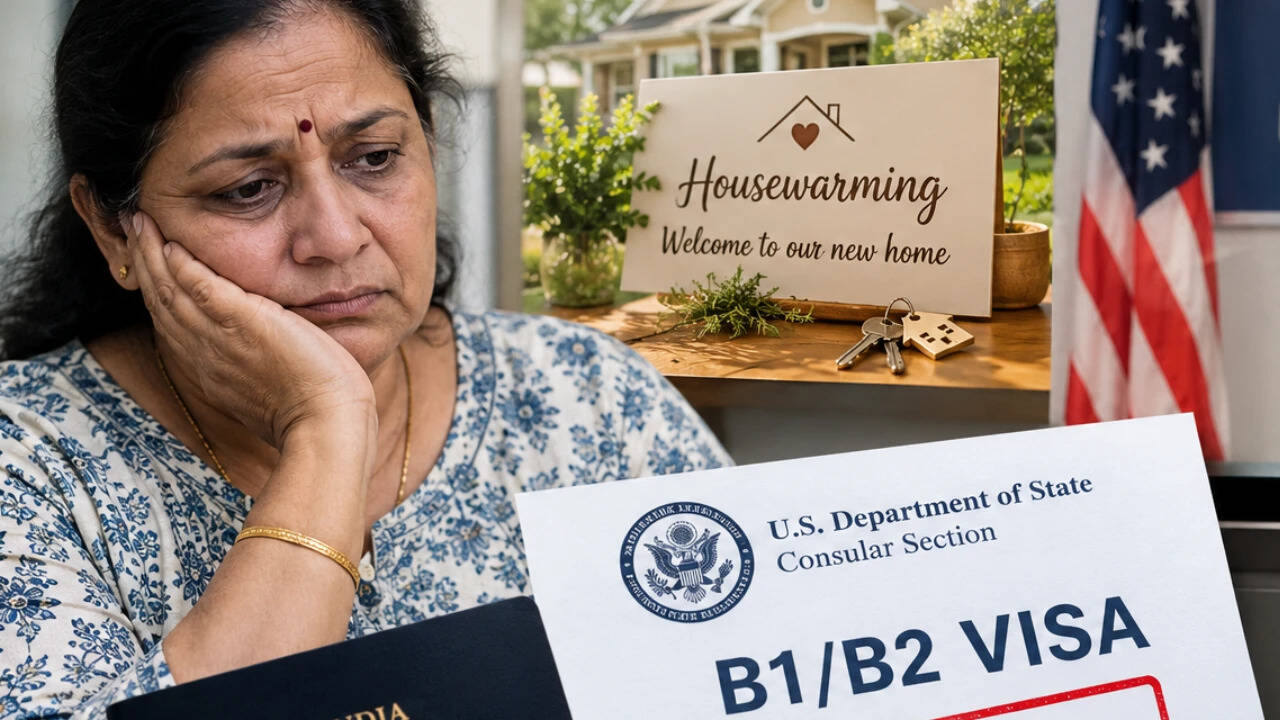
The scent of cardamom and roasted cumin always arrives first, curling under the front door before anyone even turns the key. That was the dream, anyway. A modest living room in suburban Ohio, cleared of moving boxes, waiting for the one person whose approval actually mattered.
Outside, the autumn wind stripped the maples bare. Inside, the floorboards smelled of fresh polyurethane.
Then came the email. Or rather, the absence of one.
When a Green Card holder—someone who has legally woven their life into the fabric of the United States, paying taxes, building credit, planting hydrangeas by the porch—invites their mother to visit for a milestone celebration, they assume the system possesses a basic, human geometry. They assume that documentation matters. They assume that if you bring pay stubs, employment verification letters, property deeds, and tax returns thick enough to stop a bullet, someone behind a glass partition will look at them.
They didn't look.
Consider what happens next in thousands of consular waiting rooms across the globe every single week. A mother walks up to the window. She carries a folder she has guarded with her life, clutching it against her chest the way people hold fragile things on rough roads. Inside are letters proving her ties to her homeland, her return tickets, her grandchildren waiting across the sea. She stands there, ready to prove she is not a ghost, not a risk, not an immigrant in waiting, but simply a mother wanting to see where her child finally landed.
The interview lasts less than three minutes. Sometimes less than ninety seconds.
The officer types into a glowing monitor. The questions rarely touch the actual life being lived back home or the specific joy being celebrated in America. Instead, a wall goes up. Section 214b of the Immigration and Nationality Act drops like a steel shutter: Every applicant is presumed to be an intending immigrant until they establish otherwise.
Guilty until proven innocent. Except the proof isn't allowed to be shown.
When a mother is denied a B1/B2 visitor visa to attend a housewarming ceremony, a wedding, or a graduation, the loss isn't just bureaucratic. It is structural. It alters the emotional architecture of the immigrant experience. You build a life abroad, brick by legal brick, sacrificing birthdays, funerals, and quiet Tuesday dinners to earn your place. You think that once you reach a certain rung of stability—once you hold permanent residency—the invisible walls around your family begin to lower.
They don't. They just shift shape.
The legal reality of nonimmigrant visas creates a strange, paradoxical cruelty for lawful permanent residents and naturalized citizens. Under United States immigration law, a B1/B2 tourist visa is strictly nonimmigrant. The applicant must prove, beyond a shadow of a doubt, that they have zero intention of staying permanently. But here is the trap: having a child who is a Green Card holder or a U.S. citizen is often viewed by consular officers not as a reason to visit, but as an overwhelming incentive to remain.
Your success becomes your family's liability.
Because you built a stable home, because you have a spare bedroom, because you can afford a round-trip ticket, the algorithm flags you. The closer you are to your family, the more desperate you appear to keep them with you. And so, the documents you brought—the bank statements, the land titles, the retirement accounts—are often glanced at for three seconds before being slid back across the counter untouched.
They did not ask for any documents.
That single sentence echoes across WhatsApp groups and community forums late at night. It is the universal cry of the rejected applicant. It feels less like a denial and more like a dismissal. It suggests that the decision was made before the window even opened, locked behind internal guidelines and risk matrices that ordinary human beings cannot pierce.
We talk endlessly about immigration through the lens of borders, policies, and macroeconomics. We treat it as a ledger of numbers, quotas, and processing backlogs. But immigration is fundamentally about distance. It is about the physical space between the people who love each other and the milestones they are forced to celebrate through pixelated screens.
Imagine standing in a kitchen you spent years saving to buy, holding a phone so your mother can watch you cut the ribbon on your front door from four thousand miles away. The Wi-Fi lags. Her face freezes mid-smile, pixelated and grey against the kitchen island. You tell her the food smells amazing, even though she can't smell it. You promise her that next time will be different, even though deep down, you both know the odds.
The housewarming cake gets cut. The guests clap.
And the chair at the head of the table remains precisely what it has always been since the plane tickets were booked.
Empty.
The system is designed to protect a border, but in doing so, it frequently forgets that a nation of immigrants is also a nation of families. When a mother is turned away without a glance at her papers, the message sent is corrosive. It whispers that no matter how legitimate your status, no matter how honest your intentions, your personal history is secondary to a statistical assumption.
Change does not come easily to massive bureaucratic engines. Consular officers possess vast, unreviewable discretion, a design intended to prevent fraud but one that frequently fosters arbitrariness. Yet, awareness is the first friction against systemic indifference. Families navigating this process learn, often too late, that standard documentation is rarely a shield against discretionary denial. They learn to look beyond the paperwork, preparing not just for an approval, but for the quiet, devastating pivot of walking out of the embassy empty-handed.
Until the framework catches up to the human reality of modern global families, the burden remains on those who have already crossed the ocean to carry the weight of the distance left behind.
The front door is unlocked. The porch light is on.
We are simply waiting for the day when the paperwork is actually read, and the chair at the table finally gets filled.