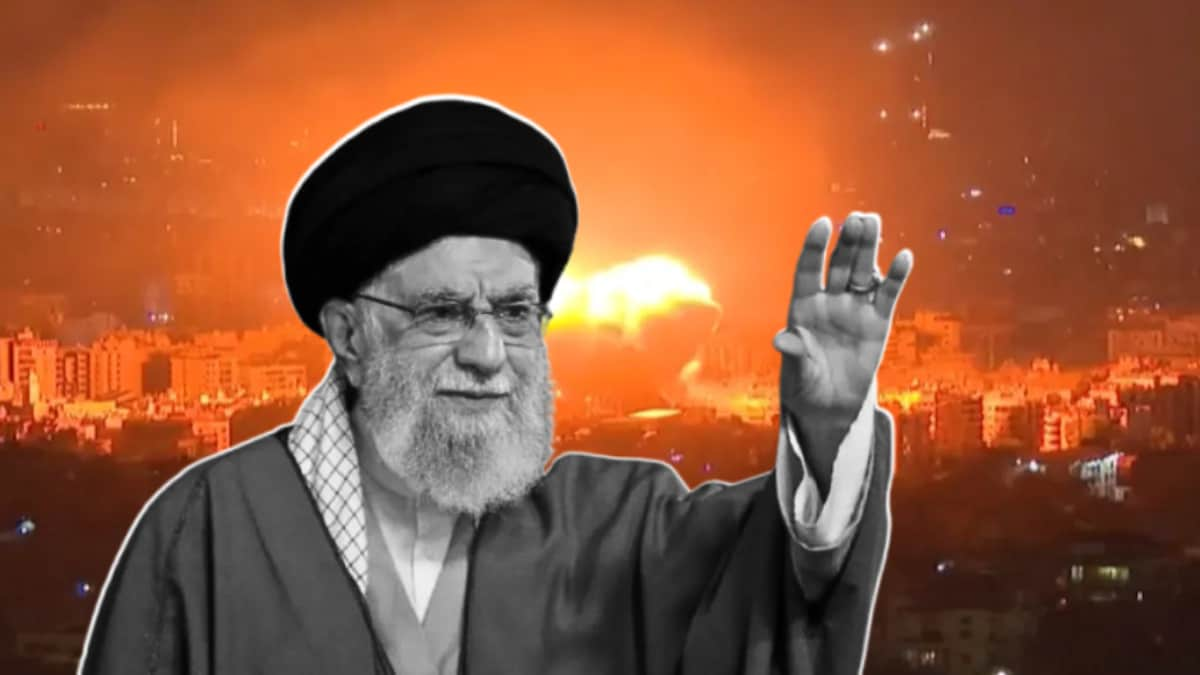
In the windowless rooms of Langley, where the air always smells slightly of ozone and overpriced coffee, the math of geopolitical survival is reduced to a single, haunting variable: the replacement.
We often view history as a series of collisions between Great Men, but intelligence officers see it as a flowchart. Before the missiles were fueled, before the satellites were repositioned, and before the world held its collective breath in anticipation of an Iranian strike, the CIA was busy solving for $X$.
The question wasn't just whether Ali Khamenei would survive a counterstrike. The question was what happens to a nation when the soul of its revolution becomes a ghost.
The Architecture of the Inevitable
The Supreme Leader is 85 years old. In the biological sense, he is already a miracle of endurance. In the political sense, he is a bottleneck. For decades, the Western world has treated the Iranian leadership as a monolith—a dark, unyielding wall of ideology. But the CIA’s recent assessment reveals a more fragile reality. They weren't just looking at military targets; they were looking at the internal plumbing of power.
If a strike had taken Khamenei off the board, the assessment suggested he would be replaced. Immediately.
This sounds like a simple bureaucratic transition, the kind we see in corporate boardrooms. It isn't. In Tehran, the "Next Man Up" philosophy is less about continuity and more about preventing a total cardiac arrest of the state. The CIA wasn't predicting a democratic spring or a sudden embrace of Western values. They were predicting a frantic, high-stakes scramble to fill a vacuum before the air rushed out of the room.
The Ghost in the Assembly
To understand the stakes, you have to look at the Assembly of Experts. Imagine eighty-eight elderly clerics, many of whom have spent their lives debating the nuances of Islamic jurisprudence, suddenly tasked with choosing a successor while the smoke of a missile strike still hangs in the air.
This isn't an election. It’s a seance.
They are looking for someone who can hold together the disparate, often warring factions of the Islamic Revolutionary Guard Corps (IRGC), the traditional clergy, and the restless, youthful population that views the leadership with a mixture of fear and exhaustion. The CIA’s intelligence suggests that the plans for this transition are not just theoretical. They are scripted.
There is a secret list.
Every few years, a small committee within the Assembly of Experts drafts a handful of names. These names are kept in a literal or metaphorical vault. When the CIA assesses that Khamenei would be "replaced," they are betting on the efficiency of this vault. They are betting that the system’s instinct for self-preservation is stronger than any internal rivalry.
The Son and the Shadow
For a long time, the whispering galleries of international diplomacy focused on Mojtaba Khamenei, the leader’s second son. The narrative was clean: a dynasty in the making. But power in Iran is rarely that linear.
The CIA’s analysis has to account for the "legitimacy gap." If the son takes the throne, the revolution looks like the monarchy it worked so hard to overthrow in 1979. If a hardline cleric takes it, the IRGC might find him too difficult to control. If a moderate takes it—well, there are no moderates left in the inner circle.
Consider the psychological weight of this. Every time Khamenei coughs, a dozen men in Tehran and a hundred analysts in Virginia recalculate the odds. They aren't just looking at political leanings; they are looking at health records, family ties, and the specific brand of loyalty each candidate holds toward the IRGC.
The IRGC is the shadow player here. They are the ones with the boots, the boats, and the ballistic missiles. They don't want a leader who will lead them; they want a leader who will provide the religious and legal cover for them to keep doing what they do.
The Simulation of Stability
When the US intelligence community briefed the administration on these findings, they were essentially saying that the Iranian state is "anti-fragile" in the short term. Kill the head, and the body has a reflexive mechanism to sprout a new one.
But reflexes aren't the same as health.
The assessment underscores a grim reality of modern warfare: decapitation strikes—the act of killing a top leader to end a conflict—rarely work the way they do in the movies. Instead of the "Game Over" screen, you often get a "Level 2" that is more chaotic, more desperate, and far less predictable. By assessing that Khamenei would be replaced, the CIA was warning that the removal of a single man wouldn't be the end of the story. It would be the beginning of a much more dangerous chapter.
Think of it as a structural stress test. A building might stay standing if you remove a load-bearing column, but the weight has to go somewhere. It shifts to the smaller, weaker beams. It creates cracks in the foundation that weren't there before.
The Invisible Stakes
Why does this matter to someone sitting thousands of miles away, scrolling through their phone?
Because the "replacement" isn't just a person. It’s a policy. A new leader, born out of the fire of an assassination or a military strike, has no choice but to be more radical than his predecessor. He has to prove his "revolutionary credentials." He has to satisfy the hawks in the IRGC who are screaming for blood.
The CIA knows this. Their assessment isn't a sign of optimism; it’s a cold-blooded acknowledgment of the trap.
We often talk about "regime change" as if it’s a light switch. You flip it, and the room goes from dark to light. The reality is more like a fire in a chemical plant. You can put out the main blaze, but the reactions occurring beneath the surface are now beyond your control. The assessment that Khamenei would be replaced is a recognition that the "system" in Iran is no longer just about one man. It is an ecosystem of survival.
The Arithmetic of the Aftermath
So, the missiles were tracked. The rhetoric was dialed up. The warships moved into position. And behind it all, the analysts kept looking at that secret list of names.
They looked at Ebrahim Raisi before his helicopter went down in the fog of East Azerbaijan. They looked at the quiet technocrats. They looked at the firebrands. They ran simulations of what happens to the global oil price if the transition takes three days versus three weeks.
They realized that the most dangerous moment in history isn't the explosion. It’s the silence that follows, when the world waits to see who steps out of the shadows to claim the chair.
The CIA’s report wasn't about the death of a leader. It was about the immortality of a machine. It was a reminder that in the game of nations, individuals are just placeholders for larger, more terrifying forces.
As the sun sets over the Alborz Mountains, the old man in the black turban continues to breathe. But in a vault somewhere in Tehran, and on a server somewhere in Virginia, his replacement is already being groomed, vetted, and weighed. The math is done. The flowchart is ready.
The chair will not be empty for long.
The question that remains—the one the CIA can't answer with a report—is whether the man who takes that chair will feel he has anything left to lose.
Would you like me to analyze the historical parallels of leadership transitions during active conflicts to see how they usually play out?