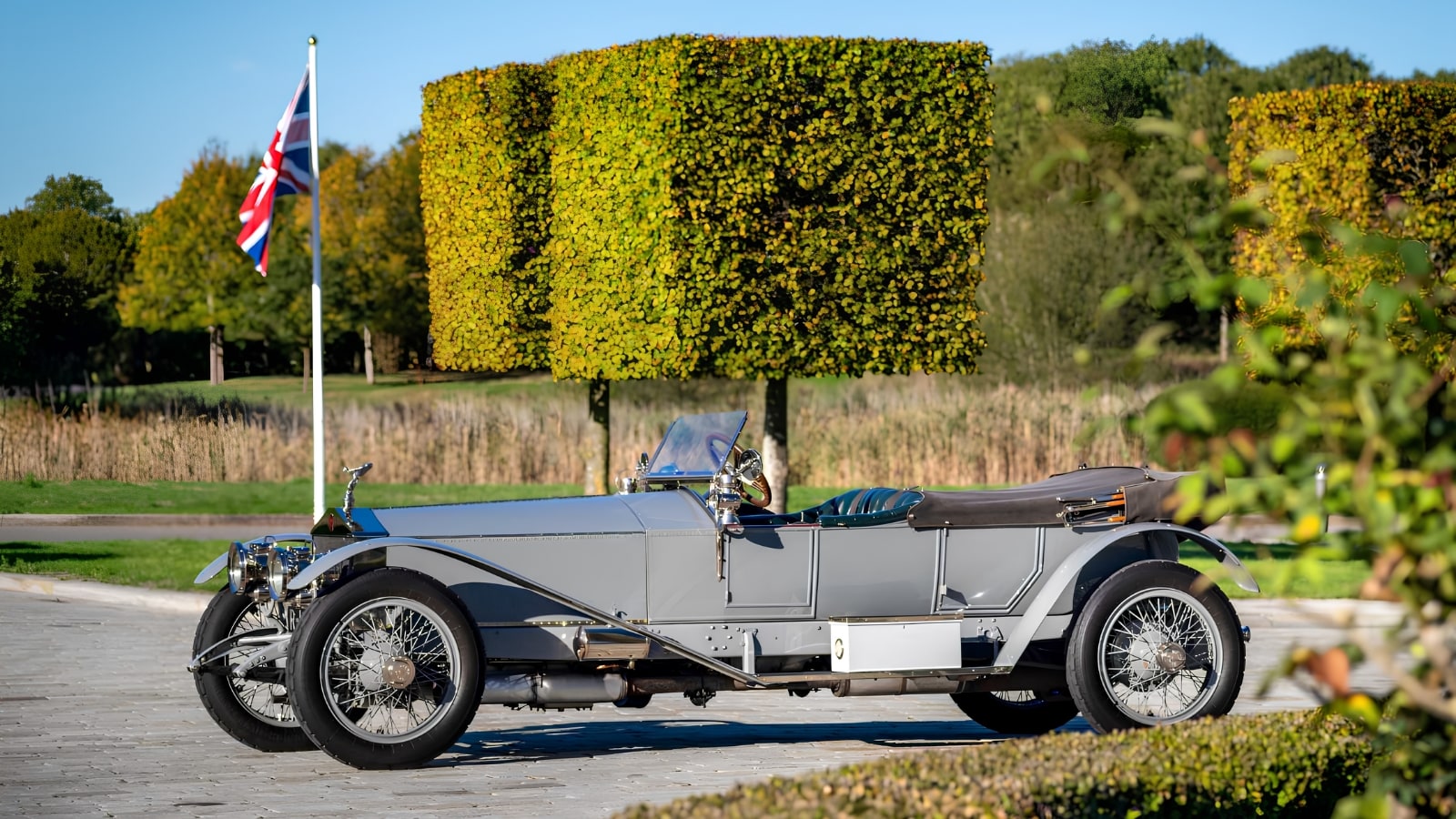
At 120 years old, the Rolls-Royce 40/50 hp—universally known as the Silver Ghost—is routinely mischaracterized as a triumph of Edwardian luxury. This framing obscures the actual historical significance of the chassis. In 1911, a modified 40/50 hp chassis driven by Ernest Hives achieved a timed speed of 101.8 mph at the Brooklands circuit, establishing a benchmark for internal combustion reliability and aerodynamic efficiency that preceded modern automotive engineering by decades. Understanding how a heavy, upright touring chassis broke the 100 mph barrier requires stripping away brand mythology and examining the thermodynamic, mechanical, and aerodynamic variables Henry Royce manipulated to overcome the physical limits of early twentieth-century metallurgy.
The Strategic Pivot From Multi-Model Complexity to Single-Chassis Standardization
Before 1906, the nascent automotive industry operated on artisanal, low-volume production models characterized by rapid, uncoordinated iteration. Manufacturers built two-, three-, four-, and six-cylinder engines simultaneously to capture fragmented market segments. This approach diluted engineering focus and created severe supply chain bottlenecks for high-tolerance components.
Henry Royce executed a decisive strategic consolidation in late 1906 by discontinuing all smaller-displacement models to focus exclusively on a single architecture: the 40/50 hp chassis. This decision established the foundational operational framework that enabled the 1911 speed record. By locking the core architectural variables, Royce shifted his engineering team from horizontal product expansion to vertical component optimization.
- Thermal Load Distribution: Moving from four cylinders to an inline-six configuration reduced the reciprocating mass per cylinder while maintaining high total displacement (initially 7,036 cc, later expanded to 7,428 cc in 1910). Smaller individual pistons dissipated heat more efficiently through the cylinder walls, preventing the pre-ignition and piston seizure common in large-bore four-cylinder racing engines of the era.
- Harmonic Balance: An inline-six engine achieves primary and secondary mechanical balance naturally. Eliminating destructive harmonic vibrations allowed the crankshaft to sustain higher rotational speeds without fatiguing the white-metal bearings—a critical prerequisite for sustained high-speed runs at Brooklands.
- Iterative Metallurgy: Concentrating capital on a single engine block design allowed Royce to refine casting techniques and alloy compositions. The cylinders were cast in two blocks of three, simplifying foundry tooling and reducing thermal distortion across the length of the block compared to a single monobloc casting.
This single-chassis policy created a closed feedback loop. Reliability failures observed during endurance trials—most notably the 1907 Scottish Reliability Trials, where chassis number 60551 (the original silver-painted "Silver Ghost") covered 14,371 miles virtually non-stop—were fed directly back into the Derby factory's metallurgical and machining tolerances.
The Physics of the 1911 Brooklands Run
Breaking 100 mph in 1911 was not merely a function of peak horsepower; it was an exercise in overcoming exponential aerodynamic drag and drivetrain friction losses using a side-valve engine architecture.
Thermodynamic Constraints of the L-Head Architecture
The 40/50 hp utilized a side-valve (L-head) configuration, where the intake and exhaust valves sit beside the cylinder bore rather than overhead. In a standard touring specification, the 7.4-liter engine produced approximately 48 to 50 brake horsepower at a modest 1,250 rpm. Side-valve engines suffer from inherent volumetric efficiency bottlenecks because the incoming air-fuel mixture must make two sharp 90-degree turns to enter the combustion chamber, restricting airflow at high engine speeds.
To extract the power necessary to push a chassis past 100 mph, Ernest Hives and the experimental department could not rely on high-revving valve train dynamics. Instead, they manipulated three specific thermodynamic variables:
- Compression Ratio Elevation: Standard touring engines ran low compression ratios (roughly 3.2:1) to accommodate the low-octane, inconsistent fuel grades available at the time. For the Brooklands run, the cylinder heads were machined and alternative pistons fitted to raise the compression ratio, extracting greater thermal efficiency from each power stroke without inducing detonation, provided high-grade aviation spirit was used.
- Carburation and Mixture Control: Royce's proprietary two-jet carburetor was modified to supply a richer, higher-volume charge at wide-open throttle. Because the engine relied on constant-vacuum principles, increasing the jet apertures and altering the needle profile prevented fuel starvation during sustained full-load operation.
- Ignition Timing Precision: The 40/50 hp featured a dual-ignition system—a high-tension magneto alongside a trembler coil and battery setup. Advancing the ignition timing manually allowed the slower-burning, high-volume charge in the side-valve combustion chamber to reach peak cylinder pressure just after top dead center, maximizing torque output at the engine's ceiling of roughly 2,000 to 2,200 rpm.
Aerodynamic Drag Reduction and Frontal Area Management
At speeds exceeding 80 mph, aerodynamic drag becomes the dominant resistive force, increasing with the square of velocity ($F_d = \frac{1}{2} \rho v^2 C_d A$), while the power required to overcome it increases with the cube of velocity. A standard Silver Ghost fitted with a heavy coachbuilt limousine or tourer body presented a massive frontal area ($A$) and an abysmal drag coefficient ($C_d$), capping top speed around 60 to 65 mph.
To bypass this physical barrier without doubling engine output, the 1911 record car—built on chassis 1701, known as the "London-to-Edinburgh" prototype—underwent radical parasitic drag reduction:
- Bodywork Stripping: All non-essential coachwork, mudguards, running boards, and windscreens were removed. The driver sat exposed behind a minimal cowl, reducing the frontal area by more than 40 percent compared to a bodied tourer.
- Undertray Streamlining: The exposed ladder-frame chassis, cross-members, and gearbox linkages created severe turbulent airflow underneath the vehicle. Fitting a smooth, full-length aluminum undertray prevented air from catching on structural components, significantly lowering the drag coefficient.
- Radiator Blanking: The iconic vertical Rolls-Royce radiator acted as a flat plate against oncoming airflow. By partially blanking the radiator core, the team reduced internal cooling drag while still maintaining adequate thermal rejection over the short duration of the timed flying half-mile.
Drivetrain Efficiency and Gearing Multiplication
Because the long-stroke (114 mm bore x 121 mm stroke) inline-six could not safely exceed roughly 2,200 rpm without risking connecting rod failure, final drive gearing had to be drastically altered to translate modest crankshaft speed into triple-digit road velocity.
The standard four-speed gearbox (which featured a direct-drive third gear and an overdrive fourth gear in early models, later revised to a direct-drive fourth) was paired with a taller bevel gear ratio in the rear axle. Coupled with large-diameter wheels fitted with narrow, high-pressure beaded-edge tires, the rolling circumference was maximized. Narrow tires minimized rolling resistance on the banked concrete surface of Brooklands, though they offered minimal lateral grip and dangerously high heat buildup under centrifugal load.
Separating Historical Fact From Brand Mythology
The longevity of the Silver Ghost narrative has generated persistent historical inaccuracies. Evaluating the 1911 achievement requires distinguishing between documented engineering metrics and retrospective marketing embellishment.
- The "Production Car" Misconception: Chassis 1701 was not an off-the-shelf customer vehicle. While it retained the core 7.4-liter block, crankshaft, and chassis rails of the production 40/50 hp, it was an experimental factory development mule. Its high-compression pistons, modified carburetor, bespoke gearing, and stripped bodywork placed it firmly in the category of a factory-prepared special.
- The Role of the London-to-Edinburgh Trial: Prior to the 101.8 mph Brooklands sprint, the same chassis completed the Royal Automobile Club (RAC) supervised London-to-Edinburgh run in top gear throughout, averaging 19.59 mpg—an extraordinary fuel efficiency metric for a 7.4-liter vehicle in 1911. The significance of the Brooklands run lies in the fact that the same fundamental engine architecture could achieve class-leading thermal efficiency in touring trim and triple-digit speed with minimal mechanical alteration.
- The Limitations of the Chassis: Despite its straight-line speed and mechanical refinement, the 1911 Silver Ghost exhibited severe dynamic limitations. The car relied exclusively on rear-wheel mechanical drum brakes operated by hand lever and foot pedal, with a transmission brake acting on the propshaft. Stopping a 1.5-ton chassis from 100 mph required immense stopping distances and carried a high risk of brake fade or rear-axle lockup. Furthermore, the semi-elliptic front and three-quarter elliptic rear leaf springs, combined with worm-and-nut steering, demanded constant, physically exhausting correction on the rough, undulating concrete slabs of the Brooklands banking.
The Structural Impact on Automotive Engineering
The 1911 speed record validated a specific engineering philosophy: extreme mechanical refinement, low-stress metallurgy, and aerodynamic efficiency could outperform brute-force displacement. While contemporary competitors built massive, fire-breathing 15- to 20-liter four-cylinder monsters (such as the Blitzen Benz or Fiat S76) that were virtually undrivable on public roads, Rolls-Royce demonstrated that a civilized, quiet, 7.4-liter touring chassis could breach the exact same 100 mph threshold.
This operational blueprint—standardizing a core high-precision architecture, eliminating parasitic energy losses through tighter tolerances, and validating durability through extreme endurance testing—became the standard methodology for both luxury automotive manufacturing and aero-engine development. When World War I forced Rolls-Royce to pivot to aviation powerplants in 1914, Henry Royce applied the exact thermodynamic and metallurgical principles refined on the 40/50 hp chassis to design the Rolls-Royce Eagle V12, directly translating automotive endurance engineering into Allied air superiority.
Strategic Takeaway for Modern Engineering Teams
Modern hardware and automotive development programs frequently fall into the trap of premature architectural fragmentation—launching multiple platforms simultaneously while relying on complex software layers or forced induction to mask fundamental mechanical inefficiencies. The 1911 Silver Ghost trajectory demonstrates that sustained competitive dominance comes from locking core platform variables early, relentlessly eliminating parasitic friction and drag losses, and subjecting a single standardized architecture to destructive, real-world endurance feedback loops before scaling complexity.


