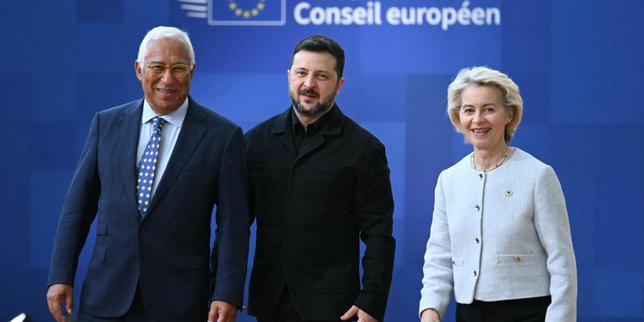
Symbolism doesn't stop artillery. When European leaders gathered to applaud Volodymyr Zelensky, calling his presence a special moment, the standing ovations felt historic. The cameras captured warm embraces in Brussels. Flashbulbs lit up the room. Leaders took turns assuring Kiev of their unwavering commitment. It made for incredible television, but standing ovations don't hold the frontline.
The disconnect between European diplomatic theater and the gritty reality of military logistics is growing wider by the day. For a long time, European support for Ukraine has operated on a dangerous loop. A crisis hits, Western leaders express deep concern, Zelensky visits a European capital, everyone promises a new package, and then the bureaucratic gears slow to a crawl. We need to talk honestly about why this approach is failing and what real commitment looks like.
The Illusion of the Special Moment
European summits love a historic narrative. When EU officials praised the unity shown during Zelensky's visits, they treated the event itself as a victory. It isn't. Showing up and shaking hands is the bare minimum of international relations.
The hard truth is that symbolic victories create a false sense of security among Western voters. When people see their prime ministers smiling next to the Ukrainian president, they assume the necessary help is flowing smoothly. They think the problem is handled. It creates a cushion of complacency that European militaries cannot afford.
Behind the scenes, the numbers tell a completely different story. Promised ammunition shipments frequently arrive months behind schedule. Air defense systems get tied up in political debates about escalation risks. While politicians celebrate a special moment in front of the press, Ukrainian soldiers face severe supply deficits in the trenches.
The Deadly Cost of European Bureaucracy
Let's look at the actual mechanics of European support for Ukraine. The European Union has used mechanisms like the European Peace Facility to reimburse member states for weapons sent to Kiev. On paper, it sounds organized. In practice, it has been plagued by national vetoes and endless arguments over domestic manufacturing.
Some nations want to ensure every euro spent stays within the bloc to support local defense contractors. Others complain about the financial burden. This squabbling happens while a conventional war rages on European soil.
Consider the production of basic 155mm artillery shells. Europe promised a million rounds but missed its initial deadlines by a mile. Why? Because European manufacturing lines weren't built for rapid scaling. Decades of peace dividends left factories optimized for low-volume, high-cost production. Fixing that requires massive capital investments and long-term state contracts, things European governments have been painfully slow to guarantee.
Beyond the Rhetoric of Unwavering Support
The rhetoric needs a serious reality check. Western leaders love the phrase "as long as it takes." It sounds noble. It sounds resolute. But as a strategic goal, it's completely hollow because it defines a timeline instead of an objective.
Are we supporting Ukraine to help it survive, or are we supporting it to win? Those two objectives require entirely different levels of industrial mobilization. Right now, Europe is doing just enough to prevent a total collapse, but not enough to change the trajectory of the conflict. This half-hearted approach achieves the exact opposite of its intended goal. It prolongs the suffering without delivering a decisive outcome.
True strategic clarity means moving past emotional speeches. It means treating defense production not as an economic stimulus package for local districts, but as an urgent security emergency.
What a Real Security Strategy Looks Like
If Europe wants to protect its own eastern flank, the approach to defense industrial policy must change immediately. The current fragmented system where every country protects its own national champions is a luxury from a bygone era.
First, governments must issue multi-year procurement guarantees to defense companies. Factories won't build new assembly lines based on vague political promises. They need binding contracts that guarantee purchases for the next decade.
Second, the continent must standardize its equipment. Right now, European armies use multiple different types of artillery systems and tanks, all requiring different spare parts and logistics chains. This makes supplying an active war zone an absolute nightmare. Streamlining these systems would drastically lower costs and speed up delivery times.
Finally, financial aid must be decoupled from unrelated political disputes inside the EU. Allowing single member states to block massive aid packages for months over domestic political leverage undermines the credibility of the entire continent.
The era of easy peace is over. No amount of emotional applause in Brussels will change the facts on the ground. European leaders must stop treating diplomacy as a substitute for hard power. It is time to replace the special moments with predictable, massive, and sustained industrial output. That is the only language a wartime economy understands.