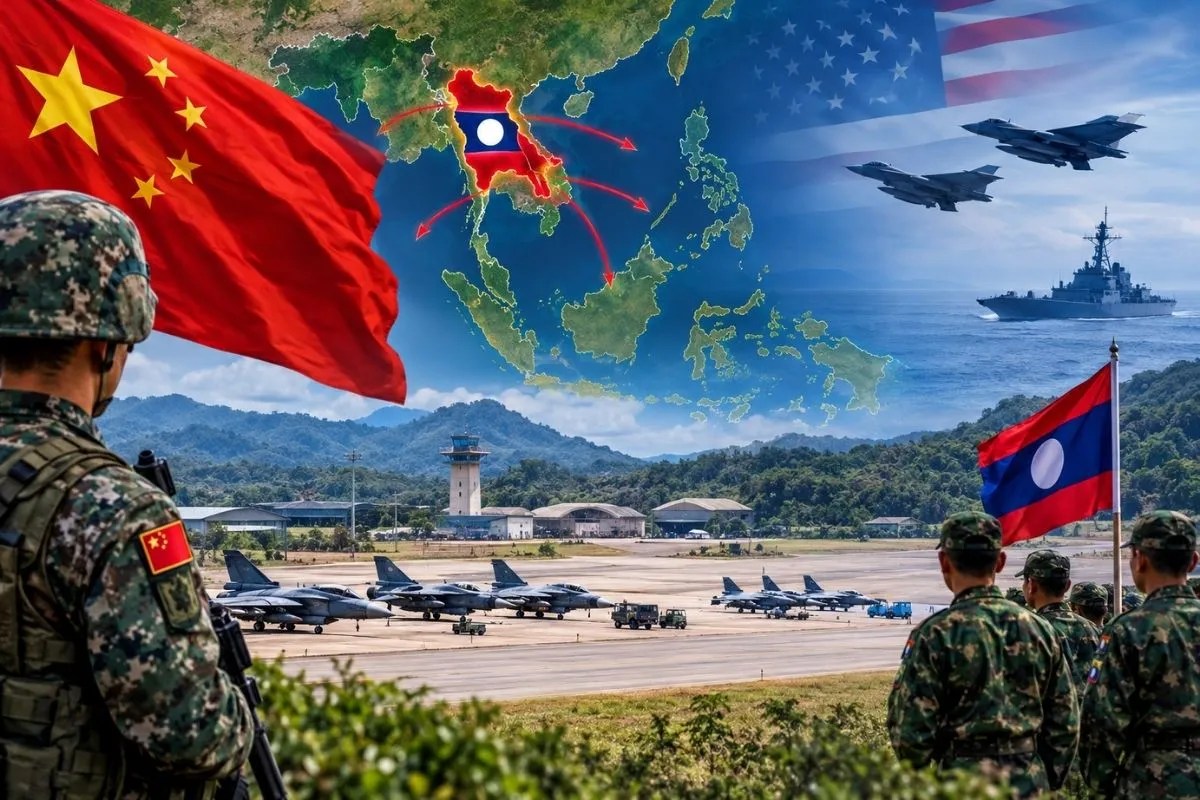
Every time a runway gets paved or a radar tower goes up in Laos, armchair strategists rush to print maps with red arrows pointing at Bangkok, Hanoi, and the South China Sea. It is predictable. Lazy. And militarily backwards.
The standard media narrative goes like this: China builds infrastructure across mainland Southeast Asia, slips military or dual-use capabilities into Lao airfields, and suddenly Beijing has a forward airbase overhanging the Mekong. Another domino tilting toward Beijing. Another crisis for ASEAN neutrality.
That story sells clicks. It also misreads geography, aviation logistics, and how real power works inside a landlocked country squeezed between larger neighbors.
I have spent years advising enterprise supply-chain and geopolitical risk teams on exposure across Asia, watching corporate boards burn millions hedging against cinematic worst-case scenarios while ignoring mundane operational bottlenecks. I have seen companies blow millions on this exact mistake—treating every concrete slab in a developing state as an imminent armored division or fighter wing.
Before anyone crowns a remote Lao airstrip as a masterstroke of power projection, we need to separate power projection from forward logistics. Power projection means sustaining high-tempo combat operations far from home against a capable adversary. Forward logistics means moving supplies, technicians, spare parts, and personnel through a friendly or permissive corridor. Most headlines confuse the two because both involve runways and cargo planes.
The Lazy Consensus on Mainland Southeast Asia
The conventional commentary on China's footprint in Laos rests on three assumptions:
- Infrastructure equals command. If Chinese state firms build or upgrade an airfield or logistics hub, Beijing automatically controls its strategic tempo.
- Landlocked means captured. Because Laos has no coastline and shares a northern border with Yunnan Province, Vientiane supposedly has no room to maneuver.
- ASEAN is watching a takeover. Any Chinese security or aviation presence in Laos is framed as a direct breach of Southeast Asian equilibrium.
All three assumptions leak air the moment you look at real-world constraints.
First, look at the map. Laos is mountainous, landlocked, and bordered by China, Myanmar, Thailand, Cambodia, and Vietnam. A landlocked airbase sitting deep inside rugged terrain is not a springboard like a coastal naval port or an island airfield overlooking open sea lanes. Any aircraft operating out of northern or central Laos faces terrain masking, limited runway redundancy in rough weather, and long supply lines over mountain passes or single-track rail corridors. In modern air warfare, a fixed airfield without deep hardening, layered air defense, and dispersed logistics is a target that planners worry about as much as an asset.
Second, look at sovereign friction. Even when a small country borrows heavily from a giant neighbor, day-to-day sovereignty is messier than grand theory suggests. Political elites in Vientiane have historically balanced between Beijing and Hanoi, while keeping economic lifelines open to Bangkok. A ruling party that hands over overt, unvarnished foreign military bases risks domestic nationalist blowback and sharp pushback from neighbors who already eye cross-border security with suspicion.
Third, think about economics. Laos has faced severe fiscal strain, currency pressure, and heavy external debt obligations in recent years. When a cash-strapped government needs roads, power grids, rail links, or airport upgrades, external financing comes with strings—commercial, political, and diplomatic. Mistaking commercial leverage and security cooperation for total military domination skips the hardest part of statecraft: managing local politics without triggering a regional backlash.
What People Actually Ask (And Why the Premise Is Flawed)
When news breaks about Chinese involvement around Lao airfields, search queries cluster around a few predictable questions. Most of them start from the wrong angle.
"Is China turning Laos into a military base?"
That question treats military presence like an on-off switch. In reality, modern influence rarely arrives with a flag-raising ceremony and a squad of tanks rolling through the front gate. It creeps in through dual-use facilities, training agreements, joint exercises, telecoms, policing cooperation, and logistics nodes.
Calling every airfield upgrade or security link a "military base" is intellectually lazy. If an airstrip primarily supports survey work, disaster relief, transport, maintenance, or border security, labeling it a full-scale forward combat base inflates the threat and blinds analysts to what is actually happening. What matters is not a scary label—it is sustainment capacity: fuel storage, munitions handling, maintenance hangars, radar coverage, and legal access rights during a crisis.
"How big a threat is this to neighboring countries like Thailand or Vietnam?"
Hanoi and Bangkok do not need sensationalist commentary to spot border risks; they have lived with complex neighbors for centuries. Both countries treat border security, cross-border crime, insurgencies, and Mekong basin dynamics as core national interests.
Yet neither neighbor reacts simply by panicking. Thailand relies heavily on cross-border trade, transit, and regional power grid connections, while guarding its own security perimeter closely. Vietnam maintains a fiercely independent defense posture and deep historical ties and frictions in Indochina. If anything pushes regional capitals closer together or toward hedging with other powers, it is not a single runway in Laos—it is prolonged instability along shared borders or coercive pressure that crosses red lines.
"Should foreign businesses pull back from mainland Southeast Asia?"
Pulling out of an entire region because of a headline is a classic executive overreaction. I have watched companies abandon high-growth corridors after geopolitical scares, only to hand market share to rivals who actually bothered to map real operational risks.
A better question for any operator is: Where are my actual single points of failure? A border crossing backed up by customs bottlenecks, a power grid vulnerable to seasonal droughts, or a single transport route with no alternate road or rail link will hurt your margins long before a geopolitical headline does.
A Thought Experiment: The Supply Corridor Stress Test
Imagine a scenario where a regional supply disruption hits mainland Southeast Asia—say, severe monsoon flooding washes out key highways and delays rail freight between northern hubs and ports to the south.
Suppose a logistics firm had assumed that a single shiny transport link solved its regional routing problem. When that corridor slows down, alternative routes through neighboring countries suddenly become the difference between meeting delivery windows and paying steep penalties. Now flip the lens: suppose a security planner assumed a remote airfield in rugged terrain could act as a frictionless hub during a regional crisis. Without massive fuel reserves, spare parts pipelines, diplomatic overflight agreements, and weather-resilient ground links, bottlenecks choke operations fast.
Infrastructure creates options, not miracles. Options only turn into decisive advantage when backed by logistics, legal access, and political room to maneuver.
What Scholars and Strategists Actually Debate
Serious defense and foreign-policy analysts—from regional security researchers in Singapore and Australia to strategic thinkers like Kenneth Waltz and Robert Jervis in classical international relations—have long pointed out two stubborn realities:
- Geography still bites. Distance, terrain, and proximity to rival powers shape what forces can realistically do. A state surrounded by capable neighbors faces very different constraints than an island power projecting across open ocean.
- Security dilemmas cut both ways. Moves meant to protect borders, curb illicit cross-border activity, or secure trade routes frequently look threatening to neighboring states, prompting counter-moves, tighter intelligence sharing, or quiet diplomatic pushback.
Notice how far that is from "China wins by building a runway." Real strategy is a tug-of-war of constraints, not a cartoon chess board.
The Downside of Taking the Contrarian View
Being contrarian has a trap of its own, and I will own it plainly: under-reacting to early dual-use normalization.
History rarely gives neat warnings. Dual-use infrastructure often starts out civilian, commercial, or low-profile. Over time, routine access, familiar procedures, and quiet agreements can lower the friction of future military use. If you dismiss early signs purely because a site lacks fighter jets today, you can get caught flat-footed if its role shifts during a crisis.
The fix is not hysteria, and it is not complacency. It is disciplined monitoring: watch legal access, fuel and storage upgrades, air-defense integration, and diplomatic signaling—not just press releases and scary headlines.
What You Should Actually Do Instead
If you run operations, manage risk, or follow Southeast Asian affairs for work, stop trading in geopolitical melodrama. Take these concrete steps instead:
- Audit your corridor redundancy, not just country risk. Map every raw material, component, and finished good moving through mainland Southeast Asia. Identify where a single road, rail line, port, or customs chokepoint can stall your schedule, and line up secondary routes across neighboring jurisdictions before a disruption hits.
- Separate civilian commerce from military capability. When reading reports on infrastructure in Laos or anywhere else in the region, ask three blunt questions: Who owns the asset? Who controls day-to-day operations? What happens to access during a regional crisis?
- Track neighbor reactions, not Western commentary. Watch how Thailand, Vietnam, and ASEAN peers respond through diplomatic statements, border patrols, and trade policy. Regional capitals feel the real temperature long before distant commentators do.
- Price in political and debt friction. In smaller economies carrying heavy debt loads, policy shifts often follow fiscal pressure and domestic survival rather than grand master plans. Stress-test contracts, currency exposure, and local partner stability accordingly.
Stop staring at red arrows on a map and start checking the fuel tanks, customs gates, and border roads. That is where real leverage lives.