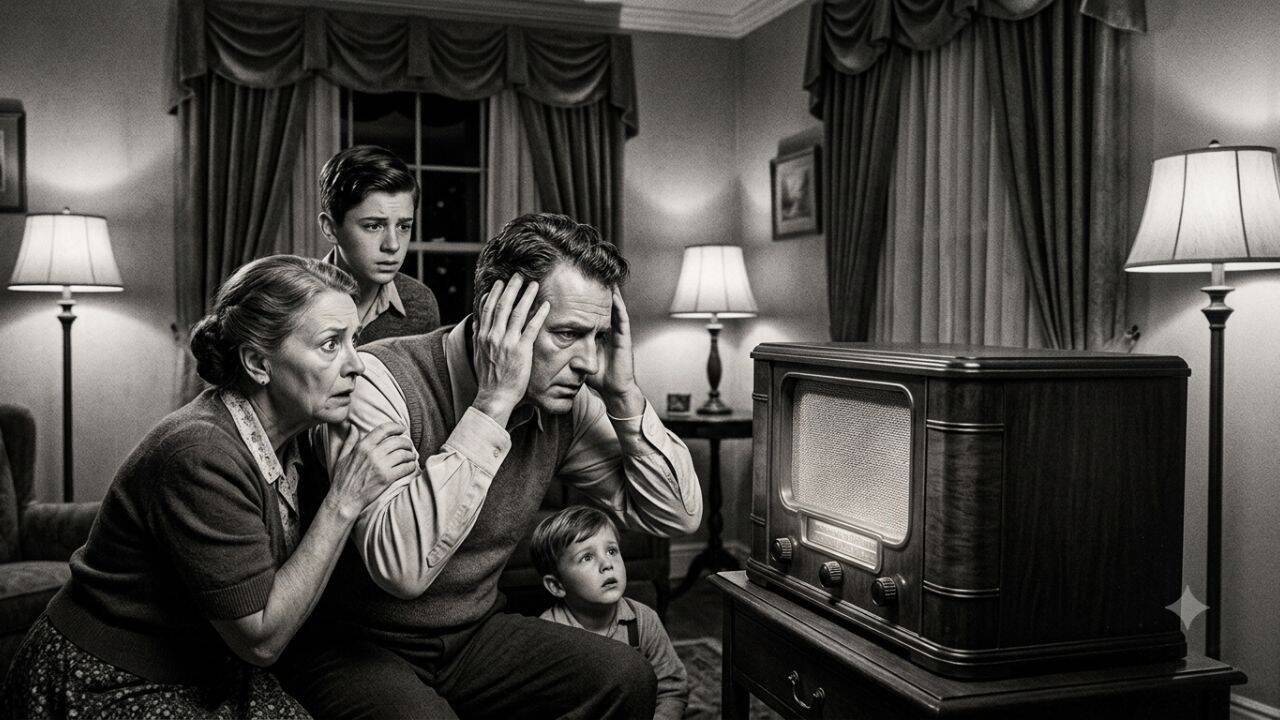
On Sunday, October 30, 1938, a 23-year-old theatrical prodigy named Orson Welles took the microphone at CBS radio studios in New York City. What happened next became embedded in American culture as the ultimate cautionary tale about mass media power: a live adaptation of H.G. Wells' The War of the Worlds supposedly tricked millions into believing Martians had landed in Grovers Mill, New Jersey, sparking nationwide hysteria, riots, and heart attacks.
Except most of that narrative is completely fabricated.
The real story behind the War of the Worlds panic isn't about an alien invasion tricking gullible listeners. It's a tale of corporate media rivalry, exaggerated newspaper headlines, and a brilliant publicity stunt that catapulted Welles to Hollywood fame.
The Reality of October 30, 1938
If you turned on the radio at 8:00 PM Eastern standard time that Halloween eve, you probably weren't listening to Orson Welles' Mercury Theatre on the Air. You were almost certainly tuned to NBC to hear ventriloquist Edgar Bergen and his wooden dummy, Charlie McCarthy.
According to C.E. Hooper rating surveys conducted that night, only about 2% of radio listeners had turned their dials to the CBS broadcast. CBS executive Frank Stanton later admitted that the vast majority of Americans never heard a single second of the program live.
So, how did a quiet Sunday night broadcast turn into an urban legend about millions fleeing into the streets with wet towels over their faces?
The answer lies in how people actually listened to the radio in 1938.
Around 8:12 PM, Charlie McCarthy finished his opening comedy routine, and NBC pivoted to a musical interlude. Millions of casual listeners spun their radio dials to find something else. When they landed on CBS, they didn't hear a play. They heard a dance band playing tango music from the Hotel Park Plaza, periodically interrupted by increasingly frantic fake news bulletins about a strange meteorite hitting New Jersey.
Because these late-arriving listeners missed the show's intro explaining it was a fictional play, some got genuinely confused. They didn't think Martians were attacking, though. Given the geopolitical tensions in Europe leading up to World War II, those who panicked were convinced the radio was describing a German military invasion.
Why Newspapers Invented the Panic
The morning after the broadcast, headlines across the country blew the event wildly out of proportion. The New York Times ran a front-page article claiming "Radio Listeners in Panic, Taking War Drama as Fact". Other papers warned of mass stampedes, traffic jams, and heart failure.
Why did print journalists blow this so far out of context?
Money and survival.
During the 1930s, the newspaper industry was engaged in a bitter commercial war with the rising medium of radio. Advertisers were shifting their budgets from print to airwaves, and publishers were desperate to prove that radio was an irresponsible, unregulated platform that couldn't be trusted with news delivery.
The War of the Worlds broadcast was the perfect weapon. Newspapers took a handful of confused phone calls to police departments and local hospital switchboards and spun them into a narrative of nationwide hysteria. When researchers surveyed six major New York City hospitals weeks later, they found zero admissions connected to the broadcast. Nobody died, and no mass riots occurred.
How Orson Welles Turned Panic into Pure Gold
Orson Welles understood the power of publicity better than almost anyone of his era.
The morning after the show, Welles faced a room full of aggressive reporters at a hastily called press conference. On camera, he looked somber, wearing an expression of deep remorse as he claimed he never anticipated the broadcast would frighten anyone. He apologized profusely, calling radio a new medium that everyone was still learning how to handle.
It was arguably the greatest performance of his life.
In reality, Welles and his writer, Howard Koch, had intentionally engineered the script to mimic real-time breaking news to make it sound as authentic as possible. They deliberately removed script markers that indicated time passing to force the narrative to feel uncomfortably real.
Far from destroying his career, the controversy made Welles an instant celebrity overnight. Hollywood took notice immediately. Within months, RKO Pictures offered him an unprecedented contract with total creative control, leading directly to his masterpiece, Citizen Kane.
Understanding Media Illusions and Modern Echoes
The enduring myth of the 1938 radio panic tells us more about our relationship with media than it does about the broadcast itself. We love stories where a new technology completely overpowers human reason, whether it's 1930s radio, late-20th-century television, or modern social media algorithms.
If you want to understand media framing today, look back at how this story evolved. The outrage wasn't caused by the broadcast itself, but by the commentary around it.
Here is what you should take away from the event:
- Check primary sources: The newspaper accounts from October 31, 1938, were opinion pieces disguised as reporting, designed to protect print ad revenue.
- Separate localized fear from systemic panic: A few hundred calls to police switchboards in New Jersey didn't equal a collapsing nation.
- Recognize narrative building: Welles weaponized the outrage to secure his own legacy, leaning into the myth because it served his personal brand.
Next time you hear a story about a new technology causing mass societal breakdown, take a step back and check who benefits from telling that story.


