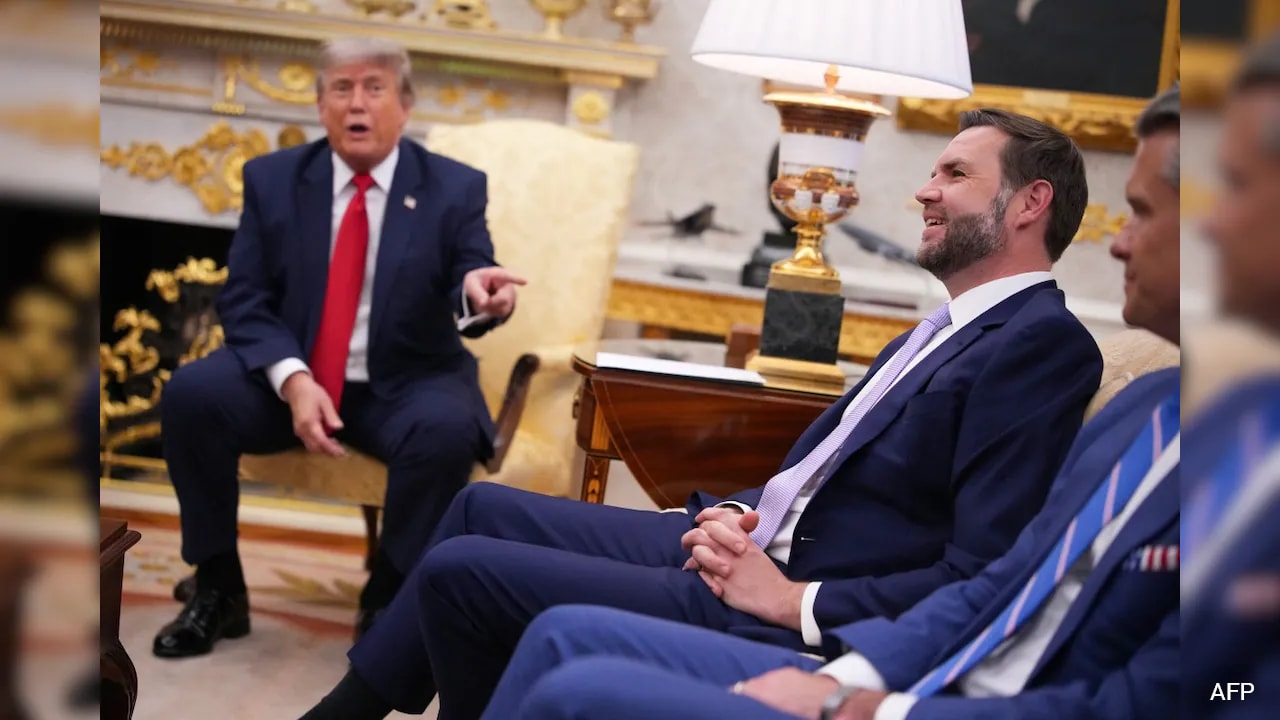
Political capital operates under strict budget constraints, and the November 12, 2026 directive from President Donald Trump reassigning Vice President JD Vance from Iranian diplomatic negotiations to domestic anti-corruption enforcement represents a textbook strategic pivot following an electoral shock. Rather than an impulsive social media outburst, this maneuver is an institutional effort to contain coalition fracturing, neutralize an unfavorable geopolitical cost function, and re-anchor executive messaging ahead of the 2028 succession cycle.
Standard news coverage treats this development as a mere interpersonal clash between a hawkish commander-in-chief and a restraint-oriented vice president. That framing misses the structural mechanics at play. When an administration suffers a decisive midterm defeat—losing control of both the House and the Senate—the executive branch loses its legislative offense and must immediately reallocate its highest-visibility principals to asymmetric, non-legislative fronts. By removing Vance from the Middle East portfolio and rejecting direct talks with Tehran, the White House is executing a dual-purpose containment strategy: eliminating a visible point of internal policy dissent while pivoting to an issue set that requires zero congressional cooperation.
The Structural Anatomy of the Executive Pivot
To understand why the administration abruptly shelved high-level diplomatic outreach led by Vance—following reports that the vice president was weighing face-to-face discussions with senior Iranian security officials—one must examine the mechanics of executive signaling. In modern statecraft, assigning a principal to lead negotiations signals openness to compromise. Following the November 3 midterm elections, however, the political calculus shifted entirely.
The directive issued via Truth Social accomplished three distinct operational objectives simultaneously:
- Termination of Diplomatic Ambiguity: By publicly declaring that the United States does not need a deal with Iran and asserting control over frozen Iranian assets and the Strait of Hormuz, the president unilaterally closed the diplomatic track. This prevents foreign adversaries from exploiting perceived daylight between the president and his deputy during post-election vulnerability.
- Narrative Substitution: In political communications, an unfavorable narrative cannot be defeated through rebuttal; it must be displaced by a higher-salience alternative. Directing Vance to target domestic "corruption and crime" attempts to shift media oxygen away from maritime security incidents in the Persian Gulf and toward domestic fiscal grievances.
- Portfolio Quarantine: Vance had previously served as the administration's point person for unsuccessful summer negotiations and subsequently published a blunt post-mortem on X attributing the Senate loss directly to the war. Leaving him on the Iran file guaranteed ongoing media scrutiny of that rift. Reassigning him removes him from the blast radius of any future kinetic escalation, such as potential strikes on nuclear-linked facilities like Pickaxe Mountain.
This structural reassignment highlights a fundamental rule of crisis management: when a policy becomes a net electoral liability, leadership must either abandon the policy or decouple its primary messengers from the ongoing operational drag. Because the president maintains that preventing a nuclear-armed Iran justifies the short-term electoral penalty, decoupling Vance became the only viable path to preserve both the military posture and the vice president's political viability.
The Electoral Cost Function of Prolonged Kinetic Conflict
The friction between the Oval Office and the Naval Observatory stems from fundamentally different interpretations of the conflict's cost function. In economic and political modeling, a cost function measures the cumulative losses incurred to achieve a specific strategic output. For the president, the output is total strategic dominance over Tehran—rejecting what he termed a "93-percent victory" during Veterans Day remarks at Arlington National Cemetery. For Vance, the cost function is measured in domestic coalition erosion.
Following the November 3 ballot losses, Vance explicitly challenged the party to confront the trade-off, questioning whether losing the Senate for six years was a worthwhile price to pay for the conflict. His assessment rests on four compounding variables that drove voter defection among the core Republican base:
- Direct War Fatigue: A segment of the populist coalition explicitly backed the administration on a platform of military restraint and non-intervention. Prolonged naval engagements and air defense strikes directly violate that baseline contract.
- Energy-Driven Inflationary Pressure: Geopolitical friction in the Strait of Hormuz and concurrent Houthi attacks in the Bab el-Mandeb Strait create severe friction in global supply chains. Even with U.S. Navy escorts restoring crude and liquefied natural gas transit toward prewar volumes, the risk premium on maritime insurance and energy futures translates directly into domestic cost-of-living pain.
- Resource Allocation Friction: Voters focused on domestic economic stabilization view billions spent on naval escorts, drone defense, and regional coalition support as a diversion from the "America First" mandate.
- Alliance Realignment Pressures: Dissatisfaction regarding the structure and cost of the U.S. relationship with Israel fractured turnout enthusiasm among younger conservative demographics.
While the president acknowledged that Vance's diagnosis of the midterm loss was "largely true", their strategic prescriptions diverged. Trump operates on an existential deterrence timeline, arguing that historical necessity overrides cyclical electoral losses. Vance operates on an electoral coalition timeline, recognizing that a governing majority cannot be sustained if its core voters stay home or defect over foreign entanglements.
Asymmetric Leverage and the Strait of Hormuz Paradox
A critical analytical flaw in conventional reporting on this standoff is treating the military situation in the Persian Gulf as binary—either total war or a negotiated peace treaty. In reality, the administration is attempting to manage a state of asymmetric maritime containment that carries severe hidden liabilities.
The president's assertion that Washington holds "Hundreds of Billions of Dollars" of Iranian funds and controls the Strait of Hormuz reflects a strategy of maximum economic and geographic denial. By choking off Tehran's revenue streams while utilizing the U.S. Navy to escort commercial tankers, the White House seeks to force Iranian capitulation without signing a formal diplomatic accord.
However, operational data from the region demonstrates the fragility of this equilibrium:
- Persistent Kinetic Attrition: Despite claims of decisive victory, commercial shipping remains under active threat. Reports from the United Kingdom Maritime Trade Operations Center confirm ongoing projectile strikes against tankers in both the Persian Gulf and the Strait of Hormuz northwest of Ras al-Khaimah.
- Allied Burden-Sharing Failure: Diplomatic efforts by Secretary of State Marco Rubio to persuade Group of Seven counterparts in Paris to expand naval protection commitments yielded zero tangible progress. Consequently, the United States bears the disproportionate operational and financial burden of policing the waterway alone.
- Proxy Escalation Vectors: Containment in the Strait of Hormuz does not neutralize asymmetric threats in adjacent theaters. Ongoing fighting between a Saudi-led coalition and Iranian-backed Houthi forces in Yemen continues to jeopardize transit through the Bab el-Mandeb Strait, threatening the maritime corridor linking the Red Sea to the Indian Ocean.
- Third-Party Mediation Vulnerability: While the White House publicly dismisses direct talks, indirect channels remain active. Qatar continues to facilitate mediation efforts, and Iranian Parliament Speaker Mohammad Bagher Qalibaf has publicly claimed that Washington sought Russian President Vladimir Putin's intervention to broker dialogue—a claim Moscow's alignment with Tehran via Supreme National Security Council Secretary Maj. Gen. Mohsen Rezaei complicates.
This creates an acute strategic paradox. Maintaining military pressure without a diplomatic off-ramp requires continuous naval deployment, exposing U.S. assets and global energy markets to low-cost asymmetric harassment. Yet pursuing a formal deal signals retreat to domestic hawks and removes the administration's primary leverage. Reassigning Vance allows the White House to sidestep this paradox rhetorically, even as the underlying naval commitments persist.
Domestic Enforcement as an Executive Asymmetric Offset
With Democrats capturing both chambers of Congress, the administration's legislative agenda is effectively dead on arrival for the remainder of the term. While the president retains veto power to block Democratic bills, vetoing legislation is a purely defensive posture that generates zero positive momentum for a bruised coalition.
To regain the initiative, the executive branch must utilize unilateral administrative authorities—policy levers that require no congressional appropriation or statutory approval. Directing the vice president to focus entirely on domestic "corruption and crime" is an operational deployment of this exact principle.
From an institutional perspective, this pivot serves three tactical functions:
- Weaponizing the Bully Pulpit: By framing Democratic leadership as inherently corrupt and linking the eradication of alleged fraud directly to balancing the federal budget, the administration creates a simplified, populist fiscal narrative. This directly counters voter anger over inflation by offering a villain-driven explanation for economic strain rather than a macroeconomic one.
- Leveraging Executive Branch Agencies: Investigations, audits, and federal law enforcement task forces operate under Article II executive authority. Deploying the vice president as the public face of a domestic anti-corruption drive allows the White House to generate continuous, high-contrast news cycles throughout 2027 without passing a single law.
- Unifying the Governing Coalition: While foreign interventionism splits the Republican base between traditional defense hawks and populist non-interventionists, anti-corruption and law-and-order messaging commands near-universal approval across all factions of the party. It functions as an immediate ideological adhesive after a divisive electoral defeat.
The limitation of this strategy lies in execution risk. Rhetoric regarding budget balancing through anti-fraud enforcement sets an exceptionally high bar for measurable outcomes. If high-profile investigations fail to yield indictments or quantifiable fiscal recoveries, the initiative risks being dismissed by voters as a transparent distraction from persistent cost-of-living pressures and ongoing Middle Eastern instability.
Succession Game Theory and the 2028 Positioning Matrix
Beyond immediate crisis management, this episode represents the opening skirmish of the 2028 Republican presidential primary. Vance's position as the presumptive heir apparent is entirely contingent on navigating a narrow corridor between two competing imperatives: maintaining fidelity to the president's record while establishing an independent ideological identity that appeals to war-weary populist voters.
In game theory, Vance faces a classic principal-agent dilemma. As vice president, he is an agent of the president's agenda. However, as a prospective 2028 candidate, his long-term electoral survival depends on distancing himself from unpopular policies before they permanently stain his brand.
His post-midterm critique of the Iran war's electoral cost was a calculated gamble to establish credibility with the populist base—a move validated when figures like Donald Trump Jr. publicly endorsed his assessment. Yet by highlighting the electoral damage without simultaneously offering a robust defense of the commander-in-chief's strategic rationale, Vance triggered a public correction.
Trump's refusal to commit to a 2028 endorsement—stating in a 60 Minutes interview that he "may or may not get involved"—is a deliberate retention of leverage. By keeping the endorsement on the table while reassigning Vance to a domestic portfolio, the president enforces discipline:
- Compliance Reward: If Vance executes the domestic anti-corruption mandate aggressively and ceases public post-mortems on foreign policy, he rehabilitates his standing in the Oval Office and rebuilds his credentials as an effective domestic enforcer.
- Defection Penalty: Continued public divergence on military strategy risks permanent estrangement from the president, which would fracture the primary electorate and open a lane for rival 2028 contenders to outflank Vance on loyalty.
Vance's subsequent assertion on Fox News that there is "no daylight" between himself and the president confirms that the vice president recognized the immediate boundary of that leverage. The reassignment gives him a face-saving exit from an unwinnable diplomatic file while testing his ability to command the domestic media cycle independently.
Strategic Execution Mandate for the Executive Branch
To convert this rhetorical pivot into a durable political recovery ahead of the 2028 cycle, the administration cannot rely on social media directives alone. Operationalizing this shift requires disciplined execution across three specific fronts:
First, institutionalize the domestic portfolio with measurable metrics. The vice president's office must move immediately from broad anti-corruption rhetoric to concrete administrative actions—such as establishing an interagency task force targeting federal grant fraud, improper Medicaid/Medicare outlays, and municipal crime metrics. Without quarterly, quantifiable data points showing recovered funds or enforcement actions, the domestic pivot will fail to displace economic dissatisfaction.
Second, enforce strict message discipline on kinetic containment. While the White House maintains its refusal to negotiate directly with Tehran, Defense Secretary Pete Hegseth and the Pentagon must frame ongoing naval escorts in the Strait of Hormuz strictly as defensive trade protection rather than open-ended regional policing. Simultaneously, quiet Qatari-mediated de-escalation channels must be utilized to reduce tanker attacks without requiring a formal treaty signature that would trigger domestic backlash.
Third, maintain total alignment between the Oval Office and the Vice President's Office. For Vance, the optimal path to 2028 requires absorbing the domestic enforcement mandate completely, allowing the president to own the national security legacy while positioning himself as the uncompromising champion of domestic economic integrity. Any further public autopsies of the 2026 midterms will only prolong internal friction and hand strategic initiative to a newly empowered Democratic Congress.