Most commentary on Rabindranath Tagore in Bangladesh reads like a barroom argument between two people who never finished the book. One side treats him as a secular saint whose verses alone hold the nation together. The other treats him as a foreign intellectual import whose shadow smothers an authentic, majority-Muslim state.
Both sides are arguing over the wrong fight.
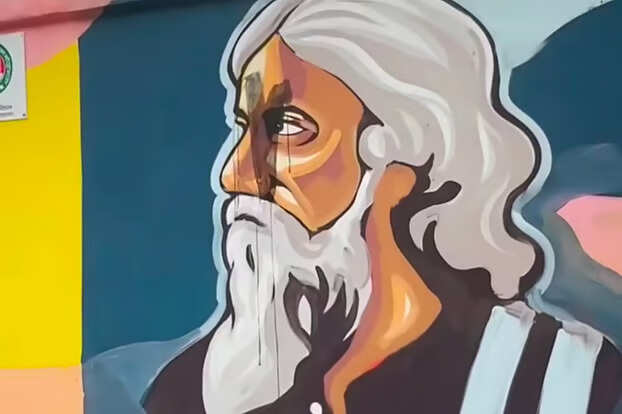
When headlines talk about black ink on Tagore, they usually mean censorship, defacement, cultural backlash, or political tug-of-war over songs and statues. It makes for tidy television. It fits neatly into a secular-versus-Islamist box. And it is mostly lazy shorthand.
Real identity battles in South Asia rarely happen at the level of poetry alone. They happen at the level of institutions, patronage, class anxiety, memory politics, and state power. A Nobel laureate's verse does not govern a ministry, staff a court, price a garment order, or settle what a teenager in Sylhet or Chattogram feels owed by the state. Treating Tagore as the central fault line of Bangladesh's identity mistakes a high-volume cultural symbol for the underlying operating system.
I have watched political analysts, cultural pundits, and foreign observers burn endless credibility treating literary debates as political forecasts. Time and again, people over-read a protest song, a statue dispute, or a spike in religious rhetoric as proof of a final ideological verdict. They miss the quieter, dirtier mechanics underneath: who controls school curricula, who gets state airwaves, which histories get taught in history classes, and how economic strain turns cultural grievance into currency.
The Lazy Consensus Around Tagore and Nationhood
Start with the standard script. In popular retelling, Bangladesh's identity rests on a clean tension between Bengali language and Islamic faith. Tagore sits on one side of that ledger as the supreme master of modern Bengali prose, song, and worldview. Political or religious pushback against him sits on the other side as hostility toward Bengali culture itself.
That framing is neat. It is also sloppy.
Identity in Bangladesh was never a static two-column table where adding one column automatically erases the other. Even during the 1971 Liberation War—a watershed where linguistic and national solidarity fused under brutal military repression—different currents existed side by side. Bengali nationalism, secularism, socialism, and Muslim identity were never identical twins. They overlapped, competed, negotiated, and collided long before anyone started drawing lines with black ink.
Historians who actually study the region rather than recycling slogans—scholars like Willem van Schendel, Tithi Bhattacharya, and Rounaq Jahan—have spent decades showing how layered and contested modern South Asian identities are. Language is not a pure, pre-political essence waiting to be discovered. It is shaped by print capitalism, standardizing elites, colonial schooling, and state building.
Consider how Tagore himself entered Bengali public life. Born into a wealthy, reformist Calcutta family in 1861, he wrote from a specific social and historical position within British-ruled Bengal. His songs—including "Amar Sonar Bangla," adopted as Bangladesh's national anthem—carry immense emotional weight in Bangladesh. Yet loving a song or singing it at dawn on Pohela Boishakh does not mean every citizen views Tagore's worldview identically, nor does questioning a cultural orthodoxy automatically equal rejecting the Bengali language.
When commentators flatten every dispute involving Tagore into a binary war between "secular Bengalis" and "anti-Bengali Islamists," they erase millions of people who hold complex, overlapping attachments. A devout Muslim can love Rabindra Sangeet. A secularist can critique elite cultural gatekeeping without hating Islam. A working-class family worried about inflation and jobs may care far more about basic governance than about how cultural elites stage their annual rivalries.
What People Actually Mean When They Ask About Identity
Search engines fill up with predictable questions whenever tensions flare in Dhaka or across the border. People type queries like Is Bangladesh becoming more Islamic or secular? Why do some groups oppose Rabindranath Tagore in Bangladesh? How does language shape Bangladeshi identity?
Every one of those questions carries a hidden trap.
"Is Bangladesh becoming more Islamic or secular?"
This question assumes a zero-sum seesaw. Push one side down, the other shoots up.
Real societies do not move on a seesaw. They move on multiple tracks at once. Public piety can rise alongside everyday pragmatism. Political slogans can sound sharper while economic life remains intensely practical. Treating public religiosity and Bengali cultural pride as permanent enemies ignores how South Asians actually live. Faith, regional history, family ties, and language coexist inside the same households every single day.
"Why do some groups oppose Rabindranath Tagore in Bangladesh?"
Often, what gets labeled "opposition to Tagore" is actually a proxy battle over something else. Sometimes it is ideological hostility from hardline groups who view secular cultural icons with suspicion. Other times, it is resentment against cultural gatekeeping—a feeling among ordinary or marginalized people that an urban, upper-middle-class cultural establishment treats its own tastes as the only "true" Bengali identity.
Confusing elite cultural monopoly with Bengali culture itself is a classic blunder. High culture in Dhaka or Kolkata has never been the whole story of Bengal. Folk traditions, Baul music, Islamic literary heritage, rural idioms, and working-class memory are part of the same river.
"How does language shape Bangladeshi identity?"
Language matters deeply—nobody serious denies that. The 1952 Language Movement remains foundational because the state tried to strip Bengalis of linguistic recognition and dignity.
Yet language alone does not settle every political argument. Two people can speak the exact same mother tongue, quote the same poets, and fiercely disagree on memory, justice, minority rights, sovereignty, and the role of religion in public life. Shared language creates a common medium of argument; it does not guarantee identical conclusions.
A Thought Experiment on Cultural Symbols vs. Real Power
Imagine a scenario where a government passes sweeping decrees mandating Tagore recitals in every school assembly, erecting new monuments in every district, and penalizing criticism of cultural icons—while doing nothing about corrupt courts, rigged elections, stagnant wages, or weak public hospitals.
Would that settle Bangladesh's identity?
Of course not. It would turn culture into a state-enforced performance. People would resent the coercion, cynicism would grow, and the real grievances driving unrest would keep festering underneath.
Now imagine the reverse scenario: a society where institutions work fairly, citizens feel safe regardless of background or belief, schools teach honest history without state censorship, and people are free to read, sing, debate, or ignore Tagore without fear.
In that second scenario, identity stops being a cudgel used by factions to beat one another. It becomes what it ought to be in a mature society: lived, debated, and negotiated without state violence or mob intimidation.
The Mechanics Behind the Noise
If black ink, protests, or cultural controversies keep flaring up, why do they keep happening? Look at the incentives.
- Outrage is cheap political fuel. Cultural symbols trigger instant emotion. A dispute over a statue, a curriculum change, a song, or a public memorial travels fast online and rallies loyalists without requiring hard policy work.
- State fragility invites identity mobilization. When institutions lose public trust or economic pressure bites hard, political actors reach for big, unmistakable markers—faith, nation, heritage, external enemies—to draw sharp lines between "us" and "them."
- Cross-border projection distorts the picture. Observers outside Bangladesh—especially in neighboring countries or Western capitals—frequently read domestic Bangladeshi disputes through their own domestic anxieties. Outside commentary often treats internal debates as simple victories or defeats for one external narrative or another.
- History gets weaponized selectively. Every camp has its favorite chapter and its convenient amnesia. Selective memory turns complex historical actors—poets, politicians, reformers, movements—into flat cartoon heroes or villains.
I have seen newsrooms and analysts fall into this trap repeatedly during moments of political transition in South Asia. When a long-standing political order cracks, old grievances surface fast. Analysts who mistake surface noise for structural inevitability get blindsided when events turn out messier than their neat binaries predicted.
Where This Contrarian View Can Go Wrong
Being contrarian for its own sake is just another lazy habit. There is a real risk in downplaying cultural clashes too far.
Symbols do matter in politics. When mobs target cultural spaces, vandalize memorials, or intimidate writers, artists, and minorities, dismissing that as "just noise" is reckless. Intimidation leaves real scars. Cultural erasure is not harmless just because economic problems also exist.
The mistake is not noticing that cultural conflicts happen. The mistake is treating the symptom as the whole disease—or assuming that a symbol's fate decides everything else. A poem cannot stop a crooked bureaucrat, and an angry crowd defacing a portrait does not automatically rewrite a nation's long-term soul.
What Serious Observers and Citizens Should Do Instead
If you want to understand—or constructively shape—where Bangladesh goes from here, stop obsessing over who holds the sharpest marker or the loudest microphone in a cultural spat. Look at what actually builds durable cohesion.
- Track institutions, not just slogans. Watch judicial independence, press freedom, local governance, and rule of law. Identity feels threatened when people lack fair legal protection; it feels secure when rules apply evenly.
- Separate heritage from monopoly. Defend the freedom to celebrate Tagore, Kazi Nazrul Islam, Lalon, folk traditions, and Islamic heritage alike without letting any single faction claim sole ownership of what counts as "real."
- Protect minority and dissenting spaces. A nation's character shows most clearly in how safely people outside the loudest majority can speak, worship, create, and disagree.
- Insist on granular reporting. When a controversy breaks out, ask who organized it, what triggered it, who benefits politically, and what ordinary people on the street actually say—before accepting a catchy headline frame.
Identity is not a fragile vase sitting on a shelf waiting for one wrong word to shatter it. It is an ongoing, sometimes rough conversation across generations. Let people argue, sing, question, and build—and judge the country by how fairly it treats its people, not by whose ink is wettest.