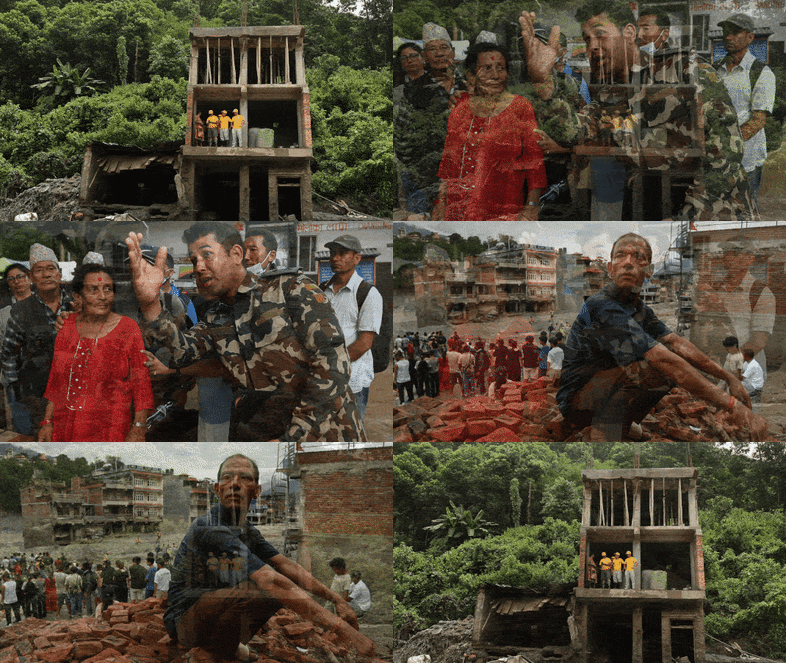
The rain did not fall. It hammered.
In the high, unforgiving passes of Nepal, water ceases to be a blessing when it arrives with the fury of an unchained engine. It becomes a battering ram. For a group of pilgrims from Tamil Nadu, journeying through the majestic yet terrifying terrain of the Himalayas, the mountains went from sacred sanctuaries to vertical death traps in a matter of hours. For an alternative view, read: this related article.
Consider the silence that precedes a flash flood. It is not peaceful. It is the suffocating quiet of a world holding its breath. One moment, the path is dry dust, ancient stone, and the distant, rhythmic roar of a river far below. The next, the earth beneath your boots turns to liquid grease.
They were five feet from the edge. Five feet from a drop that offered no second chances. Related insight on the subject has been shared by National Geographic Travel.
Faith is an abstract word when printed in a pamphlet. It sounds neat, clean, and theoretical. But faith in the belly of a Himalayan tempest smells like wet wool, woodsmoke, and sheer, unfiltered terror. It is the desperate grip of a hand clutching another hand. It is the refusal to let go when the wind howls like a wounded beast, trying to peel humanity off the cliffside.
The pilgrims from Tamil Nadu had traveled thousands of miles. They left behind the sun-drenched plains of South India, the scent of jasmine, the familiar humidity of the coast, drawn upward by a calling older than maps. They sought transcendence. Instead, they found a test of raw endurance.
When the swollen tributaries broke their banks, sweeping away bridges and turning trails into raging grey cataracts, panic threatened to do the work of the storm. Voices were swallowed by the roar. The air grew biting, thin, and freezing. Hypothermia does not announce itself with dramatic shivers; it creeps in like fog, wrapping the mind in cotton, whispering that it would be so easy just to sit down and rest.
Then came the sari.
In modern urban discourse, the six-yard drape of fabric is often debated, styled, modified, or relegated to ceremonial occasions. But out here, where technology fails and modern gear is reduced to soggy pulp, history and ingenuity stepped forward.
Let me be clear: this is not a metaphor. When the narrow mountain path collapsed, leaving a terrifying five-foot chasm that blocked escape, there were no ropes sturdy enough, no rescue lines thrown from the sky. There was only what they wore.
Saris were unspooled. Length by length, the cotton and silk weaves were twisted together, knotted with desperate, bleeding fingers, creating an improvised lifeline. It was an act born of profound instinct. A grandmother’s garment, designed for grace and tradition, transformed into an anchor of survival. One end was secured to a jagged outcropping of unyielding rock; the other was tossed across the terrifying void.
People laughed at the idea of traditional attire in the mountains. They called it impractical. They spoke of Gore-Tex and high-tech polymers. But polymers melt in the face of ancient elemental wrath, while human ingenuity, wrapped in cultural memory, holds firm.
One by one, men and women who had never known anything more extreme than a monsoon downpour in Madurai or Thanjavur found themselves suspended over the abyss. They pulled themselves across using the woven sari bridge, hand over hand, water crashing deafeningly below, mist blinding their eyes.
Fear is a physical weight. It sits on your chest. It forces shallow breaths.
Imagine looking down into that churning brown maw. Imagine the roar vibrating through your teeth, shaking your very bones. Your muscles scream. Your fingers lose feeling. Every instinct tells you to curl up and surrender to the gravity of the slope.
Yet, they moved.
It was the collective will of the group that carried them. In moments of absolute crisis, individualism dies. You do not survive as a solitary hero; you survive as a pulse in a chain of bodies. If the person in front of you slips, the shock travels straight up your arms. If the person behind you loses their footing, you lean backward, planting your heels into the mud, becoming a pillar.
This is the hidden cost of our sanitized, modern detachment from nature. We forget that the earth does not negotiate. We forget that mountains do not care about itineraries, hotel bookings, or travel insurance. They exist in a state of primal indifference. When you step into their domain, you are a guest who must remember your manners, or pay the ultimate price.
The pilgrims survived not because they were elite mountaineers, but because they possessed an internal anchor that could not be washed away by rushing water. Their faith was not merely a passive belief in a deity; it was an active, stubborn refusal to accept defeat. It was the memory of temples by the sea, of familial bonds, of promises made back home that demanded to be kept.
Hours later, when the rain finally eased—leaving behind a landscape scarred by landslides and choked with debris—the group emerged into a clearing. They were battered, bruised, shivering uncontrollably, and missing much of their luggage. But they were breathing.
They stood together on solid ground, wrapped in damp, mud-stained clothes, looking back at the monster they had just outrun. The five-foot gap behind them looked impossibly wide in the returning daylight.
Back in the cities, life resumed its frantic, frictionless pace. People tapped glass screens, complained about delayed flights, and worried about trivialities. But in the hearts of those pilgrims, the world had fundamentally shifted. They had looked into the throat of the abyss and discovered something unbreakable buried beneath the surface of everyday life.
The mountains remain. They stand silent, indifferent, and majestic, guarding their secrets in the clouds. And down below, or scattered across the plains of Tamil Nadu, survivors carry a quiet truth that no textbook can teach and no algorithm can predict.
Sometimes, salvation does not descend from the heavens in a sleek machine. Sometimes, it is spun from six yards of cloth, held together by blistered hands, and pulled taut across the edge of the world.