The air inside a cleanroom does not move like normal air. It is scrubbed, filtered, and chilled until it feels entirely divorced from the seasons changing outside the concrete walls. In these spaces, silence is a heavy, physical presence. You can hear the rhythmic click of a zip-tie being fastened or the soft scuff of a rubber-soled boot against epoxy flooring from fifty feet away.
For the technicians who spend their days looking through magnifying lenses at green circuit boards, the passage of time is measured differently. They are not building the future. They are keeping the past from decaying. Don't forget to check out our previous post on this related article.
A few weeks ago, the Pentagon quietly moved a stack of paperwork across a desk, formalizing a $50 million contract extension with Boeing. To a casual observer scanning the federal procurement feeds, the line item looked like routine bureaucratic maintenance. The defense giant was being paid to sustain the AGM-86B Air Launched Cruise Missile—a weapon system designed during the Ford administration, built during the Reagan era, and meant to be retired before the turn of the millennium.
Instead, a missile that was supposed to be a temporary stopgap is now being nursed along so it can stay in active service past its fiftieth birthday. To read more about the context here, Gizmodo provides an in-depth breakdown.
To understand why the United States is spending tens of millions of dollars to keep a fleet of Cold War relics breathing, you have to look past the spreadsheets and into the tight, claustrophobic realities of the men and women who maintain the American nuclear triad.
The Alchemy of Aging Silicon
Imagine trying to keep a 1980 Apple II computer running perfectly, twenty-four hours a day, under intense vibration, extreme temperature swings, and the absolute requirement that it must never, under any circumstance, crash. Now imagine that computer is responsible for guiding a nuclear warhead through enemy airspace.
That is the daily reality for the engineering teams tasked with maintaining the AGM-86B.
When these missiles rolled off the production line in Washington state between 1980 and 1986, the world was a different place. The microchips inside them were considered miracles of modern engineering. Today, those same chips possess less computing power than a cheap greeting card that plays a tinny song when you open it.
The companies that manufactured those original transistors went bankrupt decades ago. The factories were torn down. The blueprints exist only on fading microfiche or inside the heads of engineers who have long since retired to golf courses in Arizona.
When a component fails on an AGM-86B today, you cannot simply log onto an electronics distributor's website and order a replacement. The process is closer to archaeology than engineering. Technicians must hunt through vintage stockpiles, reverse-engineer proprietary logic gates, or design completely custom "bridge" interfaces that trick the missile's ancient brain into thinking it is still talking to 1982 hardware.
It is a delicate, agonizingly slow form of technological alchemy. A single hairline fracture in a solder joint, caused by forty years of subtle expansion and contraction inside a storage silo, can sideline a weapon. The $50 million patch is not for shiny new capabilities. It is the price of keeping old metal and brittle plastic from turning into junk.
The Weight on the Flight Line
Step out of the cleanroom and onto the tarmac at Minot Air Force Base in North Dakota, where the winter wind feels like a razor blade against exposed skin. Here, the abstract concepts of strategic deterrence lose their academic polish.
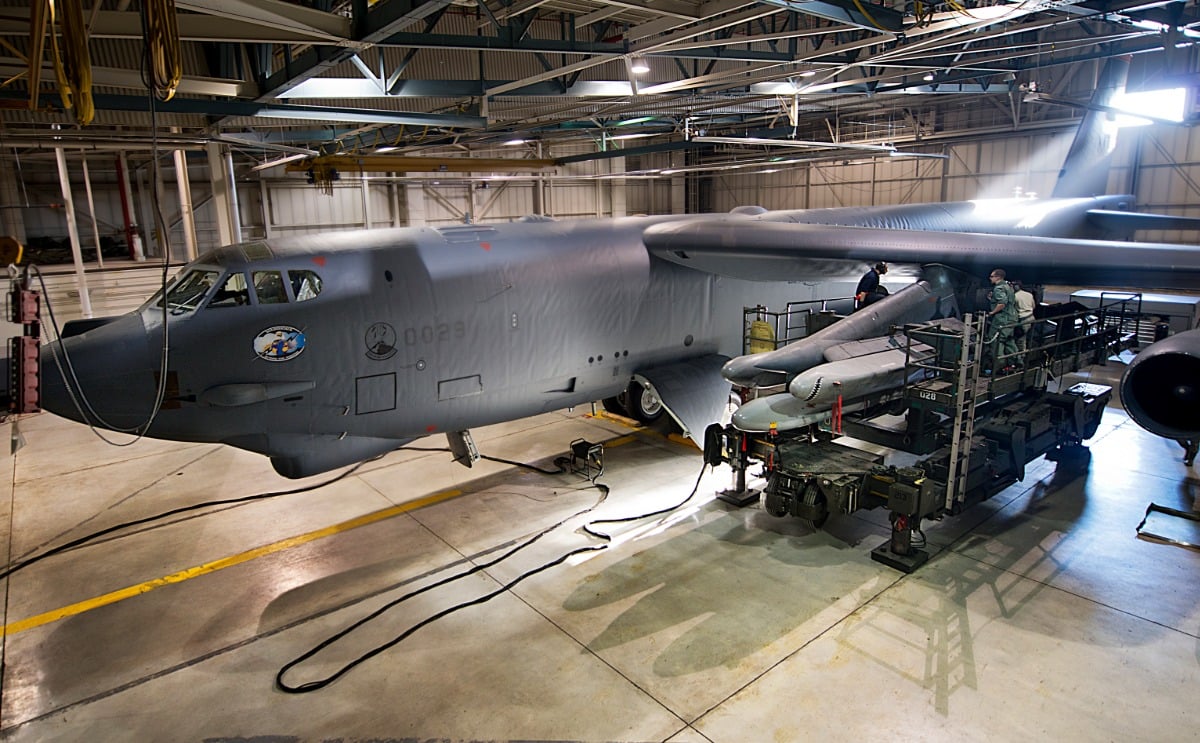
A young crew chief, barely old enough to rent a car, stands beneath the sweeping wing of a B-52H Stratofortress. The bomber itself is a grandfather, built in the early 1960s. Inside its belly sits the Common Strategic Rotary Launcher, a massive mechanical drum that holds the AGM-86B missiles like rounds in a colossal revolver.
The relationship between the aircrews and these weapons is complicated. There is no romanticism here. The AGM-86B is a blunt instrument from an era defined by the terrifying math of Mutually Assured Destruction. It doesn't have the stealthy, radar-evading geometry of modern low-observable missiles. It looks like a flying tube with stubby, pop-out wings and a small turbofan engine bolted to its back.
But it works. It has always worked.
During Desert Storm, a modified conventional version of this exact missile flew the longest combat mission in aerial history at the time, launching from B-52s that took off from Louisiana, striking targets in Iraq, and returning home without ever touching the ground. That legacy of brutal reliability is what keeps the current generation of airmen meticulous. They know that if these missiles are ever used for their primary, nuclear mission, the world has already ended. Their entire professional existence is dedicated to ensuring a weapon functions perfectly so that it never has to be fired.
The psychological toll of that paradox is invisible, but it is heavy. You can see it in the way a technician checks a guidance alignment tool three times, eyes narrowed, checking the calibration date against a clipboard. They are maintaining a bridge to an era most of their peers only know from history books, operating under the terrifying premise that the oldest gear must remain the most dependable.
The Long Road to the Horizon
The real question behind the $50 million Boeing contract is not what it keeps alive, but what it is waiting for.
The Air Force has been working on a replacement for years: the Long Range Stand Off (LRSO) missile. Built by Raytheon, the LRSO is designed to be everything the old AGM-86B is not. It will be stealthy, highly digital, and capable of slipping through the most advanced air defense networks on Earth.
But building modern nuclear delivery systems is an exercise in immense bureaucratic and technical friction. Schedules slip. Testing programs encounter unexpected anomalies. Supply chains, strained by global pressures and specialized materials requirements, slow to a crawl.
The gap between the retirement of the old and the arrival of the new is where danger lives.
If the AGM-86B fleet were pulled from service before the LRSO is fully operational and deployed in sufficient numbers, a critical leg of the American nuclear deterrent would simply vanish. The B-52 bombers, unable to fly directly over modern, heavily defended airspace without being torn apart by advanced surface-to-air missiles, would lose their ability to strike from a distance.
So, the Pentagon pays the tax.
The $50 million goes to extending engineering support, analyzing structural integrity, and running simulation after simulation to ensure the missile's flight control software doesn't suffer from digital dementia. It is a financial holding pattern, a way to buy time with cash while the future slowly takes shape in defense laboratories across the country.
The Final Guard Shift
Late at night in the maintenance bays, away from the brass and the politicians who debate nuclear modernization budgets in wood-paneled congressional hearing rooms, the work continues.
An senior technician rubs his eyes, leaning over a diagnostic console that displays green phosphor text. He was a toddler when the missile he is working on was loaded into its first operational storage container. He knows every quirk of its fuel system, every oddity of its actuator motors, and the exact smell of the preserving lubricants used to keep its internal seals from rotting.
There is a strange, quiet dignity to this work. It receives no parades, no press conferences, and very little public understanding. Most people prefer not to think about the thousands of nuclear weapons tucked away in America's grasslands and coastal bays, resting in a state of permanent, frozen readiness.
But someone has to watch them. Someone has to make sure the clock keeps ticking, even if the clock was built by a generation of engineers who are no longer alive.
The tools change, the geopolitics shift, and the names of the defense secretaries rotate on the stationery in Washington. But out on the missile lines, the mission remains entirely stubborn, pinned to the wall by a fifty-million-dollar anchor.
A technician reaches out, his gloved hand resting for a brief second on the cold aluminum skin of the missile fuselage. It is static. It is silent. It waits in the dark, a forty-year-old ghost keeping a vigil over a world that has largely forgotten why it was built in the first place.


