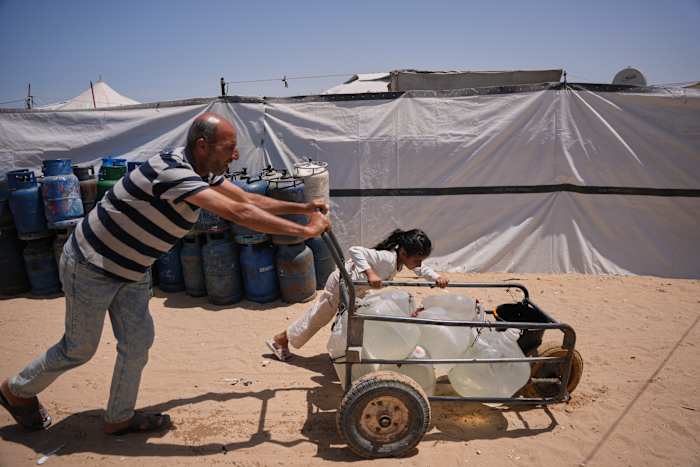
History has a brutal way of repeating itself, but right now in Gaza, it’s not just repeating. It’s getting worse.
Every year on May 15, Palestinians mark the Nakba. It’s the Arabic word for "catastrophe," referring to the 1948 mass expulsion and flight of around 700,000 Palestinians during the creation of Israel. For decades, that event stood as the absolute baseline of Palestinian trauma. It was the ultimate tragedy in the collective consciousness. Parents passed down stories to children, holding onto rusted iron keys to homes they were forced to leave behind in towns like Jaffa, Haifa, and Beersheba. Discover more on a similar subject: this related article.
That historic trauma feels almost distant compared to what’s happening on the ground today.
Talk to Palestinians enduring the current warfare in Gaza, and you'll hear a terrifying consensus. The present reality has completely eclipsed the horrors of 1948. We aren't just witnessing a commemoration of a past tragedy. We are watching a live-streamed, accelerated version that makes the original Nakba look limited in scope. Further analysis by BBC News highlights similar views on this issue.
The Mathematical Reality of Modern Displacement
To understand why people in Gaza say today's catastrophe is worse, you have to look at the sheer scale of the destruction. Numbers don’t lie.
In 1948, roughly 700,000 people were displaced from their ancestral homes. It shattered Palestinian society. Yet, compare that to the current conflict. The United Nations Relief and Works Agency (UNRWA) reports that over 1.7 million people in Gaza have been displaced since October 2023. That is more than 75% of the entire population of the strip.
| Metric | The 1948 Nakba | The Current Gaza Crisis |
|---|---|---|
| Displaced Population | Around 700,000 | Over 1.7 Million |
| Geographic Scope | Across historic Palestine | Concentrated in a tiny coastal enclave |
| Escape Routes | Open borders to neighboring Arab states | Closed borders, trapped under bombardment |
| Casualties | Estimated 15,000 deaths | Over 35,000 deaths documented by health officials |
The sheer concentration of suffering makes the current crisis unprecedented. In 1948, refugees could physically walk away. They crossed borders into Lebanon, Syria, Jordan, or the West Bank. They escaped the immediate zone of active combat.
Today, there is nowhere to go. Gaza is a tiny, walled-in strip of land, roughly 25 miles long and 6 miles wide. When the bombs fall, people flee from the north to the south, only to find the south under fire too. They are forced to move four, five, or six times. They pack up tents, carry elderly relatives on their backs, and walk through ruined streets, tracking shifting "safe zones" that don’t actually exist. It’s a closed-loop system of displacement.
Total Infrastructure Collapse and the Weaponization of Survival
The 1948 displacement was primarily about losing land and homes. People fled in fear, but the physical environment they left behind remained largely intact, even if it was quickly repopulated by someone else.
Right now, Gaza is facing total systemic erasure. Satellite imagery analyzed by the United Nations Satellite Centre (UNOSAT) shows that more than half of all buildings in the Gaza Strip have been damaged or completely destroyed. Entire neighborhoods have been reduced to gray dust and craters.
Think about what that means for the future. Even if a ceasefire happens tomorrow, where do people return? The schools are gone. The universities are rubble. The hospitals have turned into battlegrounds and graveyards.
Human rights organizations like Amnesty International and Human Rights Watch have repeatedly sounded the alarm over the weaponization of basic survival needs. Food is scarce. Clean water is a luxury. The healthcare system has collapsed to the point where doctors perform surgeries on hospital floors without anesthesia, using the flashlights of mobile phones.
In 1948, the trauma was losing your homeland. In 2026, the trauma is watching your entire society, your family tree, and your physical world get completely pulverized while the world watches on social media.
The Loss of Safe Refuges and the Myth of Humanitarian Zones
One of the biggest misconceptions about the current conflict is that civilians have viable options to escape the fighting. They don't.
During the first Nakba, fleeing meant finding safety in refugee camps established by humanitarian agencies. Those camps eventually turned into permanent townships, but they offered immediate shelter, safety from active shelling, and basic rations.
Look at Gaza today. The refugee camps themselves, places like Jabalia, Nuseirat, and Khan Younis, have been major focal points of heavy military operations. The designation of "humanitarian zones" like Al-Mawasi has proven to be a cruel illusion. Hundreds of thousands of people pack into these overcrowded beach areas without proper sanitation, clean water, or protection from the elements, only for airstrikes to hit nearby anyway.
The psychological toll of this is staggering. True terror is knowing that no designation, no flag, and no geographic coordinate offers protection. Elders who survived 1948 as children say the current level of continuous, high-tech aerial bombardment is something they never experienced during the British Mandate or the 1948 war. The violence then was face-to-face, sporadic, and localized. Today, it’s automated, relentless, and all-encompassing.
Why Keeping Up With Independent Documentation Matters Right Now
The debate over what is happening in Gaza isn't just political. It's an existential battle over memory and documentation.
During the 1948 Nakba, much of the history was suppressed or ignored by mainstream Western media for decades. It took generations of historians, both Palestinian and revisionist Israeli "New Historians" like Ilan Pappé, to unearth military archives and record oral histories to prove the systematic nature of the expulsions.
Today, we have the opposite problem. There is an overwhelming flood of information, but foreign journalists are blocked from entering Gaza independently. This leaves the entire burden of documentation on local Palestinian reporters, dozens of whom have been killed while wearing clearly marked press vests.
If you want to understand the reality beyond standard news broadcasts, you have to actively seek out verified, ground-level documentation. Look at reports from field researchers working with organizations like B'Tselem, Al-Haq, and Euro-Med Human Rights Monitor. Read the daily updates from the UN Office for the Coordination of Humanitarian Affairs (OCHA). Don't look away from the raw footage and testimonies coming directly from doctors, aid workers, and civilians inside the strip. The history of this modern catastrophe is being written in real-time, and keeping tabs on these primary sources is the only way to counter misinformation and political spin.