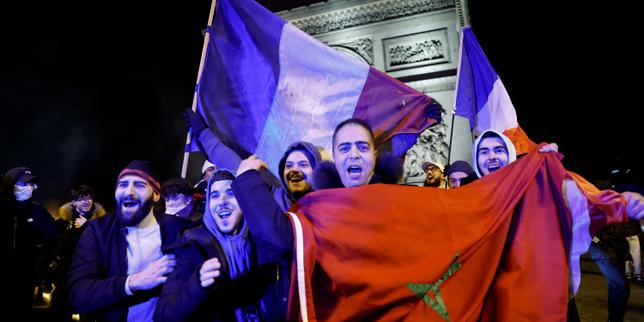
The fluorescent lights of a standard scouting office in western Europe do not scream poetry. They hum with a dull, bureaucratic vibration. For decades, men with spreadsheets sat in these rooms across France, the Netherlands, Belgium, and Spain, tracking the sons of Moroccan immigrants. They watched boys sprint across muddy community pitches in suburban Paris or navigate the concrete cages of Rotterdam. To the local clubs, these children were assets to be processed, polished, and occasionally discarded. To the Royal Moroccan Football Federation, they were something else entirely. They were a scattered diaspora holding the keys to a football revolution.
For a long time, the narrative of North African football was one of wasted potential. Talent was never the issue. The streets of Casablanca and the banlieues of Marseille produced players who could make a ball dance. But talent without structural spine is volatile. It flares up in moments of individual brilliance, then evaporates under the tactical pressure of elite tournaments.
Morocco changed the math. They did not do it by accident, nor did they do it by simply waiting for a golden generation to fall into their laps. They built an ecosystem that bridged two distinct worlds, solving a psychological and structural puzzle that had baffled football federation executives for generations.
The Kitchen Table Decisions
Consider a hypothetical teenager we will call Youssef. He is seventeen, living in a cramped apartment outside Lyon. His father arrived from Oujda twenty years ago to work in construction. Youssef trains at a prestigious French club academy. He wears the training gear. He speaks with the local accent. But inside the home, the language is Arabic, the tea is mint, and the emotional anchor remains fixed to a coastline he only visits in July.
When the French youth national team calls, it is an honor. When the Moroccan scout knocks on the door, it is an existential crisis.
This is where the old methodology failed. Traditional scouting focused purely on athletic metrics and contract lengths. The modern Moroccan approach shifted the focus to the kitchen table. Federation representatives did not just show up with jerseys and promises of playing time; they showed up with an understanding of dual identity. They recognized that these boys were not split fifty-fifty between two nations. They were one hundred percent French and one hundred percent Moroccan, navigating a world that constantly demanded they choose one over the other.
The federation stopped treating the diaspora as a secondary resource or a backup plan for players who could not make the French senior squad. They began recruiting players early, embedding them in the national system before European federations even registered their names on a depth chart. They built relationships with mothers, fathers, and local community leaders. They made the choice about heritage rather than career optimization.
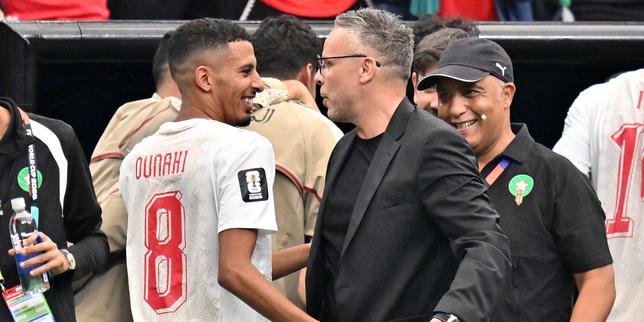
The results of this psychological shift materialized on the pitches of Qatar. When Achraf Hakimi, born in Madrid, or Hakim Ziyech, raised in Dronten, wore the red and green, they were not playing with the cautious reservation of mercenaries. They played with a ferocious, collective fury.
The Fortress in Salé
While the scouting network gathered the sons of the diaspora, a parallel experiment was unfolding on the banks of the Bou Regreg river in Salé. If you rely solely on players born abroad, you alienate your domestic base and create a fractured locker room. The local league becomes a afterthought, and homegrown talent withers.
To prevent this, the Moroccan federation poured millions into brick, mortar, and human capital. The Mohammed VI Football Academy was not designed to be a luxury resort; it was built as a cathedral of high performance.
Step inside the facility and the scale becomes clear. It is an intense, monastic environment where the country's elite youth are isolated from distractions and subjected to elite European training methodologies. The scouts combed every dusty pitch in Marrakesh, Fez, and Tangier to find kids who lacked formal training but possessed raw, unformatted instinct.
This created a unique competitive friction. In the national team setups, the street-honed, physically punishing style of domestic-bred players collided with the tactically rigid, hyper-organized education of European academy graduates.
Instead of fracturing the squad, this duality became their superpower. The domestic players provided a raw, uncompromising grit. The diaspora players brought tactical maturity and familiarity with the highest levels of European club football.
The Architect of the Middle Ground
Every structure needs an engineer who understands the stress points of the materials they are using. For Morocco, that was Walid Regragui.
Regragui was uniquely qualified to handle this volatile mixture because he was the living embodiment of it. Born in Corbeil-Essonnes, a southern suburb of Paris, he played his football in France but earned his international caps for Morocco. He understood the specific isolation of the immigrant experience and the fierce pride of the homeland.
When he took over the national team just months before the World Cup, the squad was fractured. His predecessor had alienated star players and created a rigid, top-down hierarchy that stifled the team's emotional expression. Regragui threw out the old playbook.
He did not implement a revolutionary tactical system that required years of drilling. He kept things simple. He organized a low block that was suffocatingly compact. He demanded that his wingers defend with the intensity of full-backs. But his real genius lay in his management of the human ego.
He invited the players’ families to travel with the team. He allowed the cameras to capture mothers kissing their sons on the forehead after historic victories. To the cynical European media, this looked like a heartwarming PR stunt. To the squad, it was a profound validation of their entire existence. It fused their professional duties with their deepest personal identities.
On the pitch, that emotional alignment manifested as an unbreakable defensive wall. Sofyan Amrabat ran until his lungs were empty, covering every blade of grass to protect his center-backs. Players threw their bodies in front of shots not out of tactical obedience, but out of a deep-seated refusal to let down the collective family unit sitting in the stands.
The New Global Reality
The old guard of international football is built on colonial legacies and historical wealth. European nations have long benefited from the talent of players with immigrant backgrounds, capitalizing on systems that developed them while often keeping their communities at arm's length.
Morocco inverted that power dynamic. By offering a world-class professional environment combined with an authentic embrace of cultural identity, they proved that a nation from the Global South can compete on equal terms without begging for scraps from the European table.
This is no longer a temporary fairytale or a fluke tournament run. The infrastructure is permanent. The scouting pipelines are deeply entrenched. Every young dual-national kid in Europe now looks at Morocco not as a sentimental alternative, but as a legitimate powerhouse where they can play for trophies on the biggest stages.
The old world order relied on the assumption that resources and prestige would always keep the trophy cabinets in Western Europe and South America. They forgot that football belongs to the people who need it the most.
As the sun sets over the academy in Salé, a new group of teenagers laces their boots. Some speak French, some speak Dutch, some speak Darija. They stretch in a circle, laughing at a joke that requires no translation. They look at each other and see no borders, only the red jersey and the star on the chest. The old powers are watching them now, not with condescension, but with a quiet, creeping fear.