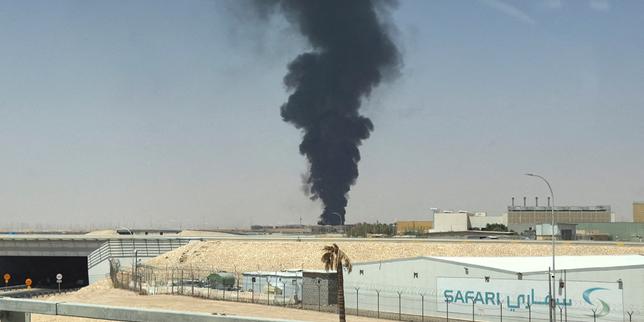
Geopolitical stability in the Arabian Peninsula operates on a thin margin of error, where a single ballistic trajectory can invalidate years of diplomatic signaling. When Houthi forces project kinetic assets toward Riyadh, the event functions as more than a localized security breach. It represents a stress test of regional deterrence architecture, exposing the cost asymmetry between offensive loitering munitions and defensive interceptor batteries. Analyzing this dynamic requires stripping away political rhetoric to examine the raw logistics of air defense, the economics of missile attrition, and the structural vulnerabilities inherent in centralized capital city defense grids.
The Cost Function of Modern Air Defense
The primary driver of modern asymmetric conflict is not the lethality of the weapon system, but the economic imbalance of the interception equation. Defensive operations against incoming ballistic vectors or long-range drones rely on high-precision surface-to-air missile systems. Each deployment incurs a severe financial penalty that heavily favors the attacking actor.
When an inbound projectile targets an urban center like Riyadh, the defending state must calculate the interceptor expenditure relative to the asset being protected. Interceptor missiles often outspend the threat asset by orders of magnitude. This creates a systemic financial bleeding mechanism for the defending coalition.
- Capital Expenditure Asymmetry: Low-cost composite-body drones and unguided ballistic variants cost a fraction of the advanced telemetry and guidance packages required for interception.
- Inventory Depletion Rates: Sustained campaigns force a structural deficit in strategic stockpiles, where resupply lead times exceed the frequency of potential incoming salvos.
- Industrial Base Bottlenecks: Global manufacturing lines for high-tier interceptors face strict production limits, preventing rapid scaling during sudden regional escalations.
This fiscal friction shifts the strategic objective. Attackers do not need to achieve high physical destruction rates to win; they simply need to sustain launch cadence until the defender's resource allocation model breaks down.
Strategic Objectives Behind Long-Range Power Projection
Executing a strike against a heavily defended capital located hundreds of kilometers from launching positions requires more than tactical capability. It serves a calculated signaling function within a broader regional deterrence matrix.
When sub-state actors or aligned factions target central administrative and economic hubs, they seek to impose costs that resonate beyond the immediate blast radius. These operations disrupt investor confidence, force costly defensive postures, and compel external security guarantors—such as the United States—to recalibrate their regional posture.
- Information Warfare and Perception: Striking a capital city alters the psychological narrative, demonstrating that geographic depth does not equal immunity.
- Diplomatic Compellence: Forcing major powers to fear escalation creates leverage at the negotiating table, compelling adversaries to engage on terms dictated by the threat of sustained instability.
- Resource Diversion: Forcing air defense assets to concentrate around high-value urban nodes leaves secondary industrial and energy infrastructure exposed, widening the defender's surface area of vulnerability.
The Structural Limits of Security Guarantees
External security providers face a distinct operational dilemma when regional partners come under direct attack. The United States maintains a complex network of deterrence commitments across the Middle East, yet its strategic calculus is governed by global prioritization and risk mitigation.
When an escalation triggers alarm bells in Washington, the response is rarely immediate kinetic intervention. Instead, it manifests as diplomatic pressure, intelligence sharing, and defensive posture adjustments. This creates a friction point between local partners who demand absolute security guarantees and a superpower operating under finite resources and competing global theaters.
- Credibility Traps: Failing to respond robustly invites perceptions of abandonment, while over-responding risks entangling military assets in protracted regional quagmires.
- Escalation Dominance Challenges: The presence of multiple proxy networks blurs attribution, complicating the mechanics of proportional retaliation and deterrence enforcement.
- Intelligence Gaps: Early warning systems depend on overlapping radar horizons, where gaps in coverage can reduce reaction windows to minutes, shifting the burden entirely to terminal defense layers.
Systemic Vulnerabilities in Capital Defense Grids
Protecting a sprawling metropolitan area presents unique geometric and engineering hurdles. Unlike point defenses protecting a single military base or oil facility, a capital city spans vast territory, making continuous 360-degree high-tier coverage mathematically improbable.
The deployment of defense batteries involves trade-offs between coverage footprint and interception probability. If batteries are concentrated too tightly, outer suburbs and approach corridors remain vulnerable. If spread too thin, gaps emerge that allow low-altitude cruise missiles or swarming drones to bypass the primary detection umbrella.
Furthermore, civilian density imposes severe operational constraints. Interception debris falling over heavily populated urban sectors introduces secondary casualty risks that can rival the impact of the original strike. Consequently, defenders must prioritize intercept zones over uninhabited corridors, further narrowing the window for successful neutralization.
Operational Forecast and Strategic Adaptation
The mechanics of modern drone and missile warfare dictate that defense-dominant paradigms are unsustainable over long horizons. To alter the cost curve, military planners must pivot toward layered, non-kinetic mitigation strategies.
- Directed Energy Integration: Transitioning from kinetic interceptors to laser-based or microwave suppression systems lowers the marginal cost per engagement toward operational parity with incoming threats.
- Decentralized Early Warning: Integrating commercial sensor networks with military telemetry can mitigate radar horizon blind spots caused by terrain masking.
- Supply Chain Redundancy: Securing domestic or diversified manufacturing nodes for critical guidance components is essential to prevent inventory exhaustion during prolonged strategic standoffs.
Without these structural adaptations, capital cities across the region will remain exposed to the corrosive economics of asymmetric bombardment, where every intercepted projectile represents a strategic victory for the attacker's ledger.


