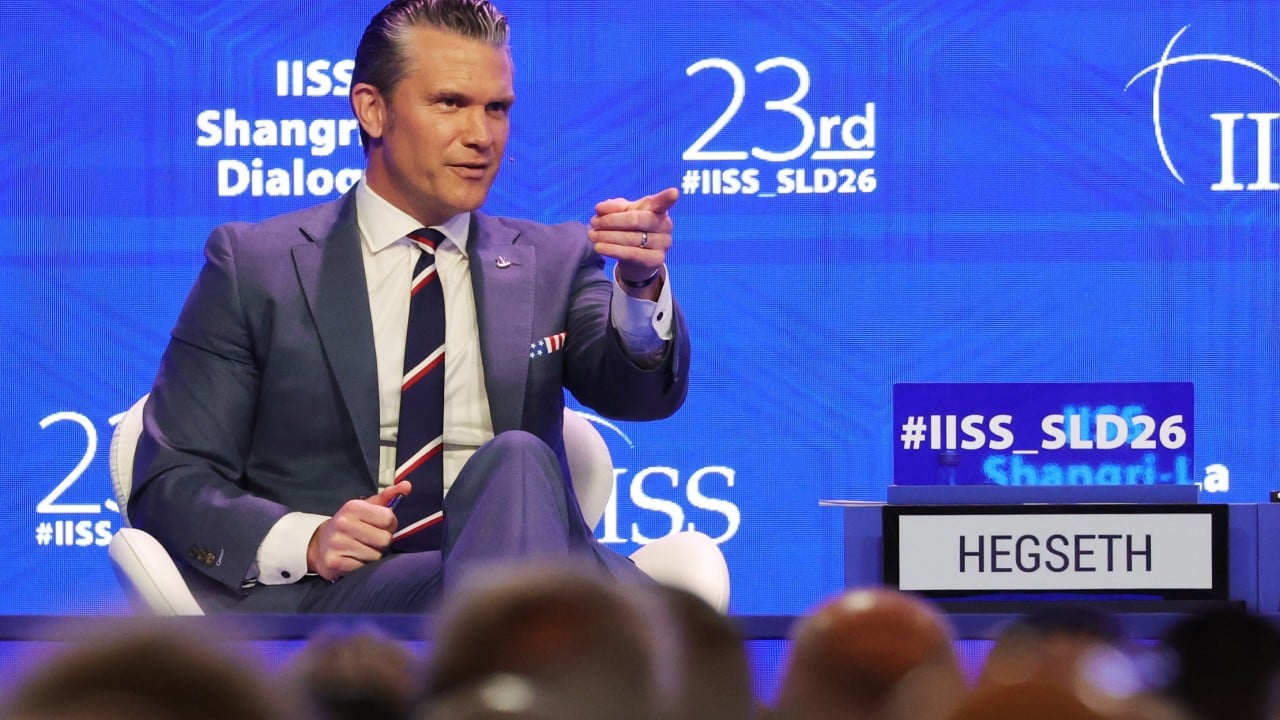
The shift in American grand strategy executed at the Shangri-La Dialogue in Singapore exposes the structural realignment of Washington’s global alliance network. By replacing explicit adversarial designations of China with a framework rooted in transactional reciprocity, the Pentagon is executing an optimization strategy designed to maximize regional deterrence while shifting financial and material operational burdens to local partners. This strategic recalibration is not an ideological retreat. It is a mathematical necessity driven by constrained industrial capacity, simultaneous secondary theater obligations, and the emergence of a multipolar security paradigm.
To understand this shift, the security environment must be evaluated through a precise conceptual framework that isolates the variables driving Washington’s defense posture. The traditional policy of ideological alignment is being replaced by an operational calculus that evaluates partnerships based on direct capital allocation, industrial manufacturing capability, and localized defense spending thresholds.
The Tri-Border Strategic Framework
The revised Pentagon approach operates across three distinct strategic pillars designed to balance major power competition with resource optimization.
1. Structural Stability via Reciprocal Equilibrium
Rather than pursuing absolute regional dominance, which demands an unsustainable volume of forward-deployed capital, the current model seeks a baseline of strategic stability with Beijing. This stability is defined by two operational variables: fairness in market access and reciprocity in security guarantees. The objective is to establish an equilibrium where both state actors protect core national interests without triggering an escalatory feedback loop that disrupts primary trade corridors.
2. Radical Burden-Shifting and Partner Demarcation
The Pentagon has established an explicit boundary between "partners" and "protectorates." The classification depends directly on a nation's defense expenditures relative to its domestic output. By setting a target of 3.5 percent of Gross Domestic Product (GDP) for Indo-Pacific allies, Washington is establishing a cost-sharing mechanism that indexes American security guarantees against local capital commitments.
3. Pragmatic De-Ideologization
The strategy discards the historical framework of a value-based, rules-based international order. In its place, it substitutes an transactional model where alliances are forged exclusively on the intersection of national survival and economic security vectors. This removes the diplomatic friction associated with governance models and focuses strictly on kinetic and logistical interoperability.
The Alliance Cost Function and Regional Asymmetry
The enforcement of the 3.5 percent GDP defense spending threshold reveals a deep divergence in how Washington evaluates its European and Asian alliances. This divergence is driven by the structural decay of European military readiness relative to the active capitalization occurring within Indo-Pacific defense frameworks.
The mechanism driving this policy shift can be modeled as a strategic optimization problem, where the total utility of American security deployment ($U_{us}$) is dependent upon localized defense spending ($S_{local}$), industrial-base integration ($I_{base}$), and the direct mitigation of hegemon expansion ($M_{heg}$):
$$U_{us} = f(S_{local}, I_{base}, M_{heg})$$
When European nations allow their localized spending to fall below sustainable operational levels, it creates an asymmetric resource drain. The Pentagon’s response is a binary resource allocation policy that explicitly penalizes defense under-investment while fast-tracking capital and technology access to compliant states.
- The Compliance Fast-Track: Nations meeting or actively pacing toward the capital allocation benchmarks—specifically India, Vietnam, the Philippines, Australia, Indonesia, Malaysia, and Singapore—are integrated into a high-tier defense architecture. This architecture includes expedited arms transfers, co-development of military hardware, and deep integration of signals and cyber intelligence networks.
- The Atrophy Penalty: Nations that rely on historical security guarantees without corresponding domestic spending are moved to the back of the procurement queue. This structural bottleneck is designed to force domestic defense industrial base capitalization in countries that have historically subsidized domestic social programs via American defense guarantees.
The Taiwan Arms Dilemma and Transactional Ambiguity
The preservation of strategic ambiguity regarding Taiwan has transitioned from a diplomatic stance to an explicit bargaining chip within a broader bilateral negotiation framework. The delay in greenlighting a crucial $14 billion arms package demonstrates how hardware transfers are being used to balance strategic objectives against economic concessions.
This mechanism functions as a two-level game. Nationally, the threat of withholding or delaying critical munitions packages incentivizes local administrative bodies to increase their independent defense procurement budgets and assume greater operational risk. Internationally, the arms package serves as a variable leverage point in direct negotiations with Beijing regarding trade balances, supply chain decoupling, and market access.
The risk inherent in this approach is the potential degradation of the deterrence gradient. If the perceived probability of American intervention drops below a critical threshold, the deterrence model fails. The administration attempts to mitigate this by decoupling rhetorical threats from material positioning, maintaining forward-deployed naval assets while softening the public diplomatic narrative.
Supply Chain Realignment and Industrial Sovereignty
A critical omission in standard diplomatic analysis is the direct link between rhetoric modification and the timelines required for defense industrial base capitalization. The United States is currently scaling up its domestic defense manufacturing industry, particularly in munitions production, shipbuilding capacity, and microelectronics sovereignty.
During this scaling phase, the military-industrial apparatus faces acute capacity constraints. It cannot simultaneously supply advanced munitions to multiple active or cold theaters while executing large-scale unilateral forward deployment in the Pacific.
The softening of tone toward Beijing acts as a tactical decompression mechanism. It secures the diplomatic runway necessary to re-shore critical supply chains and build out regional industrial capacity among compliant partners.
The strategic play moving forward is structured and clear. Indo-Pacific nations must immediately reallocate domestic capital to meet the 3.5 percent GDP threshold or risk structural isolation within their procurement and intelligence pipelines. Washington will continue to treat regional security not as a static moral obligation, but as a dynamic joint venture where equity is determined strictly by capital input and industrial capacity.