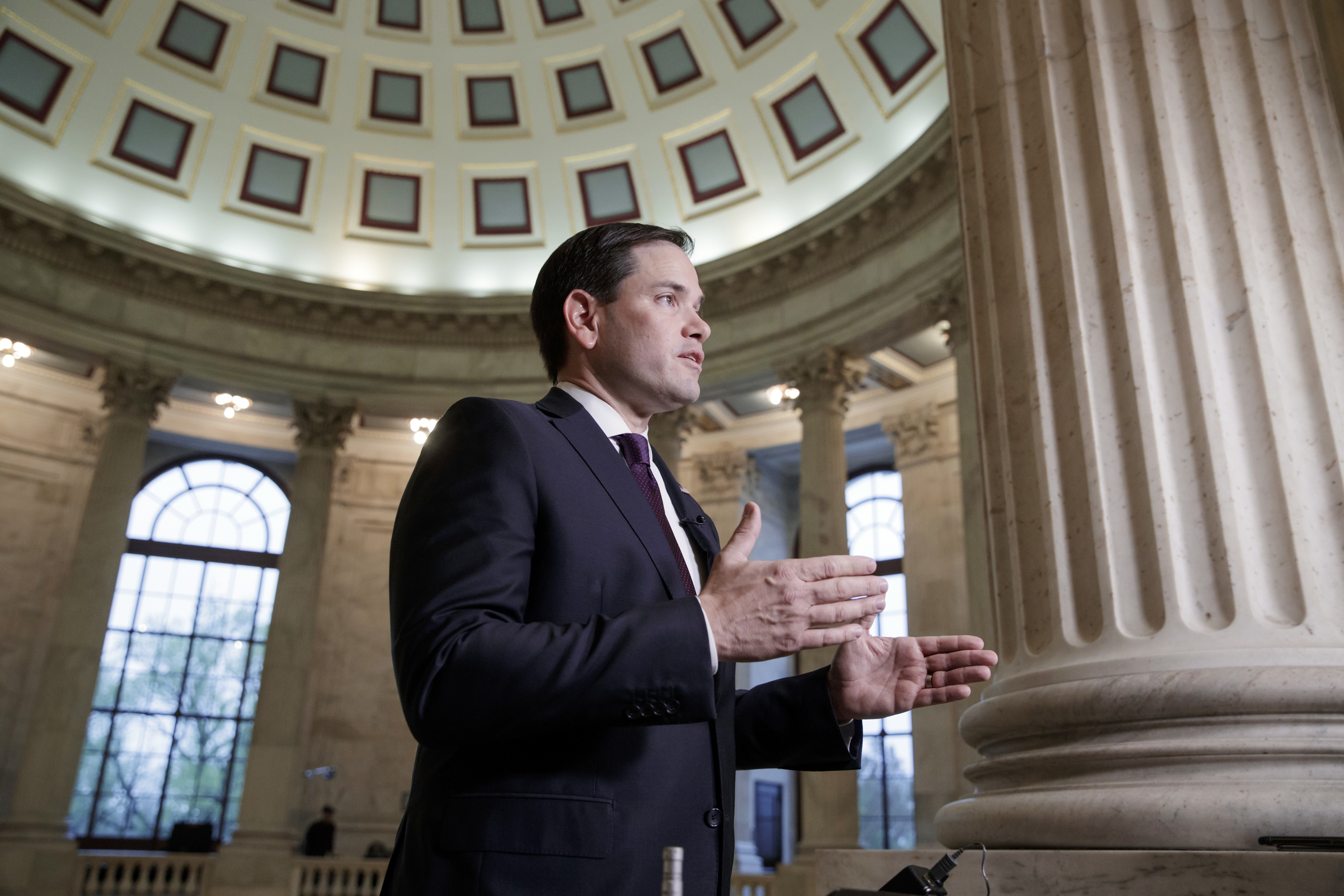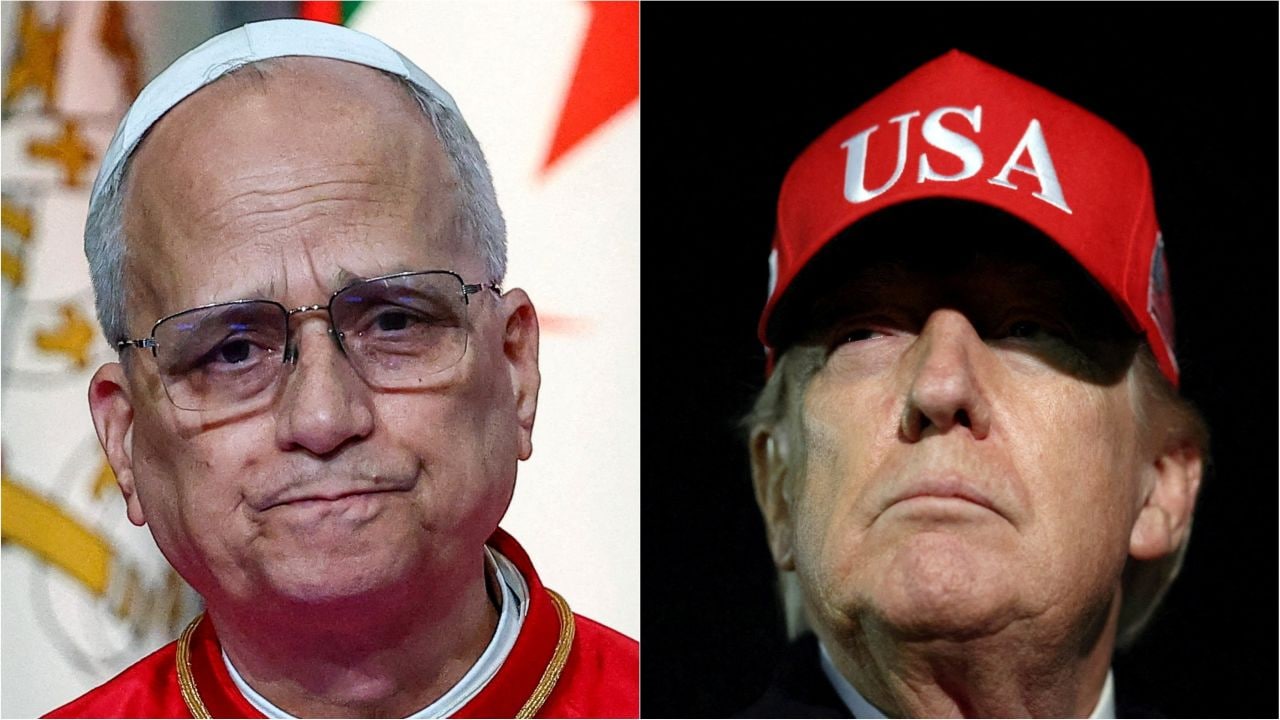
The tension between the executive branch of the United States and the Holy See represents a unique collision of hard power and moral authority. When an American president labels a sitting Pope as "weak," the statement is rarely a personal observation; it is a calculated or reactionary recalibration of a diplomatic relationship that governs significant global influence. This friction arises because the Vatican functions as a non-territorial superpower, wielding a form of "soft power" that can validate or delegitimize U.S. foreign policy objectives in Latin America, Eastern Europe, and sub-Saharan Africa.
The operational reality of U.S.-Vatican relations is defined by a three-pillar framework: diplomatic intelligence sharing, domestic constituent alignment, and global moral arbitration. To understand the current volatility, one must analyze how these pillars shift when an administration's nationalist or populist agenda intersects with the Vatican’s transnational, humanitarian priorities.
The Structural Divergence of Interests
The conflict between a "U.S. First" policy and the Vatican’s "Universalism" is a mathematical certainty. The Holy See operates on a centuries-long timeline, whereas a U.S. President is incentivized by four-year election cycles. This discrepancy in temporal horizons creates immediate friction points in three specific sectors.
1. The Migration and Sovereignty Variable
The Vatican views migration through the lens of human dignity and the rights of the displaced, a position rooted in Catholic social teaching. A U.S. administration focused on border securitization and national sovereignty views the same phenomenon as a matter of law enforcement and resource protection. When a president calls a Pope "weak" on this issue, they are effectively arguing that the Pope’s refusal to prioritize national borders over human movement undermines the integrity of the nation-state.
2. Economic Distribution vs. Capitalist Expansion
The Holy See often critiques "unfettered capitalism," a stance that creates a direct ideological bottleneck for U.S. administrations prioritizing deregulation and market-driven growth. The friction here is not merely rhetorical; it influences policy regarding international debt relief, climate change accords, and trade agreements. A president’s criticism of the Pope often serves as a signal to a domestic base that the administration will not allow "external moral actors" to dictate national economic strategy.
3. Diplomatic Utility and Intelligence
The Vatican maintains one of the world's most sophisticated grassroots intelligence networks via its global clergy. Historically, U.S. presidents have leveraged this network to achieve specific geopolitical outcomes—the most notable being the Reagan administration’s cooperation with Pope John Paul II to undermine Soviet influence in Poland. When the current relationship sours, the U.S. loses access to this "soft" intelligence channel, forcing the State Department to rely on more traditional, and often less effective, bureaucratic means.
Historical Precedents of Presidential Antagonism
The history of U.S.-Vatican relations is marked by a cycle of pragmatic cooperation followed by periods of strategic distancing. Every president since the formal establishment of diplomatic ties in 1984 has had to navigate this duality.
- The Reagan Model (Strategic Alignment): This represented the peak of synergy. Both entities shared a common existential threat: Communism. The relationship was transactional and highly effective because the ideological goals of the White House and the Vatican were temporarily aligned.
- The Clinton-Bush Divergence (Ethical Friction): Friction points emerged during these administrations regarding reproductive rights and the Iraq War. Pope John Paul II was a vocal critic of the 2003 invasion of Iraq, labeling it a "defeat for humanity." The Bush administration did not call the Pope "weak," but it did bypass the Vatican’s moral authority to pursue a unilateral military strategy.
- The Trump-Francis Paradigm (Direct Populist Confrontation): This era introduced a new variable: public, ad hominem criticism. By labeling the Pope’s stance on border walls as "disgraceful" or calling the leader "weak," the executive branch utilizes the Vatican as a foil. This strategy serves to solidify a specific nationalist identity among voters who feel the Church’s globalist leanings have moved too far from traditional or conservative national interests.
The Cost Function of Diplomatic Devaluation
Degrading the relationship with the Holy See is not a cost-free exercise. The "cost" is measured in the loss of a specific type of international legitimacy. The Vatican acts as a "force multiplier" for American interests when both are aligned. When they are at odds, the Vatican can act as a "force divider," particularly in regions where the Catholic population is a dominant political demographic.
The immediate casualty of a hostile relationship is the Moral Certification Mechanism. U.S. foreign policy often requires a veneer of moral necessity to gain international support. If the Pope—the world's most visible moral authority—publicly disagrees with a U.S. action (such as a withdrawal from a climate treaty or a hardline immigration policy), it increases the political cost for other nations to align with the U.S.
The Mechanism of "Weakness" as a Political Tool
In the lexicon of populist politics, "weakness" is defined as a failure to prioritize one's own tribe, nation, or strength over abstract universal principles. By applying this term to a Pope, a president is engaging in a process of Desacralization. This is a tactical move to strip the Pope of his religious immunity and recast him as just another political actor on the global stage.
- Reframing the Narrative: If the Pope is a "politician" rather than a "pastor," his critiques of U.S. policy can be dismissed as partisan bias rather than moral guidance.
- Internal Religious Division: This rhetoric exploits the existing polarization within the American Catholic Church. By criticizing the Pope, a president appeals to the traditionalist wing of the Church that may already feel alienated by a more progressive papacy.
- Sovereignty Assertion: It serves as a performance of "Strength." For a nationalist leader, standing up to a global figure like the Pope is a way to demonstrate that the nation’s interests are subordinate to no one, not even a spiritual leader.
Strategic Realignment and the Path Forward
The volatility in U.S.-Vatican relations is a symptom of a larger shift from a unipolar world to a fragmented, multipolar one. In this environment, the Holy See's neutrality becomes an obstacle for any administration seeking total alignment of its allies.
The current administration, or any future one, must calculate the exact trade-off between the short-term domestic gain of criticizing the Pope and the long-term loss of global moral leverage. The data suggests that while public criticism may energize a base, it creates a vacuum in international mediation that other actors—specifically China and Russia—are increasingly willing to fill.
The strategic play for any U.S. executive is to move from a relationship of personality-driven conflict to one of Functional Compartmentalization. This requires:
- Identifying areas of "Hard Interest Alignment" (e.g., human trafficking, religious freedom in the Middle East).
- Publicly ignoring "High-Conflict Ideological Zones" (e.g., economic theory, border philosophy) to avoid unnecessary diplomatic friction.
- Re-establishing the "Quiet Channel" of the State Department to ensure that even when public rhetoric is hostile, the intelligence and humanitarian coordination remains operational.
The U.S. executive branch must realize that the Vatican’s influence is not tied to a military or an economy, but to a narrative. Controlling that narrative through cooperation is consistently more effective than trying to break it through public confrontation. The most effective presidents have been those who treated the Pope not as a rival politician, but as a unique geopolitical variable that must be managed with precision rather than emotion.