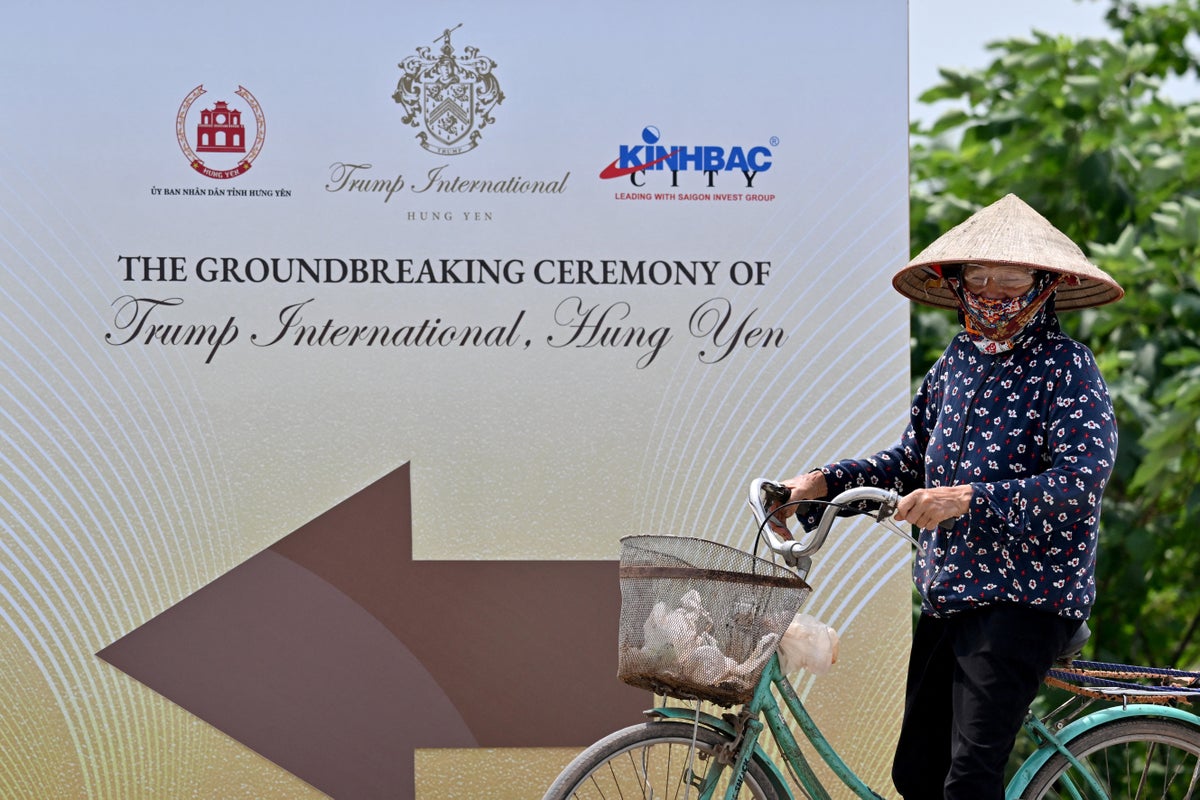
In the Chau Ninh commune of Vietnam’s northern Hung Yen province, the quiet rhythm of agricultural life has been replaced by a grim, state-orchestrated excavation. Farmers who have spent their lives cultivating lilies, longan, and bananas are now systematically unearthing the bones of their ancestors.
This mass exhumation is not the result of a local infrastructure initiative or an environmental crisis. It is the direct consequence of a $1.5 billion luxury real estate development featuring a 54-hole VIP golf course, five-star hotels, and ultra-luxury villas branded by the Trump Organization.
By clearing centuries-old graves and displacing thousands of agrarian families, Hanoi is demonstrating exactly how far it is willing to go to manage its complex relationship with Washington. This project is far more than a high-end real estate transaction. It is a calculated piece of economic diplomacy disguised as a playground for the global elite.
The Geopolitical Transaction Behind the Greens
To understand why a communist government is fast-tracking a luxury resort for an American billionaire, one must look at the global trade balance. Vietnam is heavily reliant on exports, and the United States is its primary market.
As supply chains shifted away from China over recent years, Vietnam’s trade surplus with America surged. This economic windfall came with immense political risk.
Washington recently threatened Hanoi with a massive 46 percent tariff on its exports, a penalty that would have crippled the country's manufacturing sector. Following intense negotiations and the rapid approval of the Hung Yen golf development, that threatened penalty was lowered to 20 percent for many goods.
Hanoi’s strategy centers on deep symbolic alignment. In international trade diplomacy, a tangible, multi-billion-dollar partnership with the family business of a sitting American president offers an unconventional layer of economic security.
State media reports from the project’s groundbreaking ceremony underline this intent. Government officials openly stated that the development is significant to strengthening bilateral relations and bolstering foreign investor confidence from the United States.
The transaction is transparent. Hanoi yields land and uproots local communities, and in return, it secures vital economic stability for its broader manufacturing sector.
Upending Tradition for Brand Licensing
The development stretches across a massive 990-hectare site less than an hour from Hanoi. It is being executed via a joint venture between Vietnamese industrial developer Kinh Bac City and the Trump Organization.
The financial structure of the deal reveals a sharp divide in risk and responsibility. Kinh Bac City is driving the local development and reportedly paid $5 million for the brand licensing rights alone.
The Trump Organization is not financing the construction, nor is it responsible for the contentious process of clearing local residents. It provides the brand equity and will manage the high-end operations once complete.
This model insulates the American entity from the messy realities of local land acquisition while ensuring it captures the upside. Eric Trump has publicly lauded the project, predicting it will become the envy of all of Asia.
For local farmers, however, the venture looks entirely different. Under Vietnamese law, all land is technically owned and managed by the state.
Citizens are granted long-term usage rights for agriculture, but the government retains the absolute authority to reclaimed that land for national development or commercial projects deemed strategically important.
When the state exercises this right, local residents have no legal mechanism to negotiate or refuse. They are simply handed a state-determined compensation package and an eviction notice.
The Human and Spiritual Cost of Fast-Tracked Development
The clearing of the Chau Ninh cemetery cuts directly into the core of traditional Vietnamese culture. In rural communities, ancestral graves are regarded with profound spiritual reverence.
Moving a grave is a deeply disruptive act, traditionally undertaken only under strict spiritual conditions to avoid bringing misfortune upon the living. Today, that tradition is colliding directly with international real estate development timelines.
Local resistance is quiet but persistent. While the local government disbursed approximately $2 million in late 2025 to relocate the first wave of 145 households, the broader project is slated to affect over 4,000 families.
Many residents are refusing to cooperate, pointing out the stark gap between their compensation and the commercial reality of the project. Payouts for some farmers have amounted to roughly 70 million dong, equivalent to just under $3,000, along with a few months of rice supplies and nominal fees for uprooted crops.
The land acquisition rate breaks down to somewhere between $12 and $30 per square meter. While local officials argue this aligns with standard rural land values, residents point out a fundamental double standard.
If the state were seizing land to build a public hospital, a highway, or a school, the community would accept the sacrifice as a civic duty. Watching their family farms and ancestral graveyards cleared to build a private playground for foreign billionaires and wealthy executives feels entirely different.
The anger is compounded by a distinct lack of transparency in early land surveys. Independent reports indicate that the project broke ground without completing essential regulatory steps, including standard environmental impact reviews.
The hurry is driven by a strict deadline. The developers are racing to have the first two golf courses operational by early 2027, precisely in time to service the Asia-Pacific Economic Cooperation economic leaders' gathering in Vietnam.
Ethics and the Limits of Symbolic Diplomacy
The rapid progression of the Hung Yen project has raised significant conflict of interest questions within Washington. Watchdog groups point out that a foreign state clearing its own citizens and spending millions of dollars to facilitate a project that directly enriches an American political family creates a highly problematic precedent.
The White House has consistently maintained that these business ventures are entirely separate from official U.S. trade policy, noting that the assets are held in a trust managed by the family’s children.
Yet, external analysts observe that financial disclosures show the revenue generated from these international properties ultimately flows back to the core family entity. This reality makes it impossible to completely untangle private commercial success from state-level trade negotiations.
The strategy also carries long-term risks for Vietnam. Relying on symbolic, high-profile real estate deals to smooth over massive trade imbalances is an unstable approach to foreign policy.
A multi-billion-dollar golf resort might win short-term goodwill, but it cannot fix the deep structural frictions between a socialist, export-driven economy and a highly protectionist American trade apparatus.
Issues surrounding intellectual property rights, currency valuation, and manufacturing dominance will persist long after the first ball is teed up in Hung Yen.
Meanwhile, the landscape in Chau Ninh continues to shift. Bulldozers and heavy dump trucks now sit parked next to bright red banners marking the future perimeter of the luxury complex.
Among the adjacent farms, family plots feature tombstones marked with large, spray-painted letters indicating they are scheduled for removal.
For the older generation of farmers who remain in these villages, the transformation is total. Their children have largely migrated to nearby cities for factory work, leaving the elderly to watch the fields they tended for decades turn into manicured fairways.
The state will likely resolve the remaining land disputes through its usual mix of administrative pressure and adjusted financial incentives, ensuring the project meets its 2027 deadline.
Hanoi will secure its trade concessions, the Trump Organization will expand its international luxury portfolio, and the global elite will gain an exclusive new destination. The entire cost of the transaction will be borne by the rural families currently carrying the remains of their parents away from the path of the bulldozers.