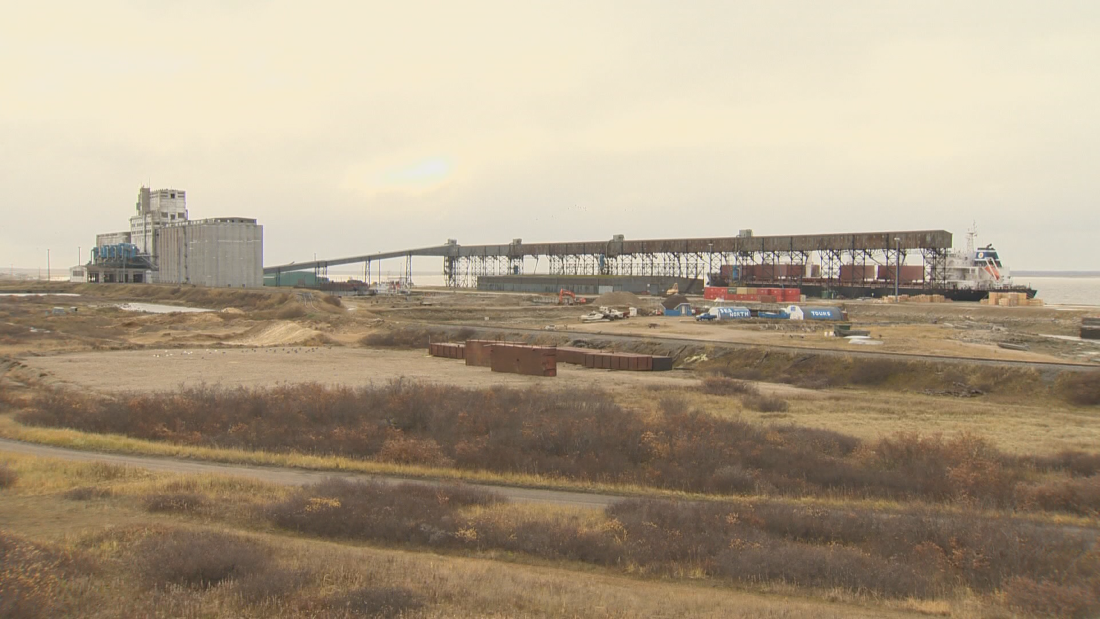
The resumption of prairie grain shipments through the Port of Churchill, Manitoba, after a four-year hiatus, is not merely a localized logistics update. It is a critical stress test for Canada’s northern sovereignty, regional supply chain diversification, and Arctic trade-enabling infrastructure. Beginning July 17, 2026, prairie grain will travel north on the Hudson Bay Railway from The Pas to the deepwater port of Churchill.
This operation represents the first commercial grain movement through this corridor since 2020. While domestic observers celebrate this as a milestone for regional development, a rigorous analysis of the logistics network reveals a complex friction between optimistic political narratives and severe structural, geological, and macroeconomic realities. Recently making headlines in this space: The Paper Rocket Deflates Why the Myth of a Trillion Dollar SpaceX Was Always Grounded in Fantasy.
The Three Pillars of Northern Logistics
To understand why the Port of Churchill has struggled with consistency—experiencing periodic shutdowns, washouts, and operational pauses—one must look at the three foundational pillars that dictate its economic feasibility.
                  [ Pillar 1: Rail Corridor Integrity ]
                                   │ (Single-track, permafrost substrate)
                                   ▼
                  [ Pillar 2: Seasonal Marine Access ]
                                   │ (Ice-locked winters, limited season)
                                   ▼
                  [ Pillar 3: Commodity Diversification ]
                                     (Mitigating high-cost grain economics)
1. Rail Corridor Integrity
The primary bottleneck of the Churchill export model is not the port itself, but the 1,300-kilometer Hudson Bay Railway line connecting the terminal to the continental network at The Pas. Built on a discontinuous permafrost substrate, this rail line is highly vulnerable to seasonal freeze-thaw cycles. The structural failure of this corridor in 2017—which left Churchill cut off for over a year—underscored the fragility of the asset. Further information on this are explored by Harvard Business Review.
The operational pause between 2021 and 2026 was explicitly required to execute extensive track stabilization and rehabilitation, transforming a high-risk liability into an active commercial line. However, maintaining Class 1 railway standards over melting permafrost remains an ongoing capital-intensive challenge rather than a completed task.
2. Seasonal Marine Access
Unlike competitive southern ports in Vancouver or Montreal, Churchill is historically constrained by a tight, weather-dependent shipping window. Typically operating from mid-July to late October, the port faces severe ice-clogging during the winter and spring.
While climate change has gradually increased the number of ice-free days in the Hudson Bay, operating without dedicated, heavy-duty marine ice-breaking capacity limits the commercial viability of the route for international shippers who demand predictable, year-round scheduling.
3. Commodity Diversification
Relying solely on grain exports is economically unsustainable for the Arctic Gateway Group (AGG)—the consortium of 29 First Nations and 12 northern communities that owns the corridor. The deregulatory collapse of the Canadian Wheat Board’s monopoly in 2012 stripped Churchill of its guaranteed grain volumes, exposing the port to raw market forces where grain companies preferred their own vertical supply chains in Vancouver or Thunder Bay.
The 2026 revival is structurally different because it forms part of a diversified export strategy. Alongside agricultural yield, the port is integrating critical minerals, potash, and northern resupply services to Nunavut to balance the seasonal volatility of grain yields.
The Economics of Northern vs. Southern Routing
The underlying thesis of the Port of Churchill is geographic efficiency. For grain producers in northern Saskatchewan and Manitoba, shipping through Churchill cuts transit times to European, Middle Eastern, and North African markets by several days compared to the congested Great Lakes-St. Lawrence Seaway or Pacific routes.
The cost function of this transport network can be expressed as:
$$C_{total} = C_{rail} + C_{handling} + C_{marine} + C_{risk}$$
Where:
- $C_{rail}$ represents the per-tonne rail tariff over the Hudson Bay Railway.
- $C_{handling}$ is the port terminal fee at Churchill.
- $C_{marine}$ is the ocean freight rate, which carries an Arctic insurance premium.
- $C_{risk}$ is the cost of potential delays, washouts, or early freeze-ups.
Under normal operating conditions, the shorter rail distance from the northern prairies to Churchill minimizes $C_{rail}$ relative to shipping to Vancouver. However, $C_{risk}$ and $C_{marine}$ are historically higher due to the absence of year-round scale and the specialized ice-class vessels required for late-season sailing.
If the capital upgrades managed by AGG successfully lower $C_{risk}$ by stabilizing the railbed, the net economic equation shifts in favor of northern routing for regional producers.
The Strategic Shift: Port of Churchill Plus
The limited capacity of the historical setup has prompted the Canadian federal and Manitoba provincial governments to explore the "Port of Churchill Plus" initiative. This is a long-term plan designed to transition the port from a seasonal agricultural outlet into a strategic national trade corridor.
A market sounding study launched in early 2026 evaluated several major upgrades required to achieve this scale:
- Class 1 Rail Standards: Upgrading the entire Hudson Bay Railway to support heavier axle loads and higher speeds, which directly reduces $C_{rail}$.
- Ice-Breaking Support: Securing dedicated marine ice-breaking assets to extend the shipping window deeper into the winter months.
- All-Weather Roadway: Constructing a parallel all-weather road to Churchill to provide redundant supply chains during rail interruptions.
- Energy and Mineral Corridors: Expanding terminal infrastructure to handle liquefied natural gas (LNG), critical minerals, and silica sand to make the port a vital node in the global energy transition.
Structural Bottlenecks and Strategic Risks
Despite the optimism surrounding the July 17 grain shipment, long-term investors and commodity traders must account for real constraints:
Capital Expenditure Discrepancies
Rebuilding an Arctic corridor is phenomenally expensive. Independent infrastructure assessments show that while federal and provincial governments have committed tens of millions to track remediation, a substantial capital gap remains to fully modernize the line to Class 1 standards. Without continuous public subvention, the toll on a low-volume line cannot easily self-fund major capital expenditures.
Ecological and Community Friction
The push for industrial diversification is meeting local resistance. Churchill’s economy is deeply reliant on ecotourism—specifically polar bear and beluga whale viewing. Increased industrial marine traffic, ship noise, and the potential of handling hazardous materials like crude oil or LNG raise significant environmental concerns that could threaten local biodiversity and the tourism sector.
Labor and Operating Constraints
Operating in the subarctic requires highly specialized labor. Recruiting and retaining rail crews, terminal operators, and marine pilots in remote northern Manitoba is a persistent operational challenge that directly drives up overhead costs.
The Strategic Play
For agricultural cooperatives and resource extraction firms in Western Canada, the reactivation of Churchill should not be viewed as an immediate replacement for primary southern ports, but rather as an essential hedging mechanism.
Logistics managers should allocate a portion of their export volumes—specifically those destined for northern Europe and North Africa—to the Churchill corridor during its peak operational window (August through October) to capitalize on shorter transit times and bypass southern rail congestion.
Simultaneously, long-term supply chain strategy must monitor the outcomes of the Port of Churchill Plus market studies. If the federal government commits to the capital-heavy task of establishing permanent ice-breaking capacity and Class 1 rail upgrades, the port will transition from a seasonal novelty into a major structural corridor. Until those capital commitments are fully realized, the northern route remains a high-value, high-risk tactical option rather than a foundational logistics certainty.