The wind off the Firth of Forth does not merely blow. It bites. It carries the scent of salt, decaying kelp, and a damp, ancient chill that settles deep into your marrow. On a jagged outcrop of rock near the Scottish coast, a man named Callum stood with binoculars pressed so hard against his face they left red rings around his eyes. He was looking for a phantom.
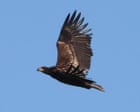
For three decades, Callum had watched the skies. He knew the precise, heavy flap of a golden eagle. He knew the frantic, erratic dance of the gannets. But he was looking for something that defied the modern imagination—an apex predator with a wingspan wider than a king-size bed, a beak like a rusted meat hook, and eyes that could spot a salmon through the churning grey surf from a mile up. The white-tailed sea eagle.
Then, the bird vanished.
It did not just fly away. It dissolved from the landscape. One day its massive silhouette was etched against the bruised clouds; the next, the sky was empty. In the local pubs, the silence from the crags became a heavy, living thing. Conservationists pointed fingers at landowners. Landowners muttered about the safety of their lambs. The disappearance of a single bird sparked a quiet war that exposed a raw, bleeding fracture in how humans relate to the wild. We want nature, but only on our terms. We love the idea of the wild until it grows teeth.
The Weight of a Shadow
To understand why a missing bird can break a community, you have to understand what a sea eagle actually is. This is not a gentle backyard songbird. Haliaeetus albicilla is an absolute titan.
Historically, these birds were the undisputed rulers of the British coastline. Then came the nineteenth and twentieth centuries. Humans did what humans do best when faced with something grand and uncontrollable: we eradicated them. The last native British sea eagle was shot in Shetland in 1918. For decades, the skies were safer, tamer, and infinitely emptier.
The trouble started when we tried to play god in reverse.
Beginning in the late twentieth century, conservationists launched a massive, multi-decade reintroduction program, flying chick after chick over from Norway to repopulate the rugged Scottish coastlines. It was hailed as a triumph of modern ecology. The eagles bred. They expanded. Tourists flooded into remote coastal towns, binoculars in hand, spending millions of pounds just to catch a glimpse of the "flying barn doors."
But the return of the king came with a receipt.
Consider the perspective of a hill farmer. Let us call him Alistair. Alistair’s family has run sheep on the windswept hills of western Scotland for four generations. His margins are razor-thin. The winters are brutal, the lambing season a exhausting, sleepless gauntlet of mud and cold. To Alistair, the sea eagle is not a majestic symbol of ecological rebirth. It is a flying wolf.
When a sea eagle swoops down on a newborn lamb, it does not use the quick, clean kill of a falcon. It uses brute force. For Alistair, the loss of twenty or thirty lambs a season is not a statistical rounding error in a government biodiversity report. It is the difference between paying the feed bill and watching his livelihood collapse.
When Callum’s favorite breeding adult eagle went missing, the fragile peace shattered.
The Confounding Anatomy of a Disappearance
The rumor mill in a small coastal town travels faster than the northern gale.
Within forty-eight hours of the eagle’s absence, two distinct, unyielding camps formed in the local community. The conservationists whispered about illegal poisoning. They spoke of banned pesticides hidden in raw meat baits left out on the heather—a dark, illegal practice that has plagued the highlands for generations. They demanded police investigations, satellite data analysis, and criminal charges.
The farming community closed ranks. They pointed out that nature is indifferent, cruel, and complex. Sea eagles are apex predators, yes, but they are also scavengers. They fight among themselves for territory. They collide with the spinning blades of newly erected wind turbines. They succumb to avian influenza, which has torn through seabird populations with the subtlety of a chainsaw.
The truth was entirely lost in the noise.
The authorities checked the bird’s satellite tag data. The map showed a chilling, sudden full stop. The signal had been transmitting strong, clear coordinates from a remote stretch of moorland, and then—nothing. Total radio silence.
In the world of wildlife crime tracking, this is known as a "no-go stop." It rarely means a battery failure. It usually means the tag, and the bird it was attached to, have been deliberately destroyed. Yet without a carcass, there was no proof. No body meant no crime. It only meant an agonizing, heavy mystery.
The Mirage of the Balance of Nature
We are brought up on a lie told by nature documentaries. We are taught that ecosystems exist in a perfect, harmonious balance, a delicate clockwork where every creature knows its place and the gears mesh smoothly.
Nature is not a clock. It is a battlefield.
When you reintroduce a massive predator into a landscape that has spent a century adapting to its absence, you do not restore balance. You trigger a chaotic, unpredictable cascade. The sea eagles did not just eat fish and lambs. They altered the behavior of every other living thing in the county.
Gulls changed their nesting habits. Otters became more cautious, keeping closer to the thick cover of the kelp forests. Even the golden eagles, long the undisputed masters of the inland mountains, found themselves pushed into bitter territorial disputes with their larger, coastal cousins.
The human reaction to this chaos is the most telling part of the story. We demand certainty. We want the data to tell a clean story with a clear hero and an obvious villain.
But looking out over the grey water, Callum realized the terrifying truth: everyone was right, and everyone was wrong. The farmer protecting his livestock was acting on a foundational human instinct to survive and provide. The conservationist fighting for the eagle was acting on a desperate need to repair the ecological vandalism of our ancestors.
Both sides were driven by love. Both sides were paralyzed by fear.
The Invisible Stakes
The loss of the eagle is a microcosm of a much larger, global struggle that will define the next century. As climate change shifts habitats and human development squeezes the wild into smaller and smaller pockets, these collisions will become our daily reality.
It is easy to vote for conservation from a comfortable apartment in a city. It costs nothing to sign an online petition to save the wolves, the bears, or the eagles when they do not hunt in your backyard, when they do not threaten your paycheck, when they do not haunt your mornings.
The real work of living with the wild is messy, expensive, and deeply uncomfortable. It requires compromise from people who have forgotten how to speak to one another. It requires the government to provide real, immediate compensation to farmers for lost livestock, recognizing that biodiversity is a public good that should be paid for by the public, not funded on the backs of rural workers. It requires hunters and landowners to accept that a landscape without predators is a sick, degraded landscape.
One evening, weeks after the disappearance, Callum sat in his kitchen, the wind howling against the windowpanes. He pulled up the historical records of the area from a century ago. He read the journals of old parish ministers who recorded the bounties paid for eagle heads.
We have been killing the sky for a long time.
The missing sea eagle was likely gone forever, its feathers dissolving into the peat or its bones resting at the bottom of a silent loch. The police investigation eventually went cold. The headlines moved on to other scandals, other political outrages, other fleeting digital noises.
But the empty space on the sea cliff remained.
The next morning, Callum walked back down to the shore. The sky was a pale, washed-out blue, the horizon stretching infinitely toward the arctic. He didn't bring his heavy tripod or his high-powered spotting scope this time. He just walked, his boots crunching on the wet shingle.
He looked up at the empty crag where the nest used to be. A solitary raven circled the rock, its sharp, metallic call cutting through the roar of the surf. It was a beautiful view, but it felt hollowed out, like a cathedral missing its altar.
The tragedy of the missing eagle wasn't just that a magnificent animal had died. The tragedy was that we still haven't figured out how to share the world with the things that terrify us. We are still the frightened creatures in the dark, throwing rocks at the shadows just beyond the firelight, wishing for a safety that ultimately robs the world of its magic.
.jpg)